- Uptime Institute’s May 12 Annual Data Center Outages Analysis 2026 clears the publish bar because it is not another generic warning that AI infrastructure is getting complicated.
- The report’s own framing is direct.
- The most important detail is also the simplest one.
- Section
- Infrastructure
- Read time
- 5 min read
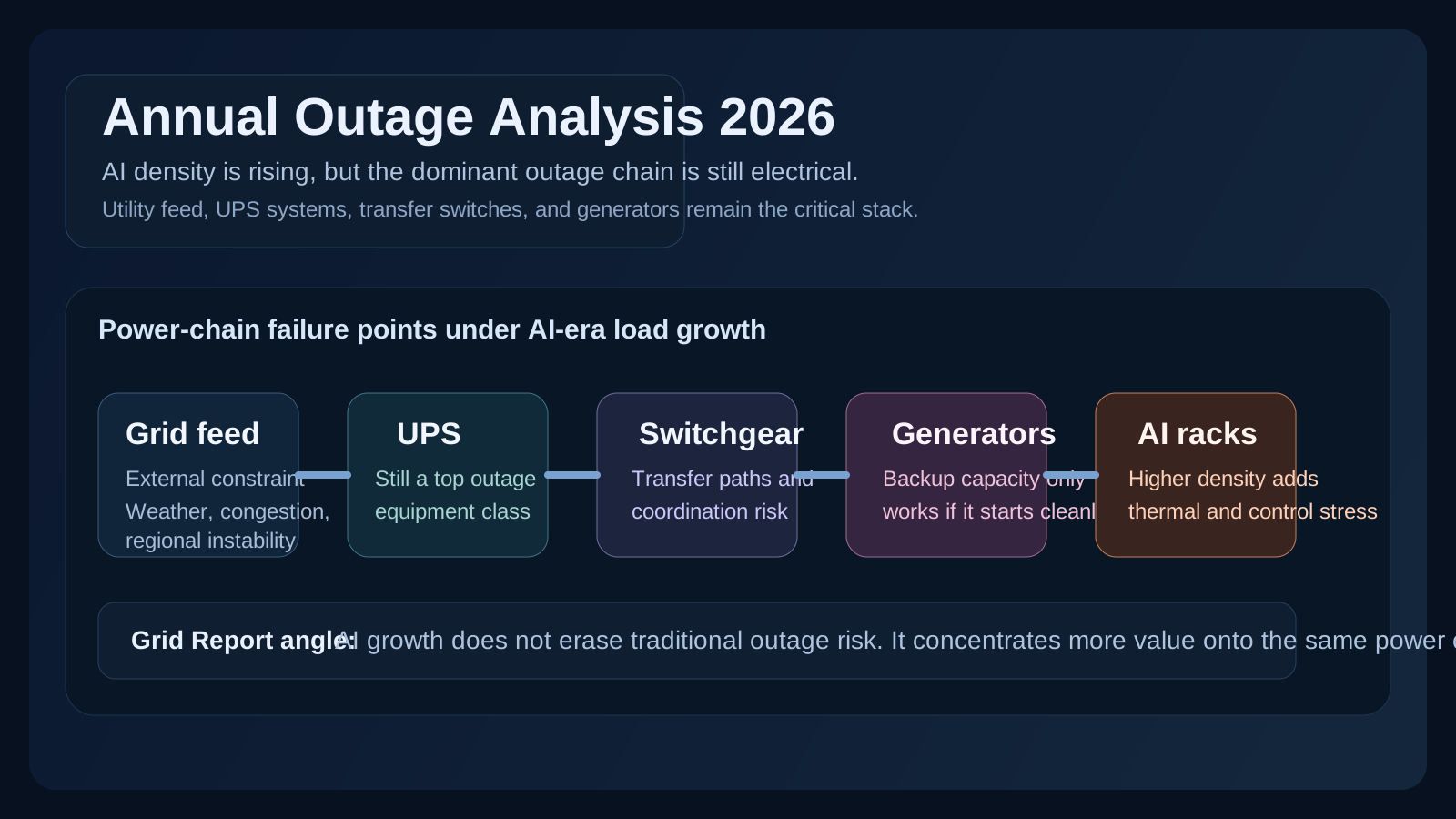
Uptime Institute’s May 12 Annual Data Center Outages Analysis 2026 clears the publish bar because it is not another generic warning that AI infrastructure is getting complicated. The stronger Grid Report angle is that AI demand is concentrating more value onto the same electrical chain that already produces the most severe failures. In other words, the AI buildout is not replacing the old outage problem. It is making the cost of that problem higher.
The report’s own framing is direct. Uptime says demand growth, AI-driven workloads, and power constraints are reshaping data center risk profiles. It also says operators face rising system complexity, grid instability, growing co-dependencies, and evolving external threats. That matters because the useful signal is not just that more compute is coming. The useful signal is that power quality and resilience are staying central even as facilities become more software-defined and more liquid-cooled.
AI demand is not replacing the old outage problem. It is piling more commercial value onto the same electrical chain that still fails first.
The most important detail is also the simplest one. Uptime says power remains the leading cause of impactful outages, with failures involving UPS systems, transfer switches, and generators still dominant. That keeps this story firmly in the infrastructure lane. The practical implication is that the expensive part of the AI data-center stack still sits on top of a failure chain operators already know well, but may now be stressing in new ways because rack density, cooling complexity, and external grid dependence are all rising together.
That is what makes the article search-worthy. Many AI-infrastructure stories focus on megawatts, campuses, or model demand. Uptime adds a more operational question: what breaks first after the campus is energized? The answer is not that AI has invented a completely new outage category. The answer is that a familiar electrical chain remains decisive, and higher-density AI workloads can make every weak link more consequential.
There is also a governance and capex angle. Uptime says operators are shifting investment toward automation and control systems to manage complexity, while resiliency assessments are still more focused on internal systems than on external and systemic risks. Read plainly, that means some of the next reliability spend will go not only into hardware redundancy, but also into visibility, operating discipline, and control layers that can detect or isolate trouble before it cascades.
This is also where the report connects back to the site’s recent power coverage without duplicating it. PJM’s Manual 13 update was about how stressed grids may call on some large loads to move to backup generation. Microsoft’s zero-water design was about siting and cooling. Uptime’s report sits underneath both of those stories. It says the AI race is landing on an electrical stack where backup systems, switching paths, and operational procedures still decide whether a disturbance becomes a routine event or a major outage.
There are limits, and they matter. Uptime does not argue that AI itself is the leading cause of outages, and the public executive-summary material does not turn the report into a precise forecast for one region or operator. The stronger conclusion is narrower and more useful: AI-driven density and power constraints are raising the stakes on traditional electrical reliability, not removing the need to get the basics right.
That is enough to publish. Searchers looking for the 2026 outage analysis do not need a broad “data centers are risky” rewrite. The more useful answer is what the report implies for the AI buildout: the biggest reliability bottleneck is still the power chain, and every new high-density campus puts more commercial value at risk when that chain fails.
Sources
Uptime Institute, “Annual Data Center Outages Analysis 2026,” published May 12, 2026: https://uptimeinstitute.com/resources/research-and-reports/annual-outages-analysis-2026
Uptime Intelligence resource page, “Annual outage analysis 2026,” for executive-summary findings on dominant outage causes and evolving risks: https://intelligence.uptimeinstitute.com/resource/annual-outage-analysis-2026
By Nawaz Lalani
The Grid Report is written by Nawaz Lalani and focuses on source-backed coverage of AI infrastructure, grid power demand, automation systems, and market signals.
Follow the signal, not just the headline.
Get the daily Grid brief for source-backed coverage on AI power demand, infrastructure timing, automation, and market signals.