- Google’s June 30, 2026 environmental disclosure clears the publish bar because it gives the AI power debate a hard operating number from a primary source.
- The company’s own framing is unusually direct.
- Google also reported real progress.
- Section
- Energy
- Read time
- 5 min read
- Data included
- The 2025 Google AI-power signal
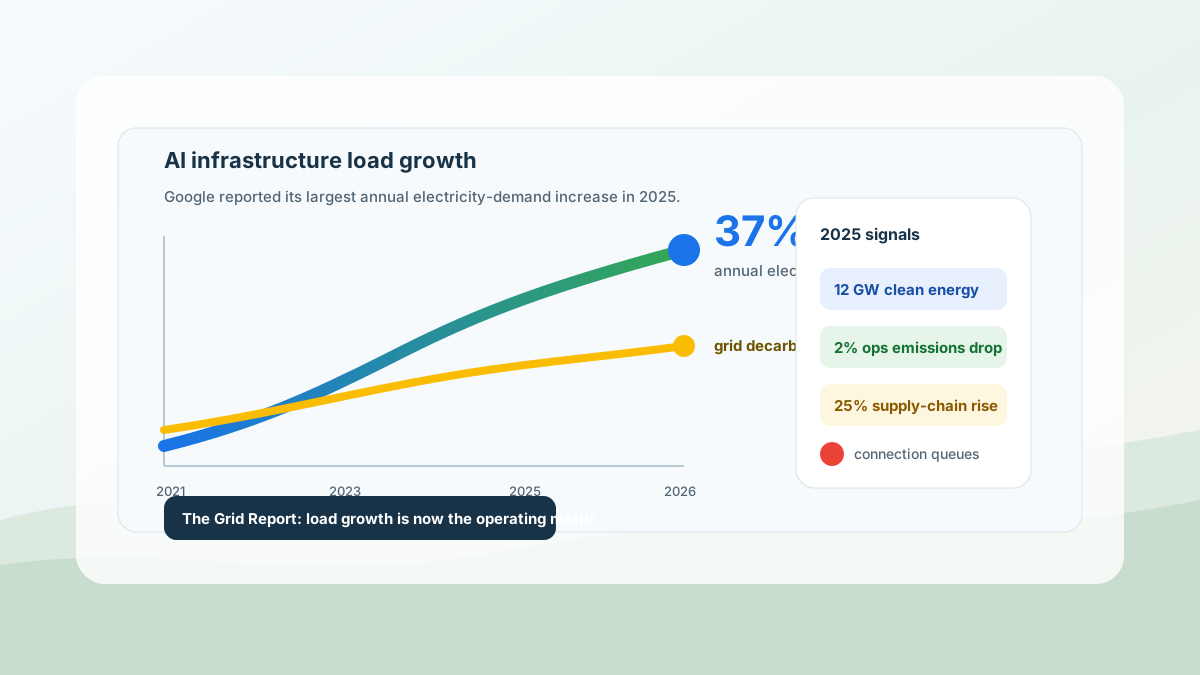
The 2025 Google AI-power signal
Google’s latest environmental disclosure turns the AI buildout into a measurable grid-timing problem.
| Metric | Google disclosure | Grid Report read-through |
|---|---|---|
| Electricity demand | Up 37% year over year in 2025, Google’s largest load growth in history | AI infrastructure demand is now moving at a speed utilities and grid operators must plan around. |
| Clean-energy procurement | More than 12 GW of net-new clean energy agreements signed in 2025 | Hyperscalers are buying aggressively, but signed capacity still has to connect and deliver locally. |
| Operational emissions | Down 2% year over year while matching 100% of electricity use with renewable purchases | Procurement and efficiency can reduce reported operational emissions even as load surges. |
| Grid bottleneck | Google says AI infrastructure is accelerating faster than the grid is decarbonizing | The key constraint is timing: generation, transmission, permitting, and interconnection must catch up. |
| Supply chain | Supply-chain emissions rose 25% year over year | The AI power story extends upstream into manufacturing regions and carbon-free-energy availability. |
Sources: Google 2026 Environmental Report and Google’s June 30, 2026 report announcement.
Google’s June 30, 2026 environmental disclosure clears the publish bar because it gives the AI power debate a hard operating number from a primary source. Google said it navigated its largest load growth in history in 2025: a 37% annual increase in electricity demand. That is the useful headline for Grid Report readers because it converts the AI buildout from a general sustainability debate into a measurable grid-capacity problem.
The company’s own framing is unusually direct. Google said its AI infrastructure buildout is currently accelerating faster than the grid is decarbonizing. That sentence matters more than any generic claim about AI being energy intensive. It describes the bottleneck exactly: hyperscale demand can move faster than interconnection queues, carbon-free generation, permitting, supply chains, and local grid upgrades.
The important disclosure is not just that Google used more power. It is that Google says the AI buildout is moving faster than the grid can decarbonize.
Google also reported real progress. In 2025, it signed agreements for more than 12 GW of net-new clean energy, the largest annual clean-energy total in its history. It said operational emissions fell 2% year over year and that it matched 100% of electricity consumption with renewable-energy purchases for the ninth consecutive year. Those numbers are not window dressing. They show how aggressively one of the world’s largest technology buyers is trying to procure around the constraint.
But the Grid-native read-through is that procurement is not the same thing as timely physical capacity. Google can sign power purchase agreements, invest in advanced energy sources, and improve data center efficiency, yet still face a grid that is not clean enough, flexible enough, or fast enough. The company specifically pointed to long waits to connect to the grid, fragmented markets, supply-chain delays, and regulatory bottlenecks slowing new carbon-free energy from coming online.
That is why this story belongs in energy-grid rather than a broad climate section. The question for AI infrastructure is no longer whether hyperscalers care about clean power. The evidence says they do. The harder question is whether the grid can absorb step-change demand while delivering new clean capacity in the same regions and timeframes where compute campuses need it.
There is also a supply-chain warning inside the report. Google said supply-chain emissions grew 25% year over year, reflecting the scale of new AI infrastructure and an Asia-Pacific supply chain operating on grids that remain undersupplied with carbon-free energy. In other words, the power bottleneck is not only at the data center meter. It also sits upstream in the manufacturing base that feeds servers, chips, equipment, and construction.
The company’s water data adds another siting signal. Google said its water stewardship projects replenished roughly 7.7 billion gallons in 2025, equal to about 78% of total freshwater consumption. That helps the local-community story, but it also underlines the broader point: every AI campus now has to defend its electricity, water, supply-chain, and ratepayer footprint together.
The most important market implication is that clean-energy buyers are being forced into a speed-to-power business. Google’s 12 GW procurement number is enormous, but the company’s own language shows why more contracted capacity is only one part of the answer. The winning infrastructure stack will combine site selection, local grid agreements, dispatchable and carbon-free resources, load flexibility, and faster interconnection execution.
That is enough to publish. Searchers looking at Google’s report do not need another recap saying AI uses more energy. The more useful answer is that Google just made the central AI infrastructure tradeoff explicit: electricity demand is compounding now, clean-energy procurement is scaling quickly, and the grid-decarbonization clock is still slower than the AI buildout clock.
Sources
Google, “Read our 11th annual Environmental Report,” published June 30, 2026: https://blog.google/company-news/outreach-and-initiatives/sustainability/2026-environmental-report/
Google Sustainability, “2026 Environmental Report,” June 2026: https://sustainability.google/reports/google-2026-environmental-report/
By Nawaz Lalani
The Grid Report is written by Nawaz Lalani and focuses on source-backed coverage of AI infrastructure, grid power demand, automation systems, and market signals.
Follow the signal, not just the headline.
Get the daily Grid brief for source-backed coverage on AI power demand, infrastructure timing, automation, and market signals.