- This July 24 story clears the publish bar because the useful signal is not another reminder that AI data centers need huge amounts of electricity.
- That is the original angle.
- The PJM read-through is what makes this publishable now.
- Section
- Energy
- Read time
- 4 min read
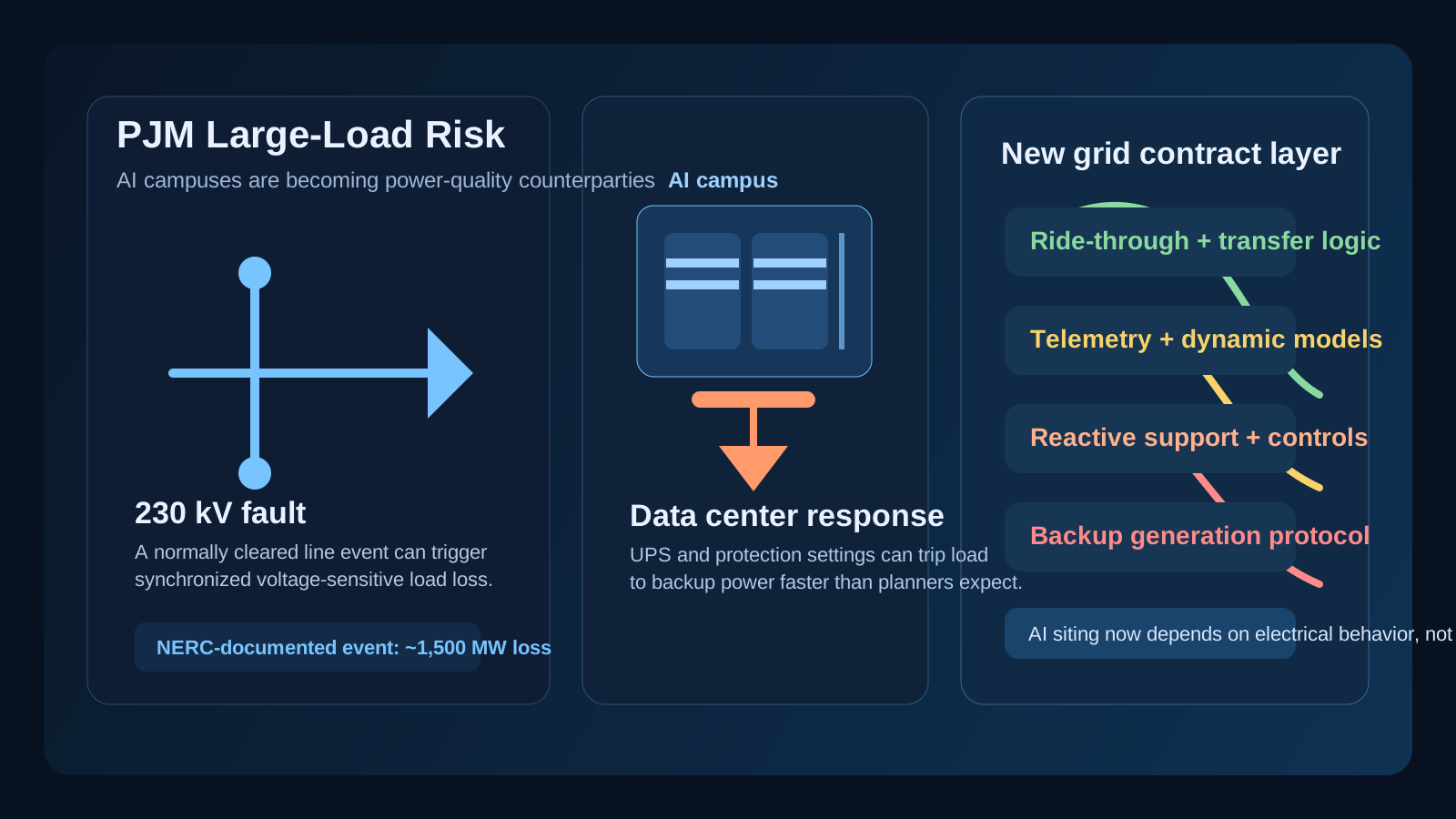
This July 24 story clears the publish bar because the useful signal is not another reminder that AI data centers need huge amounts of electricity. The stronger story is behavioral. Grid operators are increasingly being forced to care about what hyperscale computational loads do during faults, voltage depressions, and transfer events, because the problem is no longer only megawatts coming onto the system. It is also megawatts disappearing too fast.
That is the original angle. NERC’s incident review on simultaneous voltage-sensitive load reductions says a 230 kV transmission-line fault led to customer-initiated simultaneous loss of roughly 1,500 megawatts of voltage-sensitive load that bulk-system operators did not anticipate. NERC’s description matters because it reframes the reliability issue. The system has long been planned around large generation losses. It has not historically been planned around hyperscale loads dropping away in a tightly synchronized way when power quality moves outside narrow tolerances.
The next AI power fight is not only how many megawatts a campus wants, but how that load behaves when the grid takes a hit.
The PJM read-through is what makes this publishable now. In May, the Maryland Office of People’s Counsel filed a FERC complaint against PJM that cited the same July 10, 2024 event and argued that planners still do not have a public study framework for unexpected loss of the largest load under different conditions. The complaint also pointed directly to dynamic load models, control settings, and protection settings as missing pieces. Read correctly, this is not a niche engineering debate. It is a warning that AI load growth is forcing grid planners to ask data centers for generator-style operating information even if those facilities still think of themselves as ordinary customers.
That is why the story belongs in energy-grid rather than generic infrastructure coverage. The next battleground in AI power is not only interconnection speed or who pays for network upgrades. It is power-quality behavior. If a large campus trips to backup generation or sheds a massive block of IT load during a normally cleared fault, the grid sees a stability event, not just a customer preference. The practical consequence is that utilities and system operators will increasingly want ride-through expectations, validated models, telemetry, and clearer operating protocols written into large-load agreements.
The supporting standards work points in the same direction. NERC’s reliability guideline on emerging large loads says those facilities can pose reliability risks because of their demand and operational characteristics, while the March 18, 2026 standards project is refining how computational load should be treated. ESIG’s February 2026 performance-requirements report goes further by recommending study-based requirements around dynamic reactive compensation, adjustable control modes, and voltage-control behavior when the studies show the need. Put together, the direction of travel is obvious: data centers are being pulled toward a more explicit grid-behavior rulebook.
The duplicate screen holds. The site’s July stories on PJM heat-wave curtailment, PJM backup-generation operations, New Jersey tariff segregation, and the White House ratepayer pledge all focused on cost allocation, emergency flexibility, or political siting terms. This thesis is materially different. Here the issue is not who pays or whether the campus can curtail on command. The issue is whether large AI loads behave in a way the grid can actually model, withstand, and trust during electrical disturbances.
Operator relevance is straightforward. Developers should expect tougher diligence on UPS design, transfer schemes, backup-generation settings, dynamic-model disclosure, and fault ride-through performance. Utilities and balancing authorities should expect large-load interconnection packages to look more like operational-performance packages, not just service-request paperwork. Investors should read this as another reason that “available megawatts” is an incomplete underwriting shortcut. A site with weaker power-quality behavior, poor telemetry, or brittle protection settings may be far less valuable than its headline capacity suggests.
There are limits. The public record is still incomplete, some of the most detailed disturbance analysis remains nonpublic, and the industry has not converged on one universal large-load standard yet. But those caveats strengthen the thesis rather than weaken it. The grid is moving from a world where hyperscale data centers were treated mainly as giant buyers of power to one where they are also being judged as dynamic power-system participants. That is why this story is worth publishing now. AI siting is quietly becoming a power-quality contract.
Sources
NERC, “Incident Review: Considering Simultaneous Voltage-Sensitive Load Reductions,” accessed July 24, 2026: https://www.nerc.com/globalassets/our-work/reports/event-reports/incident_review_large_load_loss.pdf
Maryland Office of People’s Counsel complaint against PJM in FERC Docket EL26-63-000, filed May 7, 2026, discussing sudden large-load drops and related planning gaps: https://www.pjm.com/-/media/DotCom/documents/ferc/filings/2026/20260507-el26-63-000.pdf
NERC, “Risk Mitigation for Emerging Large Loads,” accessed July 24, 2026: https://www.nerc.com/globalassets/our-work/guidelines/reliability/RG_Risk-Mitigation-For-Emerging-Large-Loads.pdf
Energy Systems Integration Group, “Large Load Performance Requirements: Current Practices and Recommendations,” February 2026: https://www.esig.energy/wp-content/uploads/2026/03/ESIG-Large-Loads-Performance-Requirements-report-2026c.pdf
By Nawaz Lalani
The Grid Report is written by Nawaz Lalani and focuses on source-backed coverage of AI infrastructure, grid power demand, automation systems, and market signals.
Follow the signal, not just the headline.
Get the daily Grid brief for source-backed coverage on AI power demand, infrastructure timing, automation, and market signals.