- FERC’s July 16 computational-load order clears the publish bar because it moves the AI-power story into a new phase.
- The stronger signal is not merely that regulators are “watching” data centers more closely.
- That matters because the operational issues have never been only about volume.
- Section
- Policy
- Read time
- 5 min read
- Data included
- What the July 16 order now puts on the clock
What the July 16 order now puts on the clock
FERC did not instantly register every AI campus. It forced three workstreams to move together: standards, registry criteria, and the technical evidence needed to support both.
| Track | What the record now says | Why operators and investors care |
|---|---|---|
| Reliability Standards | FERC directed NERC to file new or modified standards for computational-load integration by December 31, 2026. | Large campuses may face clearer measurable obligations around modeling, coordination, commissioning, and operations sooner than many developers expected. |
| Registry criteria | FERC also directed revisions to NERC Rules of Procedure, including criteria for computational-load entities, on the same deadline. | The market needs to know which projects could become formal reliability actors instead of remaining only tariff customers. |
| Bridge standard first | NERC says the 2026 drafting effort prioritizes a bridge standard, with broader integrated changes beginning in 2027. | The first compliance-like expectations may arrive before a full multiyear standards rewrite is complete. |
| Technical readiness | NERC’s FAQ highlights data gaps around forecasting, dynamic behavior, protection settings, and coordination. | Developers that cannot explain how the load behaves electrically may discover that “power secured” is not the same as “reliability ready.” |
Source context: FERC July 16, 2026 summary for Docket No. RD26-7-000 and NERC Large Loads Frequently Asked Questions, May 2026.
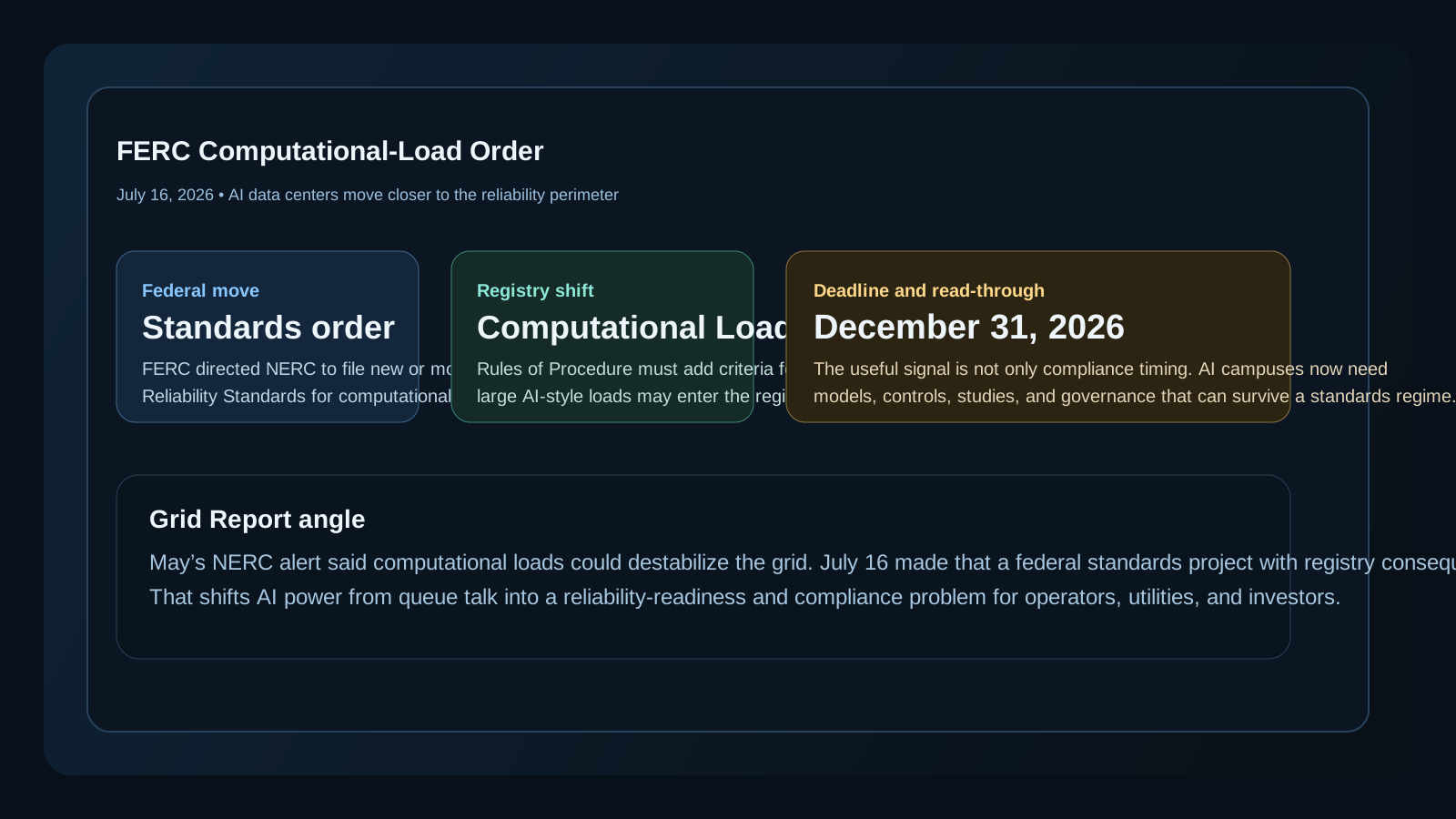
FERC’s July 16 computational-load order clears the publish bar because it moves the AI-power story into a new phase. The Commission directed NERC, under section 215(d)(5) of the Federal Power Act, to develop and submit new or modified Reliability Standards addressing the risks computational loads create for the Bulk-Power System. It also directed NERC to revise its Rules of Procedure, including registry criteria for computational load entities, by December 31, 2026.
The stronger signal is not merely that regulators are “watching” data centers more closely. That part was already visible in NERC’s May Level 3 alert and FERC’s June 18 large-load show-cause orders. July 16 is different because the federal reliability regime is now telling NERC to turn the problem into standards and registration criteria. In plain language, some large AI-style loads are being pushed closer to the core compliance perimeter rather than treated only as unusually big customers.
The new AI power question is not only who gets megawatts. It is which campuses get pulled inside the reliability regime and what standards they must satisfy.
That matters because the operational issues have never been only about volume. FERC’s own June discussion of large loads emphasized that these facilities can arrive at unprecedented scale, concentrate demand in specific areas, and change consumption rapidly. NERC’s technical work goes one layer deeper: computational loads can create modeling, protection, commissioning, and control problems if their behavior during disturbances is not understood well enough before interconnection.
The useful operator angle is that speed to power is becoming a reliability-readiness question, not only a queue or tariff question. A developer may still need land, transformers, and an interconnection path, but that is no longer sufficient. The site increasingly also needs dynamic load models, stronger technical coordination with the utility and balancing authority, defensible protection settings, commissioning evidence, and a governance posture that can survive a more formal standards regime.
NERC’s own May FAQ makes the sequence clearer. The organization says it is running three tracks at once: technical guidance, registration criteria for computational loads, and Reliability Standards. It also says the 2026 drafting effort will prioritize a “bridge” standard with essential actions first, while broader integrated changes come later. That is important because the compliance story is not theoretical. The market now has a clock, a standards project, and a registry process moving in parallel.
The registry piece is what makes this especially search-worthy. FERC ordered NERC to revise its Rules of Procedure, including registry criteria for computational load entities, by December 31, 2026. NERC says those criteria will determine which entities, based on specific physical and electrical factors, must register and comply with Reliability Standards. Once that line is drawn, the market will care much more about which campuses fall inside it, what obligations attach, and how that affects development timelines, operating costs, lender diligence, and utility negotiations.
This also clears the duplicate screen. The site already covered NERC’s May alert as a reliability warning and FERC’s June 18 show-cause orders as a tariff-rewrite fight. This story is materially different. The new thesis is that Washington has moved from identifying the computational-load problem to compelling the standards-and-registry machinery that could govern it.
There are limits. The July 16 summary is not the final end-state of the standards themselves, and the eventual registration criteria still have to be drafted, reviewed, and approved. Not every data center will become a registered entity, and the final thresholds will matter. But those caveats do not weaken the signal. They define the next battleground: which AI campuses become formal reliability actors and what proof of readiness they will have to show.
For investors and infrastructure developers, the practical read-through is that diligence has to widen. It is no longer enough to ask whether a project has tariff service, generation supply, or local political support. A serious underwriting file increasingly needs to ask whether the load behavior is model-ready, whether the operator can satisfy future registration criteria, and whether the project schedule has room for a standards process that is getting more formal rather than less.
The better conclusion is that AI power is no longer only about megawatts and who pays for upgrades. It is also becoming a standards problem. For operators and investors, that means the next scarce asset may be a campus that is not just power-ready, but compliance-ready.
Sources
Federal Energy Regulatory Commission, “Summaries | July 2026 Commission Meeting,” published July 16, 2026: https://www.ferc.gov/news-events/news/summaries-july-2026-commission-meeting
Federal Energy Regulatory Commission, “07/16/2026 Notice of Action Taken,” published July 16, 2026: https://www.ferc.gov/news-events/news/decisions-notices/07162026-07162026
North American Electric Reliability Corporation, “Project 2026-02 Computational Loads,” accessed July 19, 2026: https://www.nerc.com/standards/reliability-standards-under-development/2026-02-computational-loads
North American Electric Reliability Corporation, “Large Loads Frequently Asked Questions,” published May 2026: https://www.nerc.com/globalassets/initiatives/large-loads-action-plan/large-loads-faqs.pdf
By Nawaz Lalani
The Grid Report is written by Nawaz Lalani and focuses on source-backed coverage of AI infrastructure, grid power demand, automation systems, and market signals.
Follow the signal, not just the headline.
Get the daily Grid brief for source-backed coverage on AI power demand, infrastructure timing, automation, and market signals.