- FERC’s June 18 action clears the publish bar because it is not another vague statement about future grid reform.
- The stronger angle is that speed to power is now openly a tariff problem, not only a generation problem.
- The commission also made the operating agenda unusually explicit.
- Section
- Policy
- Read time
- 4 min read
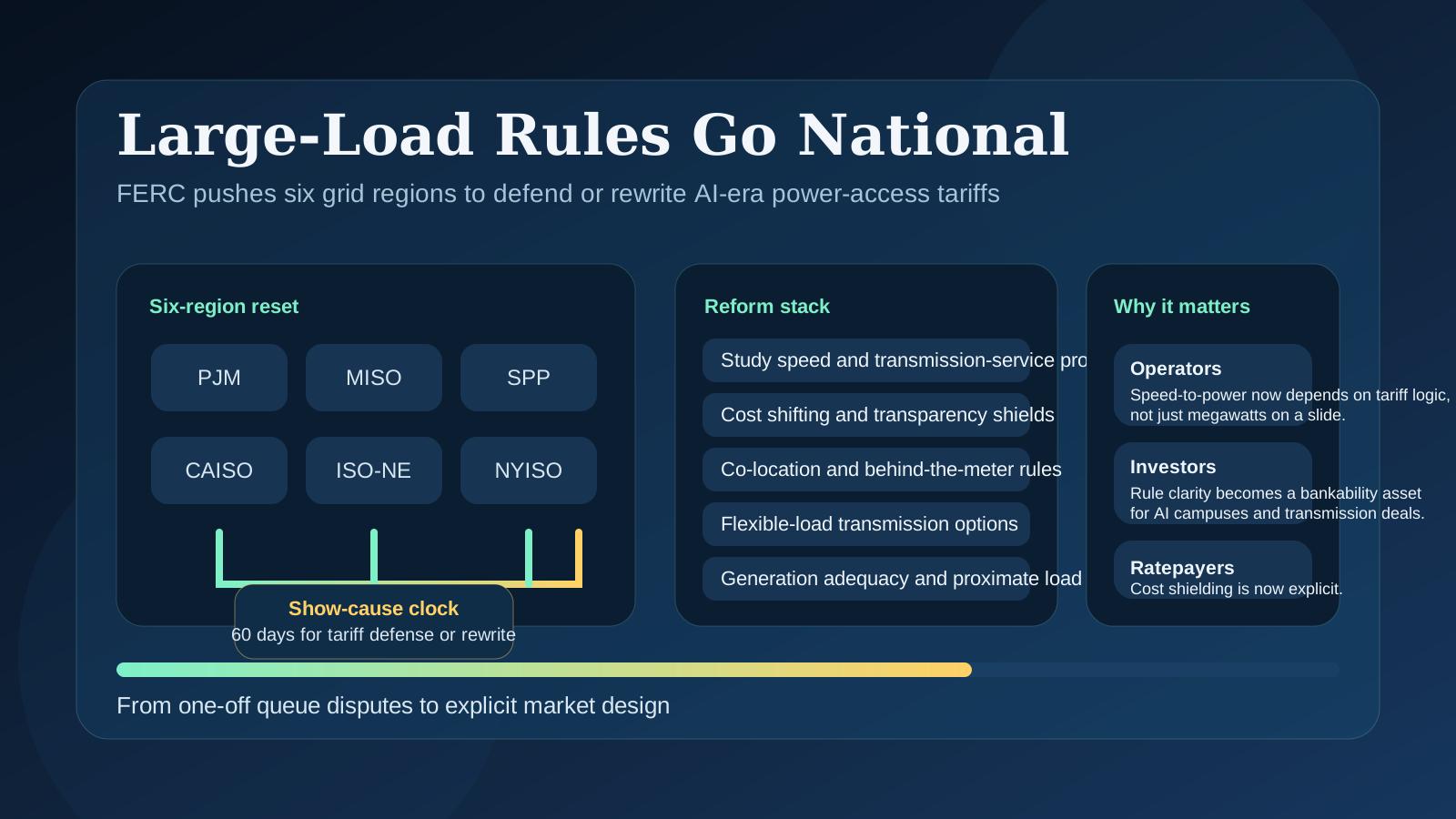
FERC’s June 18 action clears the publish bar because it is not another vague statement about future grid reform. The commission issued tailored show-cause orders to all six regional grid operators under its jurisdiction, telling them to either justify their existing tariff treatment for large loads or file reforms. That matters because it takes the large-load fight out of one docket, one state, or one regional dispute and turns it into a national market-design question.
The stronger angle is that speed to power is now openly a tariff problem, not only a generation problem. FERC said the orders cover the rules that govern how data centers, manufacturing facilities, and other large energy users connect to the grid. That shift matters for operators because the next delay may not come first from a lack of announced megawatts. It may come from whether the tariff structure can process, price, and govern unusual loads fast enough without socializing too much risk.
AI power access is no longer just a queue problem. FERC is turning it into a national tariff rewrite with explicit ratepayer and reliability rules.
The commission also made the operating agenda unusually explicit. FERC identified five reform categories for the grid operators to address: study-process efficiency, cost-shifting protections and transparency, co-location and behind-the-meter arrangements, new transmission services for flexible large loads, and processes for studying generating facilities that serve electrically proximate large loads. Read plainly, that is a roadmap for how AI-era power access is being rewritten in real time.
The national scope is what makes this story stronger than another PJM update. FERC gave each grid operator and its transmission owners 60 days to defend or revise current tariffs, and also required a detailed report within 30 days on how adequate generation will be available for existing and new large loads. That turns the AI power discussion into a timetable, not just an argument. It also tells investors that tariff quality is becoming part of infrastructure bankability.
Ratepayer politics are embedded in the order. FERC framed the action around both speed and consumer safeguards, which is exactly where the pressure has been building. If large-load rules are too loose, ordinary customers can absorb more grid cost and planning risk than they expected. If the rules are too blunt, real projects can stall even when a region wants the economic development. The more useful interpretation is that FERC is trying to force cleaner bargains into the open before the next wave of AI campuses shows up in rate cases and queue disputes.
This also has a second-order consequence for developers. The winning projects may not be the ones with the biggest demand slide or the loudest headline. They may be the ones that can fit into a regional tariff structure with clearer cost responsibility, flexible-load behavior, and credible supply plans. In that environment, legal and market-design readiness starts to matter almost as much as land, fiber, and substation access.
There are limits. These are show-cause orders, not final uniform rules, and FERC itself said the six regions face different operating conditions. That means the near-term result is likely to be a patchwork of revisions rather than a single national template. But that caveat does not weaken the signal. It sharpens it: large-load policy is moving out of the abstract and into live tariff surgery.
The better conclusion is that AI power access is becoming a regulated product. The next competitive edge is not only more capacity. It is a clearer rulebook for who gets served, on what terms, and with whose money at risk.
Sources
Federal Energy Regulatory Commission, “FERC Launches Aggressive Targeted Action to Speed Large Load Integration,” published June 18, 2026: https://www.ferc.gov/news-events/news/ferc-launches-aggressive-targeted-action-speed-large-load-integration
Federal Energy Regulatory Commission, “Commissioner Rosner’s Remarks on the Large Load Show Cause Orders, E-7 to E-12,” published June 18, 2026: https://www.ferc.gov/news-events/news/commissioner-rosners-remarks-large-load-show-cause-orders-e-7-e-12-june-18-2026
By Nawaz Lalani
The Grid Report is written by Nawaz Lalani and focuses on source-backed coverage of AI infrastructure, grid power demand, automation systems, and market signals.
Follow the signal, not just the headline.
Get the daily Grid brief for source-backed coverage on AI power demand, infrastructure timing, automation, and market signals.