- NNSA’s July 20 Savannah River selection clears the publish bar because it is the first recent federal-site move that advances the story from acreage marketing into named-project execution.
- The announced shape of the project is what makes it useful.
- That is the original angle.
- Section
- Policy
- Read time
- 4 min read
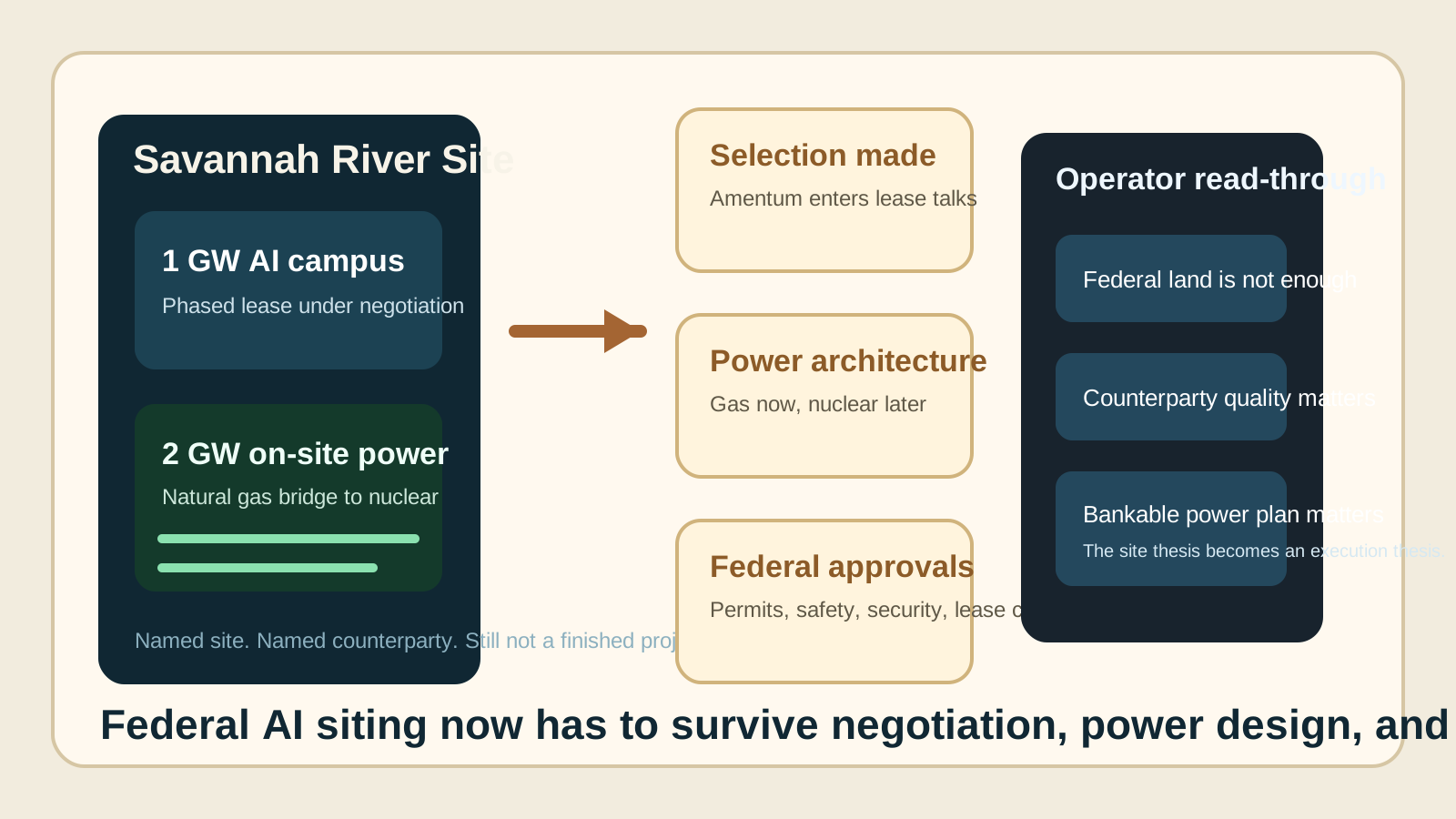
NNSA’s July 20 Savannah River selection clears the publish bar because it is the first recent federal-site move that advances the story from acreage marketing into named-project execution. The Department of Energy’s spring pitch was that federal land could become a faster path for AI infrastructure. The Savannah River decision is the first cleaner test of whether that thesis can survive contact with counterparties, power design, approvals, and eventual lease close.
The announced shape of the project is what makes it useful. NNSA says Amentum was selected to enter negotiations for a phased lease covering a 1-gigawatt AI data center plus roughly 2 gigawatts of dedicated on-site generation, beginning with natural gas and bridging toward nuclear energy. That is not just another “federal land available” story. It is a proposed full-stack campus architecture with an identified developer, a named site, and an explicit ratepayer-protection claim attached to it.
Federal AI siting has moved past acreage theory. Now it has to prove counterparty quality, power credibility, and approval discipline.
That is the original angle. Once a federal site has a named counterparty, the key policy question changes. It is no longer whether Washington can assemble enough land to court AI developers. It is whether the government can help produce a project structure that investors, operators, regulators, and local stakeholders regard as executable. Savannah River is now a counterparty-and-power-credibility test.
The July 20 notice makes that clearer than the earlier DOE-wide campaign did. NNSA says the project would meet the campus electricity needs with dedicated on-site generation so costs are not shifted onto existing utility customers. That language matters because it ties the project directly to the political vulnerability already visible across AI infrastructure: if big campuses appear to socialize their grid costs, they run into a tougher public and regulatory ceiling. Savannah River is trying to pre-answer that problem with its design.
But that does not mean the hard work is finished. NNSA explicitly says the selection does not constitute a final lease award and that any agreement remains subject to negotiations, permitting, safety and security evaluations, and other federal approvals. That is exactly why the story belongs in policy instead of generic infrastructure boosterism. Federal AI siting is now an approvals workflow. The land is only the first input.
This also clears the duplicate screen against the site’s last 30 days of federal-land and power coverage. The June 23 DOE-on-DOE-lands article was about federal sites as a speed-to-power concept. This thesis is materially different. Savannah River shows the concept hardening into a procurement and execution problem: find a credible developer, lock a bankable power path, preserve ratepayer insulation, and survive the federal approval stack.
Operators and investors should pay attention to that distinction. If this project advances, it strengthens the case that federal campuses can become a serious AI siting lane for projects needing very large power envelopes and long-dated generation plans. If it stalls, the lesson is not merely that one site failed. It is that federal control of land does not by itself solve the hardest bottlenecks in AI buildout.
That is enough to publish. Searchers looking for Savannah River or Amentum do not need a recycled government press-release summary. The more useful answer is that the federal AI-land story has entered a new phase: from site identification to execution credibility.
Sources
U.S. Department of Energy National Nuclear Security Administration, “NNSA Selects Amentum for AI Data Center and Energy Project at Savannah River Site,” published July 20, 2026: https://www.energy.gov/nnsa/articles/nnsa-selects-amentum-ai-data-center-and-energy-project-savannah-river-site
U.S. Department of Energy, “DOE Announces Site Selection for AI Data Center and Energy Infrastructure Development on Federal Lands,” published April 3, 2025: https://www.energy.gov/articles/doe-announces-site-selection-ai-data-center-and-energy-infrastructure-development-federal
Amentum, “Amentum Selected for the Department of Energy AI Data Center and Energy Generation Project,” published July 20, 2026: https://www.amentum.com/news/amentum-selected-for-the-department-of-energy-ai-data-center-and-energy-generation-project/
By Nawaz Lalani
The Grid Report is written by Nawaz Lalani and focuses on source-backed coverage of AI infrastructure, grid power demand, automation systems, and market signals.
Follow the signal, not just the headline.
Get the daily Grid brief for source-backed coverage on AI power demand, infrastructure timing, automation, and market signals.