- Australia’s July 15 framework clears the publish bar because it does something more concrete than most national AI plans.
- The stronger Grid Report angle is that Canberra is treating AI infrastructure as a behavior problem, not only a siting or subsidy problem.
- The July 15 release is more important when read against the government’s March 23 Data Centre Expectations.
- Section
- Policy
- Read time
- 4 min read
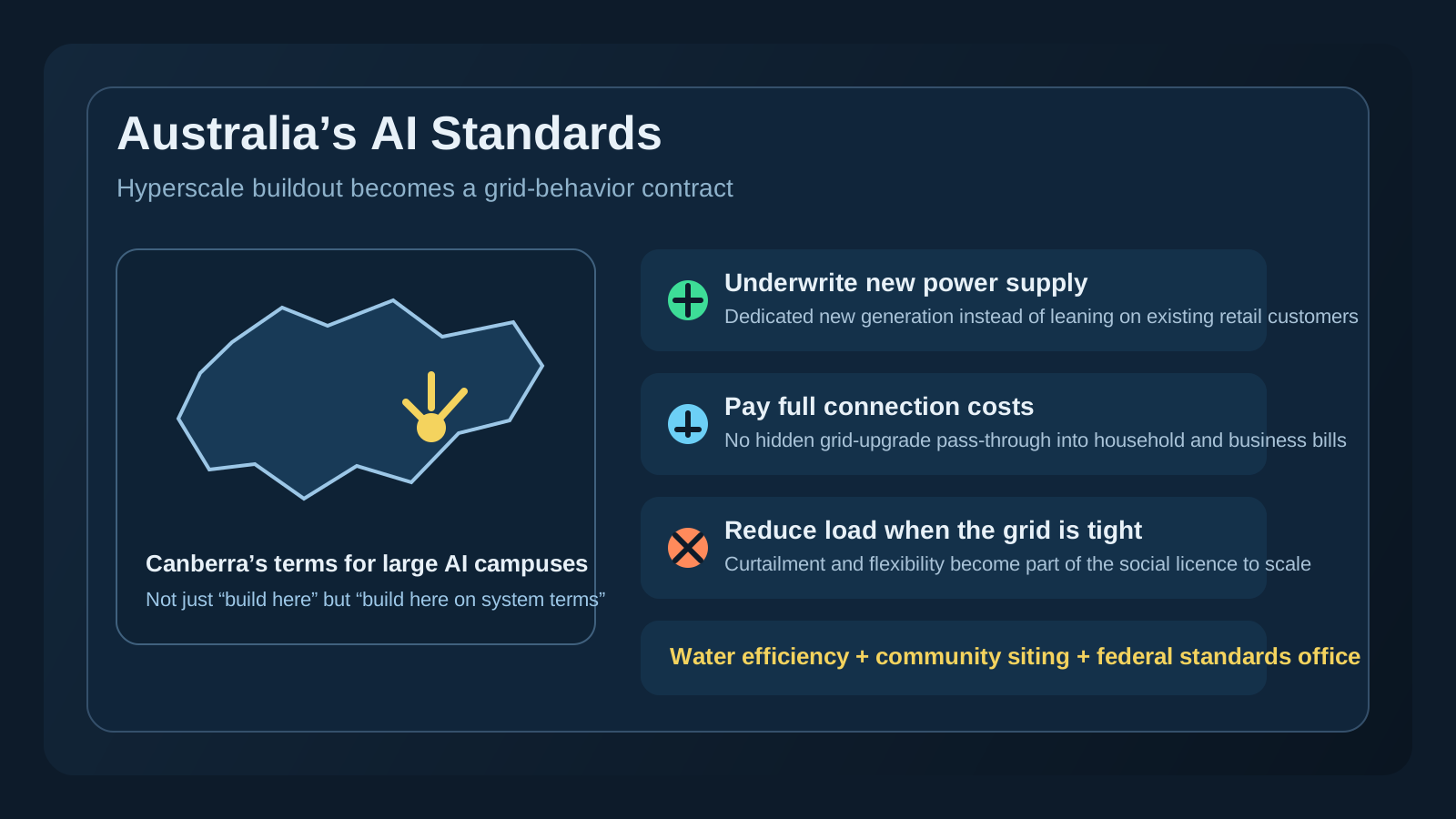
Australia’s July 15 framework clears the publish bar because it does something more concrete than most national AI plans. The government says its proposed Australian Standards for AI will require large data centres to underwrite their own new power supply, pay their full share of grid connection costs so consumer bills are not affected, reduce power when needed to strengthen the grid, and operate as water-efficiently as possible. That is not generic “responsible AI” language. It is an attempt to write physical-system obligations directly into the expansion model for hyperscale compute.
The stronger Grid Report angle is that Canberra is treating AI infrastructure as a behavior problem, not only a siting or subsidy problem. Many governments still talk about datacenters as if the only question is whether to attract them. Australia is moving toward a different question: what must a hyperscale operator do, in advance, to avoid becoming a political liability for the grid, for water systems, and for household power bills? That shift matters because it turns social licence into an operating requirement rather than a communications exercise.
Australia is trying to turn hyperscale AI from a generic investment target into a grid-behavior contract with enforceable obligations.
The July 15 release is more important when read against the government’s March 23 Data Centre Expectations. In March, officials said they expected AI infrastructure operators to underwrite new renewable supply, cover their own connectivity costs, support demand flexibility, use water responsibly, and contribute to local skills and capability. On July 15, the government said it will build those expectations into formal standards, stand up an Office of AI effective that day, take the approach to National Cabinet in August 2026, and aim for legislation in early 2027. In plain terms, the travel direction is from voluntary positioning to a national compliance framework.
That timing matters because the capital pipeline is already real. Australia is not floating this framework in a vacuum. The government has already used its National AI Plan to frame deals with Anthropic and Microsoft, and in December 2025 it welcomed the OpenAI-NEXTDC partnership tied to a planned A$7 billion AI campus in Sydney. The useful operator read-through is that Canberra wants to keep attracting hyperscale investment, but only on terms that force developers to internalize more of the grid, water, and community burden upfront.
This is why the story belongs in policy, not in generic AI regulation coverage. The operative issue is not model safety rhetoric. The operative issue is whether a national government can convert AI-era infrastructure politics into a standardized build contract: bring incremental supply, do not shift network costs to everyone else, accept flexible-load obligations, and earn approvals through a clearer national process. If that model holds, it gives other jurisdictions a template that sits between an outright moratorium and a laissez-faire subsidy race.
It also clears the duplicate screen. The site already covered New York’s data-center moratorium, Oklahoma’s ratepayer-protection law, Virginia’s data-center power tax, and FERC’s large-load actions. This thesis is materially different. Australia is not merely taxing hyperscale load or pausing projects while it studies the fallout. It is trying to define a federal operating standard for how AI campuses behave on the power system before the next wave of buildout lands.
There are still real limits. The standards are not yet enacted, the exact enforcement mechanics are still to come, and “world-leading” frameworks often get softer once states, utilities, and investors negotiate the details. Large operators may also decide some obligations are acceptable if they gain clearer approvals and less local backlash in return. But those caveats sharpen the real question rather than weaken it: how much grid discipline can governments demand from hyperscale AI before capital routes elsewhere, and how much political backlash do they invite if they demand less?
That is enough to publish. Searchers looking up Australia’s AI framework do not need another broad policy recap. The more useful answer is that Australia is trying to make hyperscale AI legible to the power system: not just faster approvals, but a formal requirement that the biggest compute campuses behave like accountable grid participants.
Sources
The Hon Dr Andrew Charlton MP, “AI in Australia’s interests,” published July 15, 2026: https://www.minister.industry.gov.au/charlton/media/ai-australias-interests
Senator Tim Ayres, “An Australian approach to AI: Expectations for data centres that deliver for Australians,” published March 23, 2026: https://www.minister.industry.gov.au/t-ayres/media/australian-approach-ai-expectations-data-centres-deliver-australians
The Hon Dr Andrew Charlton MP, “$7 billion infrastructure deal to boost AI in Australia,” published December 5, 2025: https://www.minister.industry.gov.au/charlton/media/7-billion-infrastructure-deal-boost-ai-australia
By Nawaz Lalani
The Grid Report is written by Nawaz Lalani and focuses on source-backed coverage of AI infrastructure, grid power demand, automation systems, and market signals.
Follow the signal, not just the headline.
Get the daily Grid brief for source-backed coverage on AI power demand, infrastructure timing, automation, and market signals.