- CAISO’s July 20 filing to FERC clears the publish bar because it says something more useful than the usual “AI is straining the grid” headline.
- That is the original angle.
- The load numbers matter, but they are not the whole story.
- Section
- Policy
- Read time
- 5 min read
- Data included
- What California is actually saying about AI load
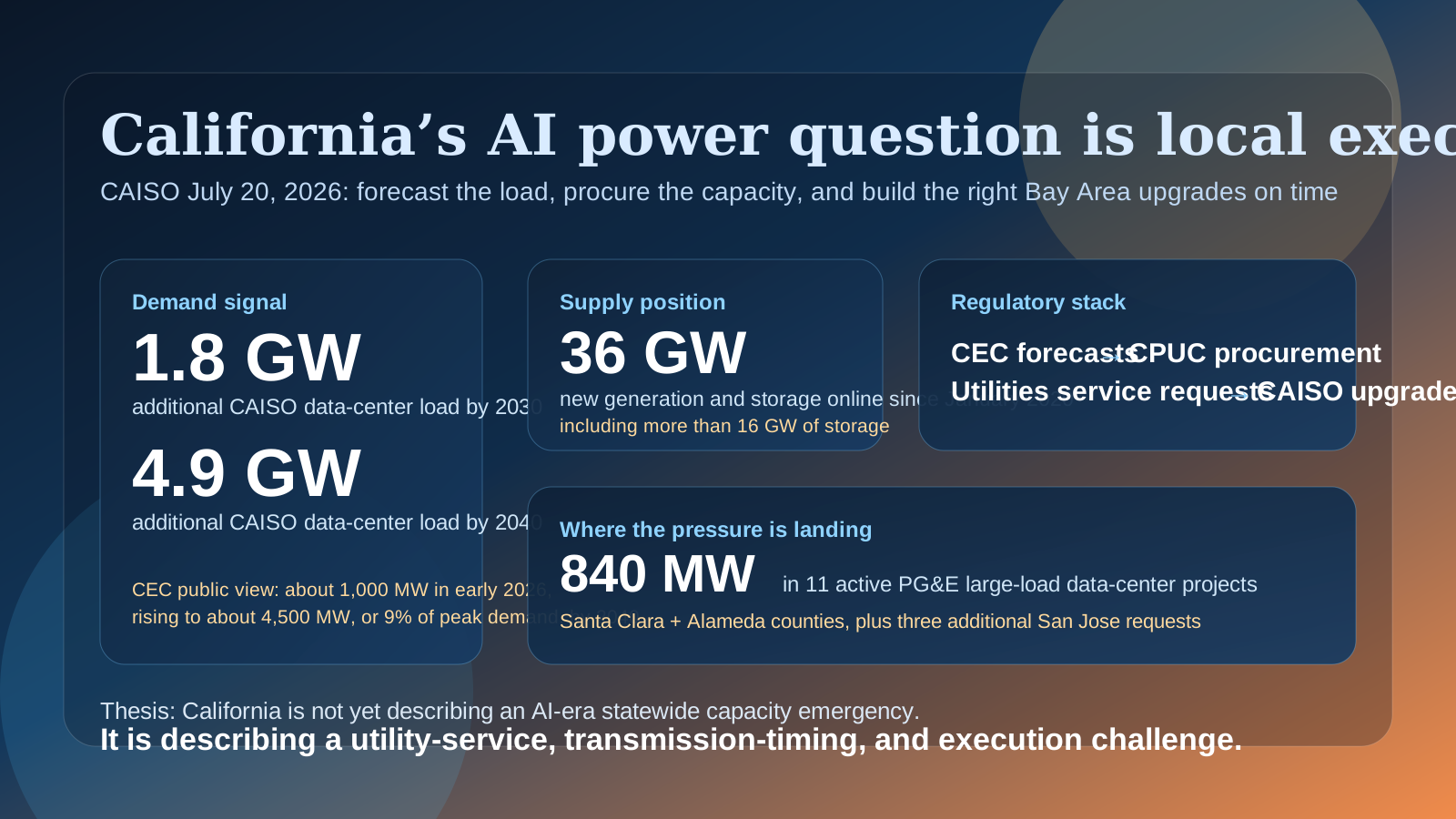
What California is actually saying about AI load
The useful read-through from CAISO is that the state is not yet describing a statewide generation panic. It is describing a coordinated execution problem.
| Signal | What the official sources say | Why it matters |
|---|---|---|
| Statewide data-center demand | CEC says data centers were about 1,000 MW in early 2026 and could reach about 4,500 MW by 2040; CAISO cites a 1.8 GW increase by 2030 and 4.9 GW by 2040. | California has a real growth curve to plan for, but not one that automatically implies an immediate statewide capacity shortfall. |
| Available supply path | CAISO says nearly 36 GW of new generation and storage came online from January 2020 to March 2026, including more than 16 GW of storage. | The state is trying to meet load growth through preplanned capacity additions rather than emergency stopgaps alone. |
| Reliability position | CAISO says its 2026 summer assessment shows the current portfolio meets the reliability target with more than 2.5 GW of surplus. | The present bottleneck is less about an immediate statewide deficit and more about timely execution. |
| Local concentration | CAISO says PG&E’s 2024 large-load cluster includes 11 active data-center projects totaling 840 MW in Santa Clara and Alameda counties, plus three additional San Jose requests. | The pressure is concentrating in Bay Area service territories, which turns AI growth into a local utility and transmission problem first. |
Sources: CAISO July 20, 2026 informational report, California Energy Commission data-center overview, and CAISO revised draft 2025-2026 transmission plan.
CAISO’s July 20 filing to FERC clears the publish bar because it says something more useful than the usual “AI is straining the grid” headline. California is not primarily describing a statewide shortage of generation. It is describing a coordination and execution problem: utilities are getting more large-load service requests, planners have to decide which projects are real, regulators have to order enough capacity, and transmission owners have to build the upgrades in the specific places where data-center demand is clustering.
That is the original angle. In its informational report responding to FERC’s June 18 large-load order, CAISO says California’s planning framework already incorporates data centers into statewide demand forecasting, resource procurement, and transmission planning. The CEC, CPUC, and CAISO are using a shared planning stack rather than waiting for each large load to show up as an emergency. Read correctly, California is trying to turn AI load growth into a managed utility-service workflow instead of a late-stage reliability surprise.
California’s AI power problem is increasingly a utility-service execution problem, not yet a statewide capacity panic.
The load numbers matter, but they are not the whole story. CAISO says the CEC forecasts data-center load in the CAISO grid rising by 1.8 gigawatts by 2030 and 4.9 gigawatts by 2040. The CEC’s public data-center page frames the same arc a little differently: about 1,000 megawatts in early 2026, or roughly 2% of CAISO peak demand, rising to about 4,500 megawatts, or 9% of peak demand, by 2040. Those figures are large enough to matter, but they do not automatically imply an East Coast-style capacity panic.
CAISO makes that distinction explicit. The filing says current planning assessments do not indicate a systemic generation adequacy shortfall comparable to those in other regions. It says the principal mandate is timely development, interconnection, and commercial operation of the resources California has already identified. That matters because it shifts the operator question. In California, the first-order problem is less “Is there any power at all?” and more “Can the state execute the utility, procurement, and transmission sequence fast enough in the exact locations where AI load is arriving?”
The supporting numbers make the point stronger. CAISO says nearly 36 gigawatts of new generation and storage have come online to serve CAISO load between January 2020 and March 2026, including more than 16 gigawatts of storage. It also says its 2026 Summer Loads and Resource Assessment indicates the current portfolio meets the reliability target with a surplus of more than 2.5 gigawatts. On the procurement side, CAISO says the CPUC has ordered 24.8 gigawatts of mostly new net qualifying capacity between 2021 and 2032, including 6 gigawatts ordered in February to account for projected load growth that includes expected new data centers.
But the filing also shows where the real friction is moving. CAISO says PG&E is seeing large growth for data-center and other large-load interconnections specifically in the Greater Bay Area. In PG&E’s 2024 large-load cluster, CAISO says there are 11 active data-center projects totaling 840 megawatts in Santa Clara and Alameda counties, plus three additional data-center requests in San Jose moving through serial studies. That is the buried detail that makes the story worth publishing: California’s AI buildout is becoming a local network-upgrade and service-territory problem before it becomes a statewide adequacy problem.
The project economics reinforce that read-through. CAISO’s transmission plan describes identified local network upgrades for these interconnections, including one 49-megawatt project with estimated network-upgrade costs of $69 million to $138 million and a pair of 99-megawatt projects tied to a new switching station and reconductoring work with estimated costs of $223 million to $446 million. These are not abstract planning numbers. They are examples of how AI demand starts turning into wires, breakers, stations, timelines, and cost-allocation decisions.
This clears the duplicate screen against the site’s last 30 days. New York’s moratorium story was about a political brake on hyperscale siting. PJM’s recent coverage was about reserve margins, curtailment, and large-load market rules in a capacity-constrained region. Texas Batch Zero was about queue discipline and qualification. This thesis is materially different. California’s message is that the state may have a more coordinated planning structure than PJM or ERCOT, but it still has to prove it can convert that planning stack into timely utility service for real projects.
The next watchpoint is process speed. CAISO says it will expedite its Large Loads stakeholder initiative, with a straw proposal due August 12, 2026, a draft final proposal due September 21, and board approval targeted for October 28. If those timelines slip, or if local upgrades drag while service applications keep arriving, California’s “planned not panicked” narrative will get harder to defend. If the timeline holds, the state could become the clearest test of whether coordinated planning can absorb AI load growth without turning into a ratepayer and reliability crisis.
That is enough to publish. Searchers looking up California data-center power demand do not need another recycled thesis that AI uses a lot of electricity. The more useful answer is that California’s bottleneck is increasingly utility-service execution: proving that demand forecasts, procurement orders, interconnection studies, and localized transmission builds can move in sync before the queue outruns the plan.
Sources
California Independent System Operator, “Informational Report” in Docket No. EL26-71-000, filed July 20, 2026: https://www.caiso.com/documents/jul-20-2026-informational-report-large-loads-and-co-located-loads-el26-71.pdf
California Energy Commission, “Data Centers,” accessed July 23, 2026: https://www.energy.ca.gov/programs-and-topics/topics/data-centers
California ISO, “Revised Draft 2025-2026 ISO Transmission Plan,” published May 12, 2026: https://www.caiso.com/documents/revised-draft-2025-2026-transmission-plan-may-2026.pdf
By Nawaz Lalani
The Grid Report is written by Nawaz Lalani and focuses on source-backed coverage of AI infrastructure, grid power demand, automation systems, and market signals.
Follow the signal, not just the headline.
Get the daily Grid brief for source-backed coverage on AI power demand, infrastructure timing, automation, and market signals.