- PJM’s July 1 stakeholder update clears the publish bar because it is more than another admission that data-center demand is rising.
- The core primary-source facts matter.
- The Connect and Manage side is the sharper signal.
- Section
- Energy
- Read time
- 5 min read
- Data included
- What PJM is building around new large loads
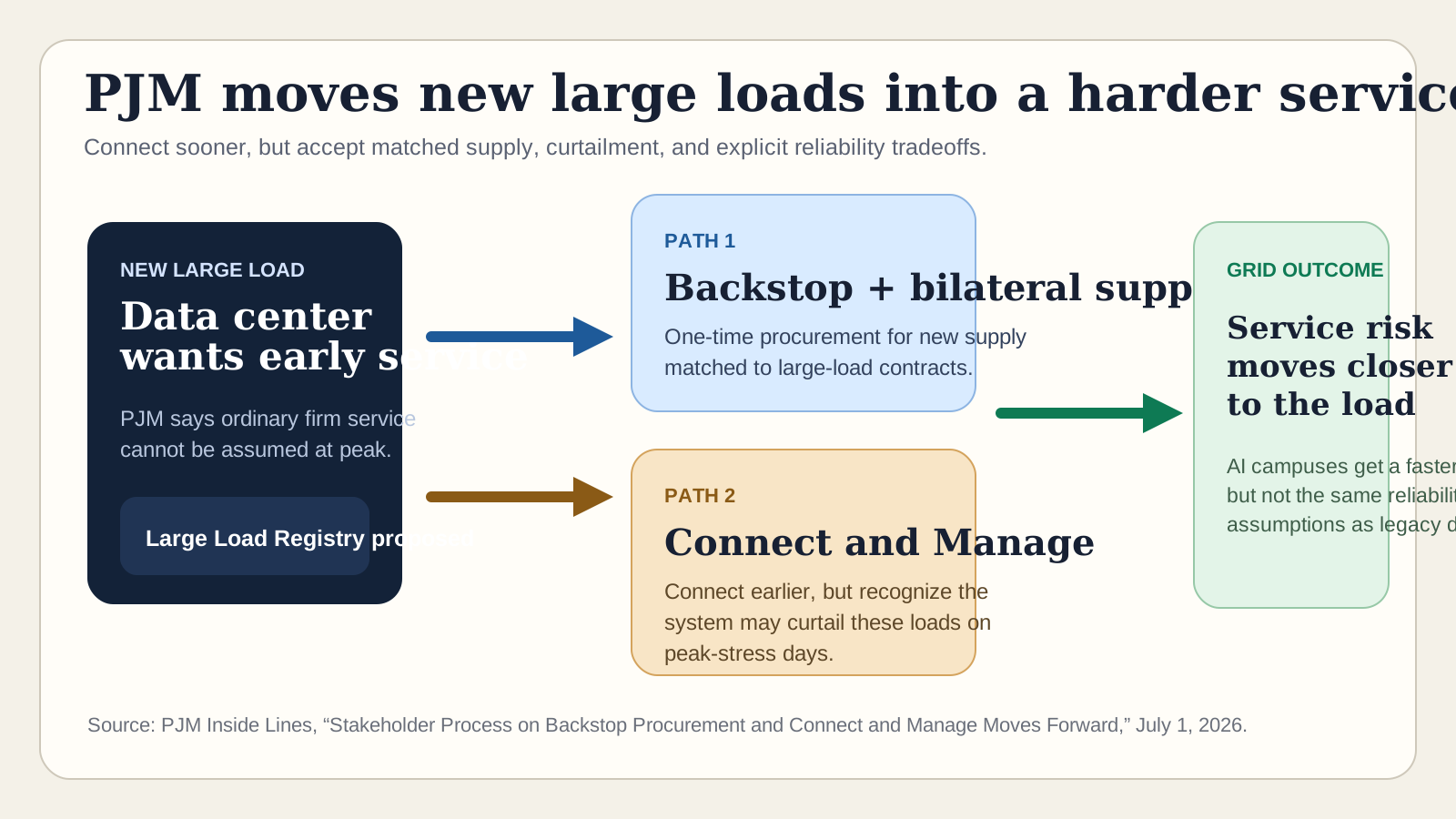
What PJM is building around new large loads
The important shift is not just faster connection. It is the combination of matched supply, registry visibility, and explicit curtailment logic.
| Element | Primary-source detail | Why it matters |
|---|---|---|
| Backstop procurement | PJM says it would run a one-time process to buy new supply resources for new large loads | The region is treating capacity adequacy for large-load growth as an active procurement problem. |
| Bilateral matching | PJM says large-load customers would be matched with developers of new supply resources for long-term contracts | Some new demand may need dedicated or explicitly paired supply rather than relying on pooled assumptions alone. |
| Connect and Manage | PJM says large loads could connect while recognizing the system cannot serve them on peak-stress days | Faster connection is being paired with explicit curtailment risk. |
| Stakeholder split | A backstop proposal cleared the two-thirds threshold, but none of the 11 Connect and Manage proposals did | Consensus is stronger on adding supply than on the final service terms for curtailment. |
| Large Load Registry | Multiple proposals centered on a public registry for large-load additions | Operators want earlier visibility into who is coming, how large the load is, and what service assumptions it carries. |
Sources: PJM Inside Lines posts published February 2026, June 25, 2026, and July 1, 2026.
PJM’s July 1 stakeholder update clears the publish bar because it is more than another admission that data-center demand is rising. PJM says stakeholders concluded an expedited process to help the board devise a proposal that would accommodate data-center growth through bilateral transactions, a reliability backstop procurement, and a Connect and Manage framework for new large loads. The stronger Grid Report angle is that PJM is sketching a new service class in which faster connection comes with more explicit curtailment and supply obligations.
The core primary-source facts matter. PJM says the Reliability Backstop Procurement would create a one-time process to purchase new supply resources to serve new data centers and other large loads. It also says that procurement would be combined with a bilateral contracting process that matches large-load customers with developers of new supply resources for long-term supply contracts. That is already a different posture from assuming the bulk system will quietly absorb every new request on ordinary terms.
The strongest PJM signal is that speed to power is starting to look like a different product: some new large loads may connect sooner only if they accept curtailment and matched-supply conditions.
The Connect and Manage side is the sharper signal. PJM says the framework would allow large loads to connect while recognizing that the system currently does not have the capacity to serve them on days of peak electricity use. That means the system is no longer being described as “connect now and we will sort out reliability later.” It is being described as “connect earlier if you accept the possibility of curtailment when the grid is stressed.”
This is why the story belongs in the energy-grid lane. The useful change is not procedural choreography at a stakeholder meeting. The useful change is that PJM is moving service risk closer to the load. That is exactly what happens when large-load growth arrives faster than conventional generation additions, transmission upgrades, and full interconnection timelines can keep up.
The voting outcome also matters. PJM says one Reliability Backstop Procurement proposal led by the Data Center Coalition and a group of electric distribution companies exceeded the two-thirds sector-weighted majority threshold, while none of the 11 Connect and Manage proposals cleared that bar. In practice, that means the supply-matching idea has more consensus than the exact terms of the curtailment framework, even though both are now on the board’s near-term agenda.
A proposed public Large Load Registry is another sign that this is becoming an operator story rather than just a politics story. PJM is trying to get better visibility into what large loads are coming, what kind of service they want, and what supply assumptions sit behind them. That is operational discipline, not just stakeholder theater.
This piece is materially different from the site’s recent PJM coverage. The June 30 auction story was about capped capacity prices and a supply-demand gap. The Manual 13 piece was about emergency procedures after the system is already under strain. This new update sits in between those layers. It is about rewriting the service bargain for new demand before the emergency stack is triggered.
There are obvious uncertainties. PJM has not finalized the board filing, Connect and Manage did not emerge with stakeholder supermajority support, and any eventual tariff path could change at FERC. But the narrower conclusion is solid: PJM is signaling that some AI-era large loads may get faster access only by accepting a lower-assurance form of service tied to new supply and curtailment rules.
That is enough to publish. Searchers looking for PJM’s latest large-load move do not need a generic summary of “data centers pressure the grid.” The more useful answer is that PJM is trying to formalize a new reliability bargain in which speed to power comes with explicit curtailment and supply conditions.
Sources
PJM Inside Lines, “Stakeholder Process on Backstop Procurement and Connect and Manage Moves Forward,” published July 1, 2026: https://insidelines.pjm.com/stakeholder-process-to-procure-generation-and-serve-large-loads-moves-forward/
PJM Inside Lines, “The Capacity Auction Is Coming. Here’s What We’re Doing Now,” published June 25, 2026, for board-plan context: https://insidelines.pjm.com/the-capacity-auction-is-coming-heres-what-were-doing-now/
PJM Inside Lines, “PJM Board Outlines Plans To Integrate Large Loads Reliably,” published February 2026, for prior plan context: https://insidelines.pjm.com/pjm-board-outlines-plans-to-integrate-large-loads-reliably/
By Nawaz Lalani
The Grid Report is written by Nawaz Lalani and focuses on source-backed coverage of AI infrastructure, grid power demand, automation systems, and market signals.
Follow the signal, not just the headline.
Get the daily Grid brief for source-backed coverage on AI power demand, infrastructure timing, automation, and market signals.