- PJM’s June 30, 2026 capacity-auction opening clears the publish bar because this is no longer a niche market-calendar item.
- The immediate facts matter.
- That smoothing is exactly why the stronger angle is not just “the auction opened.” PJM said on June 25 that the collar should limit year-to-year volatility for consumers and investors, but it also said the collar does not solve the underlying imbalance.
- Section
- Markets
- Read time
- 5 min read
- Data included
- Why this PJM auction matters now
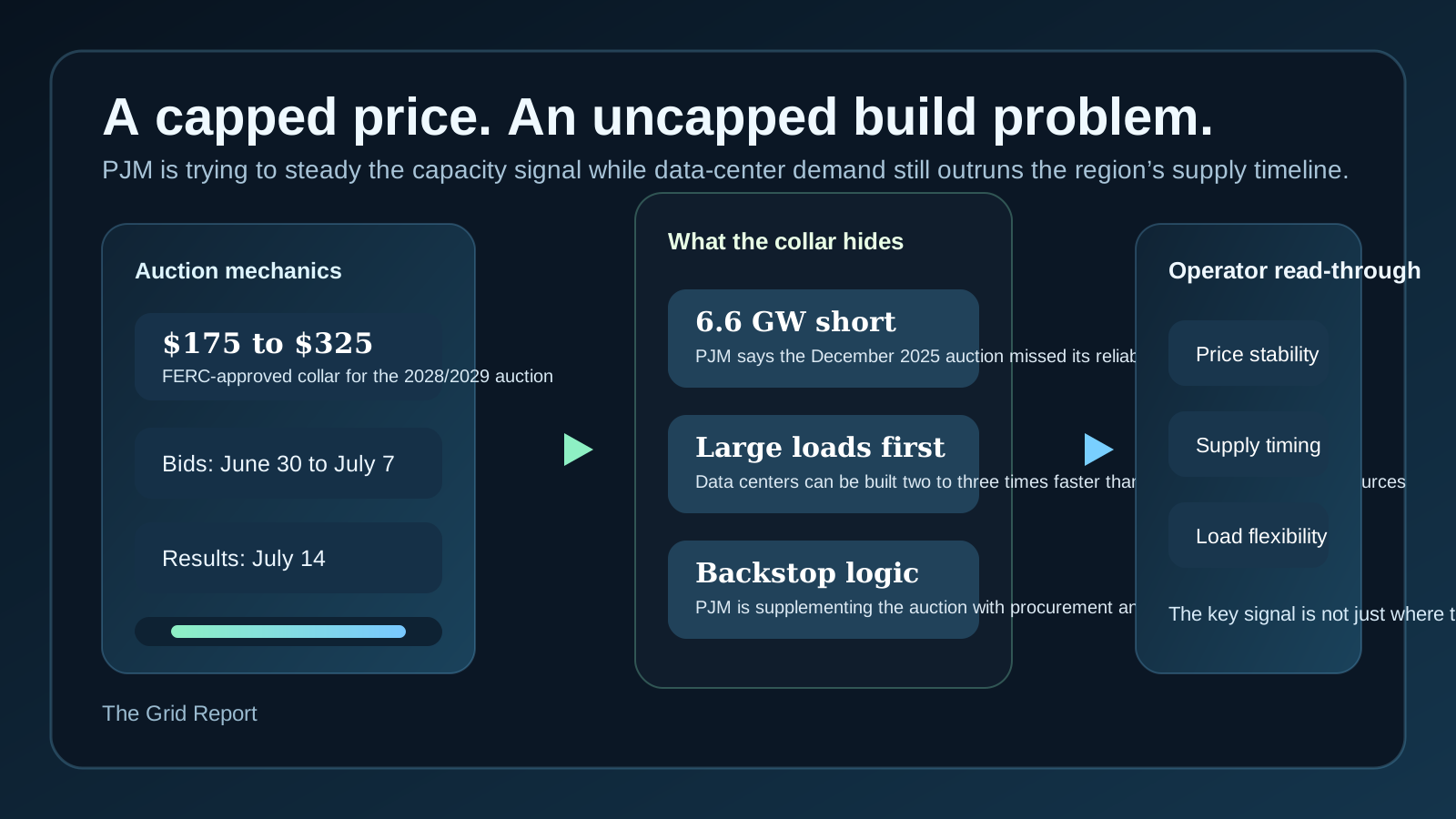
Why this PJM auction matters now
The current auction is being managed for price stability even as PJM keeps signaling a deeper reliability and buildout mismatch.
| Item | Primary-source detail | Why it matters |
|---|---|---|
| Auction window | Bids opened June 30, 2026, close July 7, with results due July 14 after 4 p.m. Eastern | This is a live near-term market event, not a distant planning document. |
| Price collar | FERC-approved cap of about $325/MW-day and floor of $175/MW-day apply to this auction | The reported clearing price will be intentionally constrained rather than fully free-floating. |
| Prior shortfall | PJM says the December 2025 auction for 2027/2028 fell 6.6 GW short of its reliability requirement | The system already showed a meaningful mismatch between needed and procured future capacity. |
| Demand driver | PJM says data-center growth is the primary source of accelerating electricity demand | AI-linked large loads are now central to regional power-market economics. |
| Current response | PJM is pursuing backstop procurement, faster project paths, and Connect and Manage rules for large loads | The market is being supplemented with operational fixes because price signals alone are not enough. |
Sources: PJM Inside Lines posts published April 30, June 25, and June 30, 2026.
PJM’s June 30, 2026 capacity-auction opening clears the publish bar because this is no longer a niche market-calendar item. The 2028/2029 Reliability Pricing Model auction opens with a FERC-approved price collar, a recent auction shortfall, and an explicit admission from PJM that data centers are the main driver of faster demand growth. That makes this a real power-economics story for operators, investors, utilities, and policymakers.
The immediate facts matter. PJM opened the bidding window on June 30, will close it on July 7, and plans to post results on July 14 after 4 p.m. Eastern. The region is running this auction under a price cap of about $325 per megawatt-day and a floor of $175 per megawatt-day, after FERC approved extending the collar on April 28, 2026. That means this year’s headline clearing price is being intentionally smoothed before the market even starts.
The useful PJM signal is not just where the auction clears. It is that the market is being capped for stability while the data-center supply gap remains.
That smoothing is exactly why the stronger angle is not just “the auction opened.” PJM said on June 25 that the collar should limit year-to-year volatility for consumers and investors, but it also said the collar does not solve the underlying imbalance. In plain terms, PJM is trying to keep the price signal politically and commercially manageable while admitting that supply is still struggling to catch up with large-load growth.
The most important supporting data is the gap from the last cycle. PJM said the auction conducted in December 2025 for the 2027/2028 delivery year procured capacity that fell 6.6 gigawatts short of its reliability requirement. PJM was careful not to frame that as an immediate outage warning. But it is a concrete sign that the market is no longer clearing comfortably against future system needs.
PJM also made the load driver explicit. In the June 25 market note, Adam Keech wrote that new data-center facilities and expansions can be developed up to two or three times faster than many of the generation technologies needed to serve them. That timing mismatch is the real Grid Report hook. The issue is not simply that demand is growing. It is that demand tied to AI campuses can show up faster than new firm supply, transmission, and interconnection execution.
This is why the story belongs in markets rather than a pure policy or utility-news bucket. Capacity auctions are supposed to provide an investment signal. But when the signal is capped and the shortfall persists, the market becomes harder to read. A collar may reduce panic and retail bill shock, yet it also means the published price alone tells less of the truth about how tight the system actually is.
PJM’s response stack reinforces that interpretation. The organization says it is pursuing additional reliability backstop procurement, fast-tracking some large capacity projects, and advancing a Connect and Manage framework so large new loads can connect with clearer service-priority and flexibility rules. Those are not cosmetic tweaks. They are workarounds for a grid that needs more supply and more operational discipline before every new megawatt of demand can be treated as ordinary growth.
That is enough to publish. Searchers looking for the 2028/2029 PJM capacity auction do not need only the dates. The more useful answer is that the auction opens with capped prices, unresolved supply tightness, and a regional market structure that is being actively reworked because AI-linked load growth is arriving faster than the old build cycle can absorb.
Sources
PJM Inside Lines, “PJM Capacity Auction for 2028/2029 Delivery Year Opens,” published June 30, 2026: https://insidelines.pjm.com/pjm-capacity-auction-for-2028-2029-delivery-year-opens/
PJM Inside Lines, “The Capacity Auction Is Coming. Here’s What We’re Doing Now,” published June 25, 2026: https://insidelines.pjm.com/the-capacity-auction-is-coming-heres-what-were-doing-now/
PJM Inside Lines, “FERC Approves Capacity Auction Price Collar to Next Two Capacity Auctions,” published April 30, 2026: https://insidelines.pjm.com/ferc-approves-capacity-auction-price-collar-to-next-two-capacity-auctions/
By Nawaz Lalani
The Grid Report is written by Nawaz Lalani and focuses on source-backed coverage of AI infrastructure, grid power demand, automation systems, and market signals.
Follow the signal, not just the headline.
Get the daily Grid brief for source-backed coverage on AI power demand, infrastructure timing, automation, and market signals.