- Google and Voltus’s June 2 agreement clears the publish bar because it is more than another corporate clean-energy announcement.
- The original angle is that Google is not only trying to secure more electrons.
- That matters in PJM because the region is already a focal point for AI load growth, high capacity prices, and long arguments over how quickly new supply can come online.
- Section
- Energy
- Read time
- 4 min read
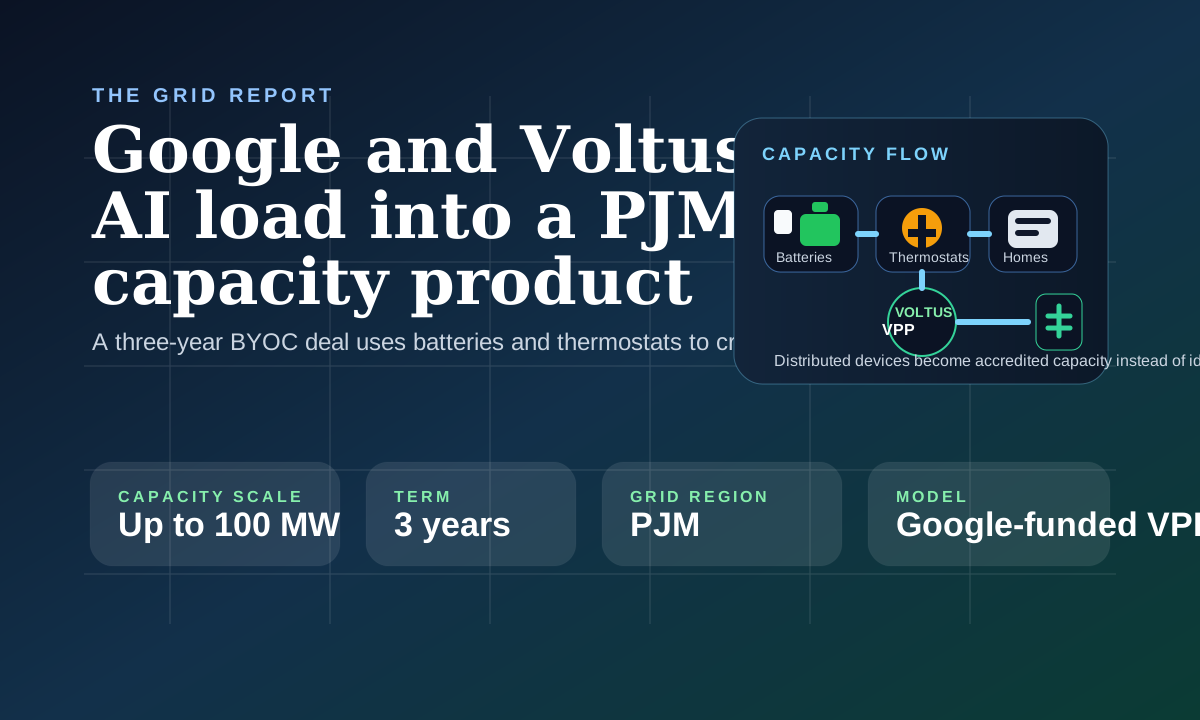
Google and Voltus’s June 2 agreement clears the publish bar because it is more than another corporate clean-energy announcement. The companies said they signed a three-year deal to unlock up to 100 megawatts of new capacity from flexible distributed energy resources in PJM through a Google-funded virtual power plant. That matters because it turns a piece of AI power demand into something closer to a capacity procurement strategy.
The original angle is that Google is not only trying to secure more electrons. It is helping create an accredited flexibility product around its own growth. Voltus said it will aggregate batteries, smart thermostats, and other distributed resources from homes and businesses, then pay those participants for reducing demand when the grid needs relief. In practical terms, Google is using software-coordinated demand flexibility to help create capacity that can support data-center expansion without waiting for every incremental need to be solved by a new central plant.
One of the clearest new AI-power signals is that grid flexibility itself is becoming a product hyperscalers can buy.
That matters in PJM because the region is already a focal point for AI load growth, high capacity prices, and long arguments over how quickly new supply can come online. The stronger read-through is not that 100 megawatts solves hyperscale power demand. It does not. The useful signal is that large-load buyers are starting to treat distributed energy resources as a serious part of the interconnection and reliability toolkit rather than as a side sustainability program.
Google’s own description makes the intent clearer. The company said the agreement is designed to create new capacity for the system, channel investment into local communities, and strengthen the grids that serve its data centers. Voltus framed the deal as an industry-leading blueprint for meeting data-center capacity needs through smarter use of existing infrastructure. That is the important shift. Grid slack itself is becoming something that can be financed, packaged, and contracted around new AI load.
Operators should care because this changes what “power strategy” can mean for a data-center buildout. If distributed devices can be organized into dependable peak relief, then speed to power is no longer only a land, substation, and turbine problem. It also becomes a market-design and orchestration problem. The companies are effectively testing whether a hyperscaler can buy a cleaner, faster slice of reliability by funding the flexibility layer around the grid.
Investors and utility planners should care because this model could spread if it works. A successful BYOC structure gives large-load customers another way to reduce the cost and timing pressure associated with traditional expansion. It also creates a clearer revenue path for demand response, batteries, thermostats, and software platforms that can aggregate them into accredited capacity. That does not replace generation or wires, but it can change which projects become urgent and which capital stacks become financeable.
There are limits. A 100-megawatt program is small relative to multi-gigawatt AI ambitions, distributed portfolios can underperform if they are poorly assembled, and the economics depend on PJM market design, accreditation, and execution quality. But those caveats do not weaken the thesis. They clarify why this is worth watching: AI load growth is starting to pull new grid products into existence.
The better conclusion is that hyperscale power procurement is broadening. The next useful capacity may not always come first from a new power plant. Sometimes it may come from turning thousands of smaller devices into a contractable reliability layer.
Sources
Google, “We’ve signed a first-of-its-kind agreement with Voltus to create a smart capacity solution for the grid,” published June 2, 2026: https://blog.google/company-news/outreach-and-initiatives/sustainability/voltus-agreement/
Voltus, “Voltus and Google to Deliver Grid Capacity and Local Economic Benefits Through Bring Your Own Capacity Agreement,” published June 2, 2026: https://www.voltus.co/press/voltus-google-bring-your-own-capacity-pjm
By Nawaz Lalani
The Grid Report is written by Nawaz Lalani and focuses on source-backed coverage of AI infrastructure, grid power demand, automation systems, and market signals.
Follow the signal, not just the headline.
Get the daily Grid brief for source-backed coverage on AI power demand, infrastructure timing, automation, and market signals.