- GE Vernova’s July 22 second-quarter results clear the publish bar because the useful signal is not that an energy-equipment stock had a strong quarter.
- That is the original angle.
- The data-center read-through is explicit.
- Section
- Energy
- Read time
- 4 min read
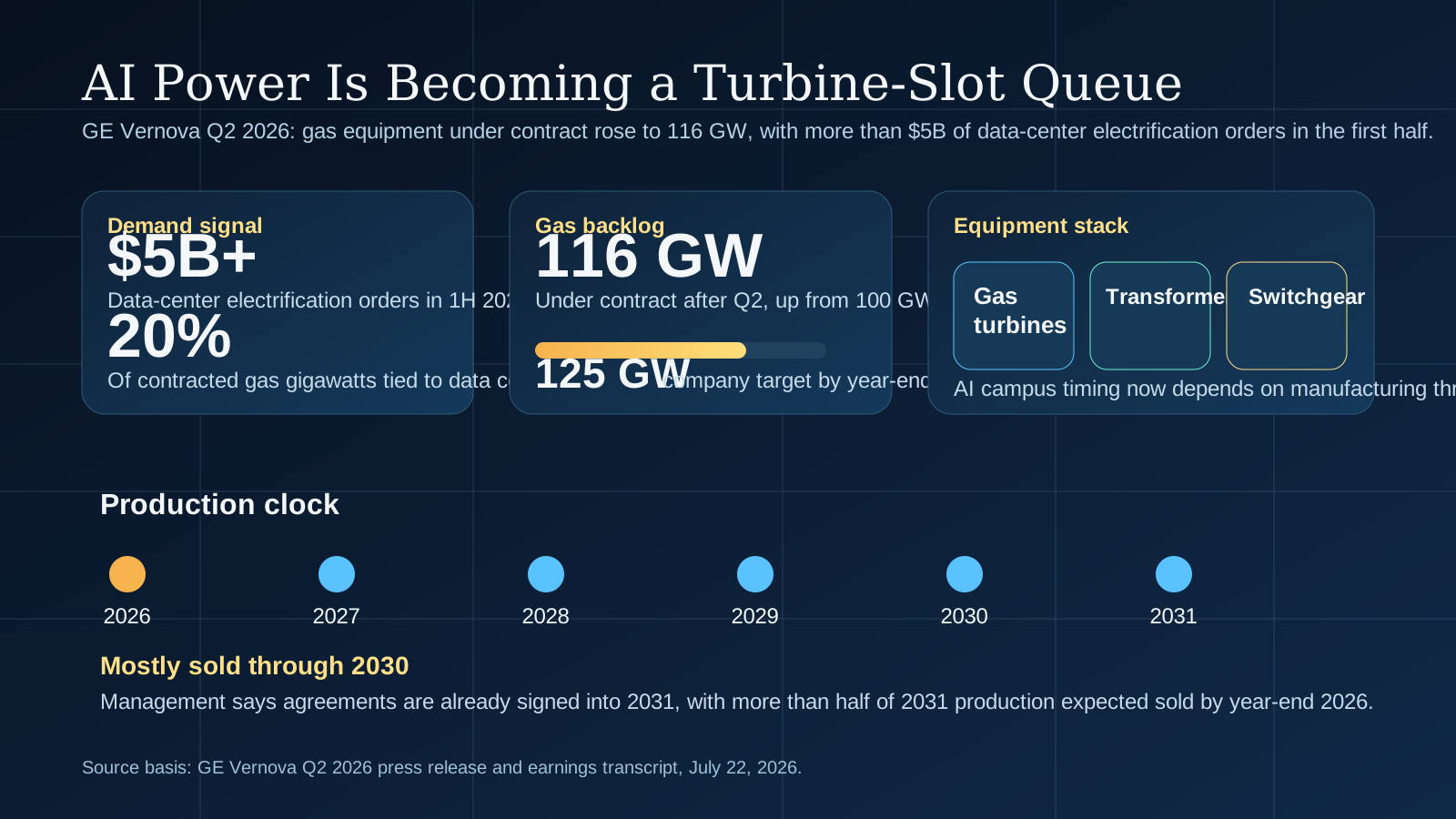
GE Vernova’s July 22 second-quarter results clear the publish bar because the useful signal is not that an energy-equipment stock had a strong quarter. The stronger story is that AI power is becoming a manufacturing-queue problem. For developers, utilities, and investors, the practical bottleneck is moving beyond generic “need more power” language and into a harder timing stack: who can secure gas turbines, transformers, switchgear, and associated electrical gear early enough to energize large campuses on schedule.
That is the original angle. GE Vernova said its Gas Power equipment backlog and slot reservation agreements grew from 100 gigawatts to 116 gigawatts in the second quarter, and the company now expects to reach at least 125 gigawatts under contract by year-end 2026. On the earnings call, CEO Scott Strazik said the company already has agreements signed into 2031 and expects to have sold more than half of 2031 production slots by the end of this year. Read correctly, that is not only a demand story. It is a clock. If AI builders want firm power equipment in this cycle, they increasingly need to reserve manufacturing capacity years in advance.
For the next wave of AI campuses, the scarce asset is no longer only power on paper. It is place in line for the equipment that makes that power real.
The data-center read-through is explicit. Strazik said about 20% of the gas gigawatts now under contract are for data centers, while roughly 80% remain tied to traditional customers. That matters because it shows AI load is no longer a marginal add-on inside the turbine market. It is large enough to change how operators should think about procurement priority, delivery windows, and the value of counterparties that can lock in supply earlier than rivals.
The electrical side makes the thesis stronger. GE Vernova said Electrification booked $2.7 billion of data-center orders in the second quarter, bringing first-half 2026 data-center electrification orders to more than $5 billion, more than double the company’s full-year 2025 total. The company also said Electrification equipment backlog rose above $40 billion. This is the part many generic rewrites miss. AI power readiness does not stop at generation. A campus can still lose time waiting on transformers, switchgear, substations, and the control gear needed to make new capacity usable.
Management’s capacity language raises the bar further. GE Vernova said it is on track to deliver a 20-gigawatt annual gas-turbine output run rate in the third quarter of 2026, sees 24 gigawatts in 2028, and is now implementing actions to reach 30 gigawatts in 2030. But the important operator lesson is not simply that output is rising. It is that even with expansion underway, the market is still being sold forward. When a supplier is mostly sold through 2030 and already placing 2031 slots, the scarce asset is not only megawatts. It is place in line.
This is why the story belongs in energy-grid coverage rather than commodity markets coverage. The core issue is system timing. Utilities, hyperscalers, independent power developers, and large-load sponsors now have to coordinate site control, permits, interconnection, and financing with manufacturing lead times for the equipment stack that turns an AI power plan into live electrons. A project with a plausible power contract but no credible equipment path is not actually power ready.
This also clears the duplicate screen against the site’s last 30 days. Google’s Steel River story was about community-facing procurement structure. KKR’s EDF deal was about renewables-platform scale. Project Jupiter was about permit-stack fragility. AEP Texas was about transmission prebuild finance. This thesis is materially different. GE Vernova turns the next phase of AI power into an equipment-throughput and slot-allocation story inside the manufacturing base itself.
The operator takeaway is straightforward. In the next phase of the AI buildout, power advantage will belong less to the team with the best deck and more to the team that can line up actual hardware, utility interfaces, and delivery timing across the full stack. The investor takeaway is similar. The most important signals are no longer only announced gigawatts or flashy campus claims, but whether those claims sit behind real turbine reservations, real electrification backlog, and realistic commissioning windows. On July 22, GE Vernova gave the market one of the clearest looks yet at how tight that queue is becoming.
Sources
GE Vernova, “GE Vernova reports second quarter 2026 financial results and raises 2026 financial guidance,” published July 22, 2026: https://www.gevernova.com/news/press-releases/ge-vernova-reports-second-quarter-2026-financial-results-raises-2026-financial
GE Vernova Investor Relations, “2Q 2026 Earnings Webcast” transcript, published July 22, 2026: https://www.gevernova.com/sites/default/files/gev_webcast_transcript_07222026.pdf
By Nawaz Lalani
The Grid Report is written by Nawaz Lalani and focuses on source-backed coverage of AI infrastructure, grid power demand, automation systems, and market signals.
Follow the signal, not just the headline.
Get the daily Grid brief for source-backed coverage on AI power demand, infrastructure timing, automation, and market signals.