- Project Jupiter clears the publish bar because the latest move is not just another local controversy around a big AI campus.
- That is the original angle worth publishing.
- The July 14 state-land letter is especially revealing because it does not reject the project on a narrow technicality.
- Section
- Infrastructure
- Read time
- 4 min read
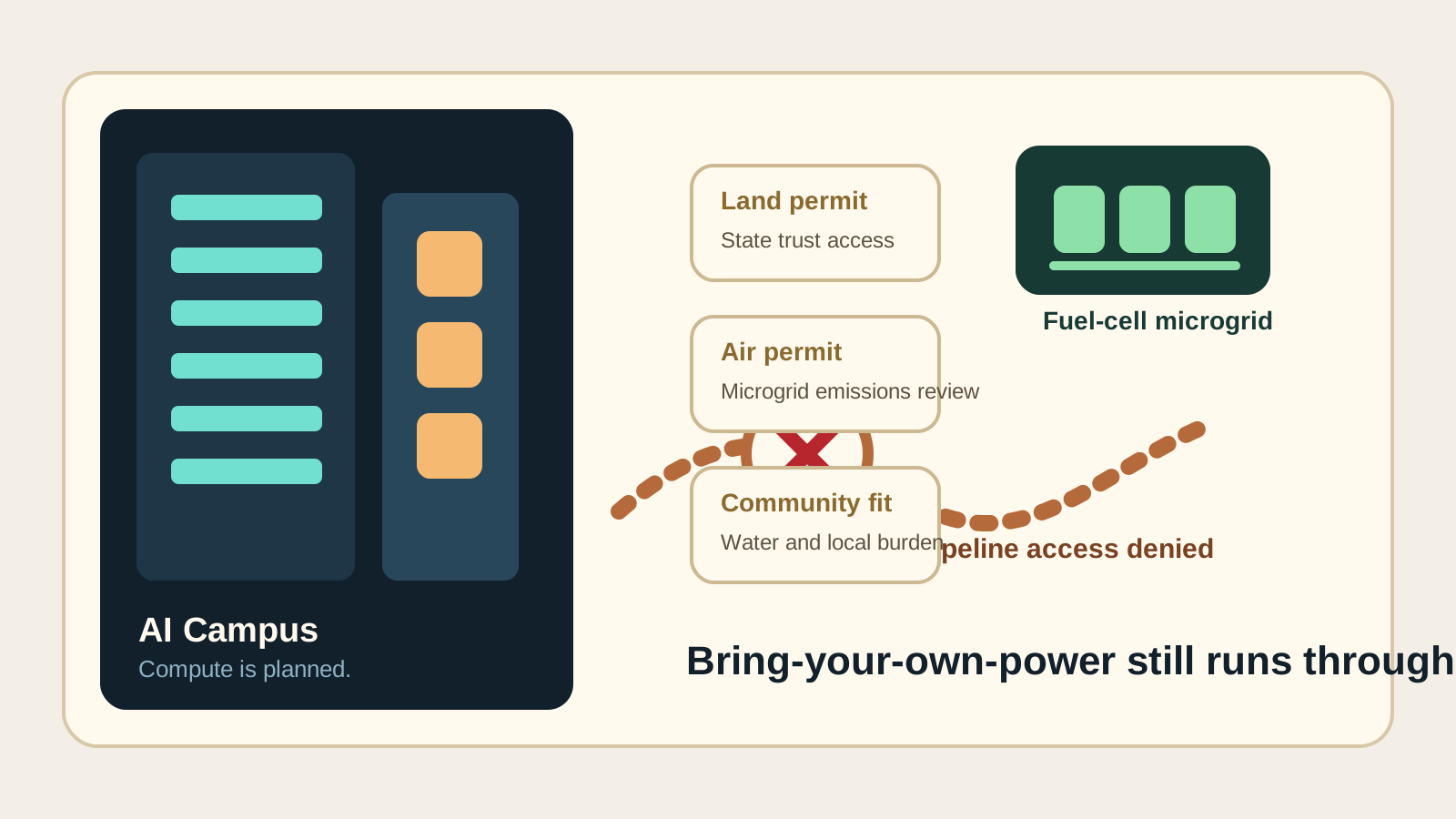
Project Jupiter clears the publish bar because the latest move is not just another local controversy around a big AI campus. On July 14, 2026, the New Mexico State Land Office denied Energy Transfer’s request to reconsider the rejection of rights-of-way and a business lease tied to the proposed Green Chili Lateral pipeline for Project Jupiter in Doña Ana County. Six days later, the New Mexico Environment Department opened public notice on the YGI Microgrid air permit for the site’s revised Bloom Energy fuel-cell design. Read together, those two actions create a more useful infrastructure story than a standard “project faces opposition” headline: even when an AI campus tries to bring its own power, it still has to survive a layered local permit stack.
That is the original angle worth publishing. The market has spent the last year talking about behind-the-meter power as if it were a clean escape hatch from transmission queues and utility delays. Project Jupiter shows the escape hatch is narrower than it looks. If a developer cannot secure the land path for a 17-mile gas connection, and still must pass air-quality review for a major on-site microgrid, then the constraint has not disappeared. It has moved from interconnection timing into land, fuel, emissions, and community process risk.
Bring-your-own-power does not remove the bottleneck. It often just moves the AI campus into a harsher permit stack.
The July 14 state-land letter is especially revealing because it does not reject the project on a narrow technicality. The commissioner says the trust-land rights-of-way and business lease would generate only modest revenue, that collateral benefits to the trust are limited, and that the project would impose outsized burdens on water, climate, and surrounding communities relative to the direct state-land benefit. That matters because it shows a large AI campus can lose a critical piece of its power path even when the actual land footprint under dispute is only a small portion of the broader project.
The revised power design does not eliminate that problem. Oracle said in its June 3 update that Project Jupiter shifted from the earlier gas-turbine-and-diesel plan to Bloom Energy fuel cells, and that the new application is expected to reduce NOx emissions by about 92 percent while lowering water use. The state’s July 20 air notice confirms the new path is still a major-source air permitting process for a natural-gas-fed solid oxide fuel cell system, with permit number 10883 and a preliminary intent to issue on or before August 25, 2026. In other words, the project has improved its environmental posture, but it has not escaped infrastructure politics. It has entered a different permitting lane.
This is why the story belongs in infrastructure rather than generic policy coverage. The operative question is not who won a local dispute. The operative question is what operators and investors should learn from it. The answer is that “dedicated power” is not a magic phrase. Self-supplied campuses still depend on fuel delivery, major-source emissions review, local water credibility, and enough political durability to keep the project moving through each layer without delay or redesign.
It also clears the duplicate screen against the site’s recent coverage. Microsoft’s Pecos story was about pairing a campus with a dedicated power stack. Meta’s Alberta story was about turning off-grid energy into a jurisdiction product. Bloom and National Grid were about private power-delivery platforms. This thesis is materially different. Project Jupiter is showing that once developers step outside the conventional utility path, they may simply trade one bottleneck for another: a permit stack where land access and local environmental scrutiny become the real gating items.
There is still uncertainty here. The YGI Microgrid notice is only a preliminary determination, and Project Jupiter’s backers will keep arguing that the revised design lowers emissions, avoids using public drinking water for power generation, and brings jobs plus community investment. But that does not weaken the operator takeaway. It sharpens it. The more an AI campus depends on custom power architecture, the more site readiness becomes a permitting-and-political execution problem rather than a simple megawatt problem.
That is enough to publish. Searchers looking for Project Jupiter do not need another binary pro-versus-anti recap. The more useful answer is that the site has become a live test of a broader AI infrastructure thesis: bring-your-own-power can help dodge the grid queue, but it does not let a hyperscale campus dodge the permit stack.
Sources
New Mexico State Land Office, letter denying reconsideration of rights-of-way and business lease for Project Jupiter-related pipeline infrastructure, dated July 14, 2026: https://www.nmstatelands.org/wp-content/uploads/2026/07/2026-07-14-Letter-re-Informal-Request-for-Reconsideration_Final.pdf
New Mexico Environment Department, public notice and preliminary determination for Yucca Growth Infrastructure LLC Permit No. 10883, accessed July 21, 2026: https://service.web.env.nm.gov/urls/IzYCTYNY
Oracle, “Public Review Opens for Updated Project Jupiter Power Plan,” published June 3, 2026: https://www.oracle.com/news/announcement/public-review-opens-for-updated-project-jupiter-power-plan-2026-06-03/
By Nawaz Lalani
The Grid Report is written by Nawaz Lalani and focuses on source-backed coverage of AI infrastructure, grid power demand, automation systems, and market signals.
Follow the signal, not just the headline.
Get the daily Grid brief for source-backed coverage on AI power demand, infrastructure timing, automation, and market signals.