- Microsoft’s Pecos announcement clears the publish bar because it reveals a more specific pattern than the usual hyperscale-capacity press release.
- The stronger angle is not simply that Microsoft is getting bigger in Texas.
- This makes the story more useful for operators and investors than a routine land-and-megawatts update.
- Section
- Infrastructure
- Read time
- 5 min read
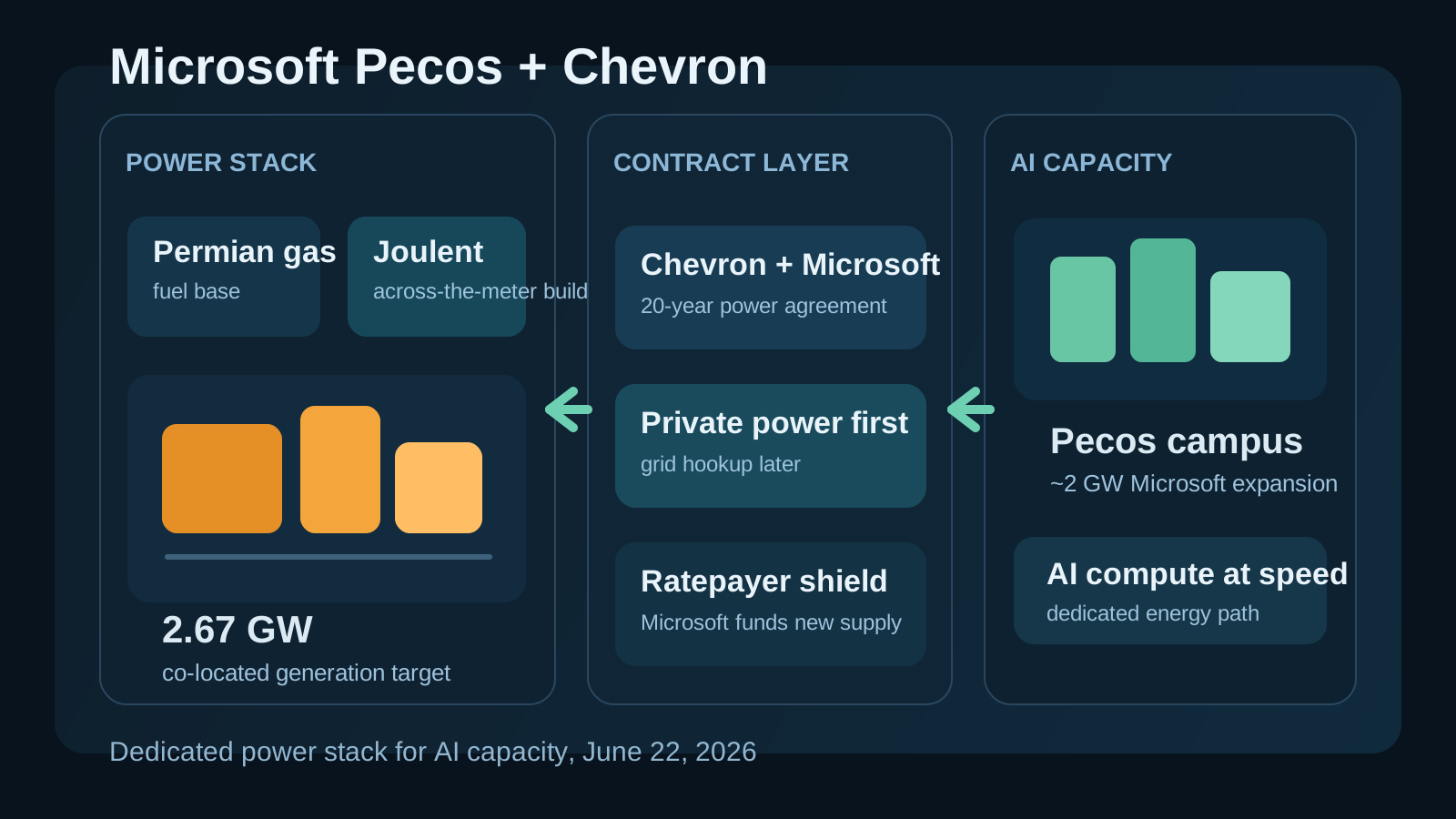
Microsoft’s Pecos announcement clears the publish bar because it reveals a more specific pattern than the usual hyperscale-capacity press release. On June 22, Microsoft said it will build a new datacenter campus in Pecos, Texas that adds about 2 gigawatts of capacity, one of the largest single expansions in the company’s history. On the same day, Chevron said it signed a 20-year agreement with Microsoft to develop Project Kilby, a co-located power facility in West Texas. Joulent, the Engine No. 1-backed developer involved in the project, said Kilby is expected to deliver about 2.67 gigawatts for a Microsoft-operated campus.
The stronger angle is not simply that Microsoft is getting bigger in Texas. It is that the company is increasingly buying a dedicated power stack rather than waiting for the conventional grid buildout to catch up. Microsoft said the Pecos campus will pair new datacenter infrastructure with dedicated onsite energy supply and that Microsoft will fund the new generation and supporting infrastructure required to serve its own operations. That is a much harder signal than generic language about sustainability or long-term demand. It says speed to compute is now being underwritten by custom energy architecture.
The next hyperscale advantage may be the ability to buy compute and dedicated power as one coordinated system instead of waiting for the grid to catch up.
This makes the story more useful for operators and investors than a routine land-and-megawatts update. Joulent describes its model as an across-the-meter approach that co-locates new power with new demand and eventually connects to the grid. Chevron’s announcement shows the commercial wrapper around that model: a long-duration offtake agreement tied to one customer, one campus, and one physical power plan. Read together, the three announcements point to a new infrastructure template for AI: hyperscaler demand, fuel access, generation development, and datacenter expansion are being coordinated as one project instead of four separate timelines.
That matters because the usual AI-infrastructure bottleneck is no longer only chip supply or substation timing. It is orchestration. A developer can have land, capital, and customer demand and still lose years waiting on transmission upgrades, tariff fights, or uncertain utility sequencing. The Pecos structure is a way around that problem. It converts grid delay into a private contracting problem. That does not make the project simple, but it puts more of the critical path inside counterparties that have already chosen to move together.
The West Texas setting sharpens the point. The Permian already matters because it combines abundant associated gas, existing energy infrastructure, and a region looking for new industrial demand. This morning’s EIA-linked fuel story on the site argued that Texas AI power is also becoming a gas-supply story. Pecos adds the next layer. Fuel abundance by itself is not enough. Someone still has to package that fuel into bankable generation, connect it to a campus, and create a commercial structure that gets compute online on a credible schedule.
There is also a policy read-through here, and it is more concrete than a broad opinion about ratepayers. In Microsoft’s January Community-First AI Infrastructure framework, the company said it would pay its way so datacenters do not raise local electricity prices. The Pecos announcement is the first large-scale example that makes the promise operational. Microsoft said the initial campus will run behind the meter, independently of the public grid, and that the demand will not draw from existing community supply. Joulent went further and said the model is designed to avoid pushing electricity costs onto consumers while creating exportable capacity over time.
That combination is why the story is search-worthy. It ties together a named hyperscaler, a named oil major, a named power developer, a disclosed campus location, a disclosed commercial duration, and a disclosed capacity path. More importantly, it answers a real question in the AI buildout: what happens when the fastest way to add compute is to procure generation and compute as one system rather than argue over queue priority.
There are still real limits. The project still depends on permitting, equipment delivery, water management, and a final investment decision that Chevron expects later this year. Microsoft’s roughly 2-gigawatt campus figure and Joulent’s roughly 2.67-gigawatt power figure are not the same number, which means the exact operating configuration will matter. And company announcements naturally present the model in its best light. The right conclusion is narrower and more defensible: dedicated, co-located power is moving from theory into commercial practice for hyperscale AI.
That is enough to publish. The better read-through is not “Microsoft is building another datacenter.” It is that AI infrastructure is starting to look more like a privately assembled industrial system, where compute growth is gated by whoever can line up fuel, turbines, contracts, and community politics before everyone else.
Sources
Microsoft Official Blog, “Powering the next wave of AI: Expanding capacity with our new datacenter in Pecos,” published June 22, 2026: https://blogs.microsoft.com/blog/2026/06/22/powering-the-next-wave-of-ai-expanding-capacity-with-our-new-datacenter-in-pecos/
Chevron, “Chevron Signs 20-Year Power Agreement with Microsoft for West Texas Data Center,” published June 22, 2026: https://www.chevron.com/newsroom/2026/q2/chevron-signs-20-year-power-agreement-with-microsoft-for-west-texas-data-center
Joulent, “Joulent Launches to Deliver Multi-Gigawatt Power Solutions for American Innovation,” published June 22, 2026: https://www.businesswire.com/news/home/20260622143711/en/Joulent-Launches-to-Deliver-Multi-Gigawatt-Power-Solutions-for-American-Innovation
Microsoft On the Issues, “Building Community-First AI Infrastructure,” published January 13, 2026: https://blogs.microsoft.com/on-the-issues/2026/01/13/community-first-ai-infrastructure/
By Nawaz Lalani
The Grid Report is written by Nawaz Lalani and focuses on source-backed coverage of AI infrastructure, grid power demand, automation systems, and market signals.
Follow the signal, not just the headline.
Get the daily Grid brief for source-backed coverage on AI power demand, infrastructure timing, automation, and market signals.