- Texas’ June 18 approval clears the publish bar because it is not another vague promise to move faster on AI infrastructure.
- The stronger angle is that speed to power in Texas is becoming a qualification problem before it becomes a construction problem.
- Batch Zero matters because it replaces that churn with triage.
- Section
- Energy
- Read time
- 4 min read
Texas’ June 18 approval clears the publish bar because it is not another vague promise to move faster on AI infrastructure. The Public Utility Commission of Texas approved ERCOT’s Batch Zero framework for large electricity users, and the practical effect is that one of the country’s most important data-center markets has stopped treating giant new loads as ordinary project-by-project requests. Instead, ERCOT is moving to a batch allocation system that screens which projects keep prior standing, which ones get studied together, and which ones wait.
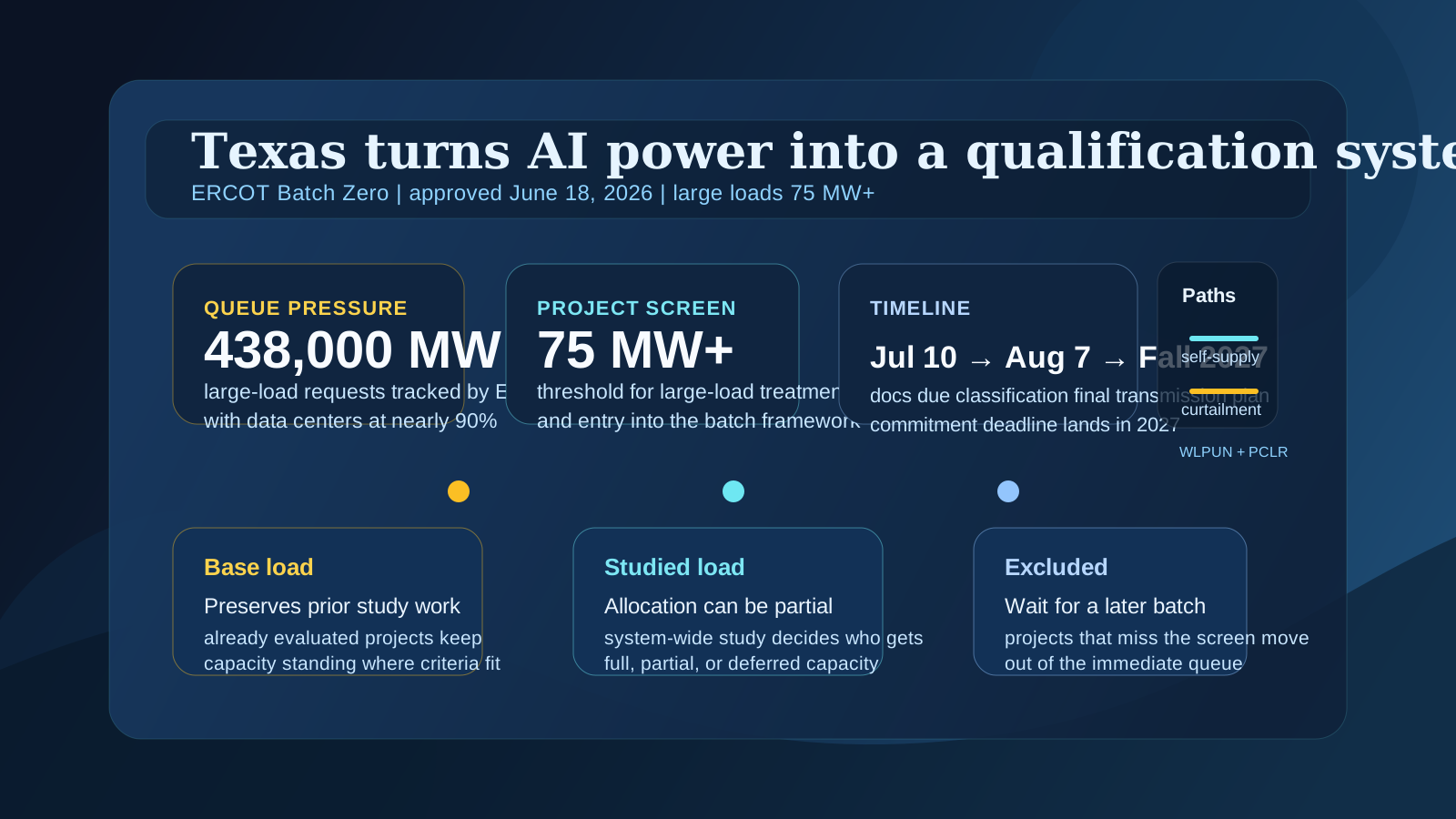
The stronger angle is that speed to power in Texas is becoming a qualification problem before it becomes a construction problem. ERCOT said it is tracking more than 438,000 megawatts of large-load requests, with nearly 89% tied to data centers. At that scale, the old one-at-a-time study method was not just slow. It was destabilizing the queue by forcing costly restudies as each new project changed the transmission picture for the projects behind it.
Texas is telling large-load developers that earlier grid access may now require proof of readiness, on-site supply, or a willingness to be curtailed.
Batch Zero matters because it replaces that churn with triage. ERCOT’s June 18 explainer says eligible projects are sorted into three practical buckets: base load, studied load, and excluded load. Base-load projects preserve certain benefits from prior studies or planning work. Studied-load projects enter the system-wide review and may receive full capacity, partial capacity, or effectively a wait signal. Excluded projects move to a later batch. That is a much harder screen than the market has been used to, and that is exactly why the story matters.
The more original part of the framework is that Texas is also turning flexibility into a speed-to-power product. ERCOT created two optional pathways for large users that change how they interact with the grid: the Withdrawal-Limited Private Use Network, or WLPUN, for projects that bring on-site generation, and the Provisional Controllable Load Resource, or PCLR, for projects willing to let ERCOT curtail their demand during localized transmission stress. Read plainly, Texas is telling developers that if they want earlier access, they may need to show up with either self-supply or dispatchable flexibility.
That has immediate operator relevance because the timeline is now concrete. ERCOT says Batch Zero implementation began immediately after the June 18 approval, with technical studies and documentation due July 10, project classification expected August 7, project-specific allocation signals planned for spring 2027, and a final transmission plan due in fall 2027. That sequence means the competitive edge is shifting toward teams that can satisfy the paperwork, site-control, technical, and financing requirements quickly enough to survive the screen.
It also has investor and infrastructure relevance because the Texas market is moving from land-option theater toward bankability tests. Once a grid operator can classify projects into preserved, partial, or deferred capacity, the headline megawatt request stops being the real story. The real story becomes which projects can prove commitment, accept curtailment risk, support their own generation strategy, and still finance the campus. That is a more mature market structure, but it is also a harsher one.
This is materially different from the FERC story already dominating the national large-load conversation. FERC’s June 18 action is a national tariff rewrite. Texas’ June 18 action is a live operating framework with deadlines, project buckets, and reliability-based connection pathways. One is a rulebook fight. The other is a queue-clearing mechanism that can change who actually gets to energize first in a state where AI campuses keep piling up.
There are limits. Not every request in the queue will become a real project, Batch Zero still needs developers to meet commitment milestones, and a final transmission plan is not due until 2027. But those caveats do not weaken the signal. They sharpen it: Texas is openly moving from “first to file” style enthusiasm toward a more explicit capacity-allocation regime.
The better conclusion is that AI power access in Texas is becoming less about who can announce the biggest campus and more about who can qualify under a stricter grid bargain. In this market, flexibility and proof of readiness are starting to matter almost as much as raw demand.
Sources
Public Utility Commission of Texas, “PUCT Approves New ERCOT Process to Manage Electricity Requests from Data Centers, Large Power Users,” published June 18, 2026: https://ftp.puc.texas.gov/public/puct-info/agency/resources/pubs/news/2026/PUCT-Approves-New-ERCOT-Process-to-Manage-Electricity-Requests-from-Data-Centers-Large-Power-Users.pdf
ERCOT, “PUCT Approves ERCOT’s Batch Zero Process for Connecting Large Electricity Users While Protecting System Reliability for Texans,” published June 18, 2026: https://www.ercot.com/news/release/06182026-puct-approves-ercots
ERCOT, “ERCOT’s New Batch Connection Process for Large Electricity Users,” published June 18, 2026: https://www.ercot.com/files/docs/2026/06/18/ERCOT-Trending-Topic-New-Batch-Connection-Process-for-Large-Electricity-Users.pdf
By Nawaz Lalani
The Grid Report is written by Nawaz Lalani and focuses on source-backed coverage of AI infrastructure, grid power demand, automation systems, and market signals.
Follow the signal, not just the headline.
Get the daily Grid brief for source-backed coverage on AI power demand, infrastructure timing, automation, and market signals.