- OpenAI’s Project Camellia clears the publish bar because the useful signal is not merely its size.
- That is the original angle.
- This belongs in energy and grid coverage because the most important product is not the building.
- Section
- Energy
- Read time
- 4 min read
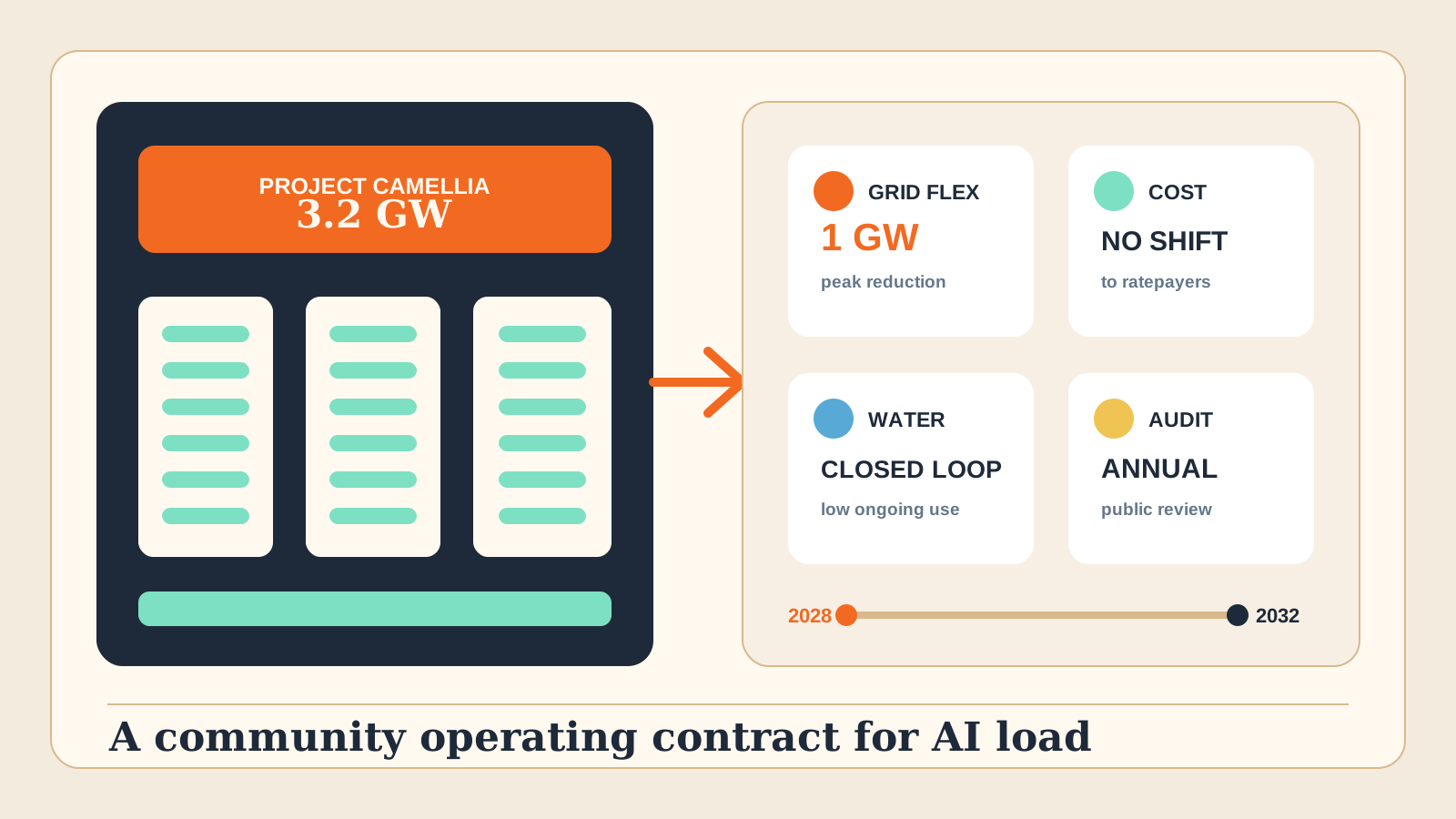
OpenAI’s Project Camellia clears the publish bar because the useful signal is not merely its size. The stronger signal is the operating package wrapped around the load. OpenAI is proposing a 3.2-gigawatt campus while publicly committing to pay the project’s infrastructure and electric-service costs, reduce demand before residential customers are affected during grid stress, limit ongoing water use, fund community benefits, and submit the commitments to an independent annual audit.
That is the original angle. In its July 22 announcement, OpenAI said Georgia Power would deliver the 3.2 gigawatts in phases between 2028 and 2032. The company said existing customers would not subsidize the project and that the campus would be designed to proactively reduce consumption during high-demand periods. The Atlanta Journal-Constitution reported that the reduction could reach 1 gigawatt at peak, which would make flexibility a material part of the campus design rather than a symbolic demand-response promise.
The real siting product is no longer just land and power. It is an enforceable operating package covering cost, curtailment, water, community benefits, and verification.
This belongs in energy and grid coverage because the most important product is not the building. It is the proposed behavior of the load. A 3.2-gigawatt customer is large enough to reshape generation, transmission, and reserve planning. If up to 1 gigawatt can reliably step down during system peaks, the campus is asking to be evaluated partly as a dispatchable operating resource. That does not erase the need for new supply and wires, but it changes the capacity profile utilities have to plan around.
The ratepayer commitment matters for the same reason. OpenAI says it will cover all infrastructure and electric-service costs required to serve the site and that Georgia Public Service Commission rules prevent those costs from being passed to existing customers. The claim will ultimately be tested in tariffs, contracts, and utility proceedings, but stating it upfront shows how quickly cost allocation has moved from a policy footnote into the core commercial proposition for AI campuses.
Water and local accountability are being packaged the same way. OpenAI says the project will use a closed-loop cooling system with ongoing water needs comparable to an office building with the same workforce. It also committed $80 million in community benefits, separate from projected taxes and student Codex credits, and promised an annual public audit by an independent firm. The proposed Georgia Community Compact is meant to convert local input into specific commitments and accountability measures.
The project economics make those commitments more than generic community-relations language. The Atlanta Journal-Constitution reported a planned $20 billion investment, a 50% property-tax abatement for 15 years, 400 permanent jobs when the site opens in 2028, and a rise to 1,000 jobs by 2032. The same report said the campus could become Effingham County’s largest taxpayer despite the abatement. Those are company and local-authority projections, not completed outcomes, but they define the bargain residents and regulators will be asked to evaluate.
This thesis is distinct from recent Grid Report coverage. Google’s Alabama expansion centered on ratepayer protection as a utility bargain, while Australia’s draft AI standards framed large-load behavior as a national policy contract. Project Camellia combines those ideas at the project level: private cost recovery, explicit peak-load reduction, low-water operations, a community-benefit fund, and annual verification attached to one named 3.2-gigawatt campus.
The operator relevance is straightforward. Developers pursuing multigigawatt sites should expect flexibility, cost allocation, water design, local benefits, and verification to become one integrated approval package. Utilities will need enforceable performance terms, not press-release promises. Communities will need the compact, tariff, audit scope, phasing plan, and enforcement mechanism before they can judge whether the protections survive construction and operation.
There are still meaningful limits. OpenAI says the project is early, with major work remaining on infrastructure, phasing, design, financing, and the operating model. The public commitment does not yet disclose the tariff mechanics, curtailment triggers, measurement rules, penalties for nonperformance, or the generation and transmission portfolio required to serve the load. Those missing details are the real diligence list.
That is enough to publish. Searchers looking up Project Camellia do not need another rewrite of a $20 billion campus announcement. The more useful answer is that hyperscale AI siting is evolving into a community operating contract—and the credibility of this project will depend on whether its grid and ratepayer promises become enforceable infrastructure terms.
Sources
OpenAI, “Building AI infrastructure with the Effingham County community,” published July 22, 2026: https://openai.com/index/building-ai-infrastructure-with-the-effingham-county-community/
The Atlanta Journal-Constitution, “Tech giant OpenAI plans to build $20 billion data center near Georgia coast,” published July 22, 2026: https://www.ajc.com/news/2026/07/tech-giant-openai-plans-to-build-20-billion-data-center-near-georgia-coast/
Axios, “OpenAI plans 3.2-gigawatt data center in Georgia,” published July 22, 2026: https://www.axios.com/2026/07/22/openai-savannah-georgia-data-center-project
By Nawaz Lalani
The Grid Report is written by Nawaz Lalani and focuses on source-backed coverage of AI infrastructure, grid power demand, automation systems, and market signals.
Follow the signal, not just the headline.
Get the daily Grid brief for source-backed coverage on AI power demand, infrastructure timing, automation, and market signals.