- Google’s June 15 Alabama expansion clears the publish bar because it addresses one of the most politically sensitive questions in the AI infrastructure cycle: what local communities get in return when a large new data-center campus asks for more power.
- That makes this an energy-grid story rather than a generic campus-growth story.
- The more useful read-through is that hyperscalers are starting to sell a local political bargain alongside compute growth.
- Section
- Energy
- Read time
- 4 min read
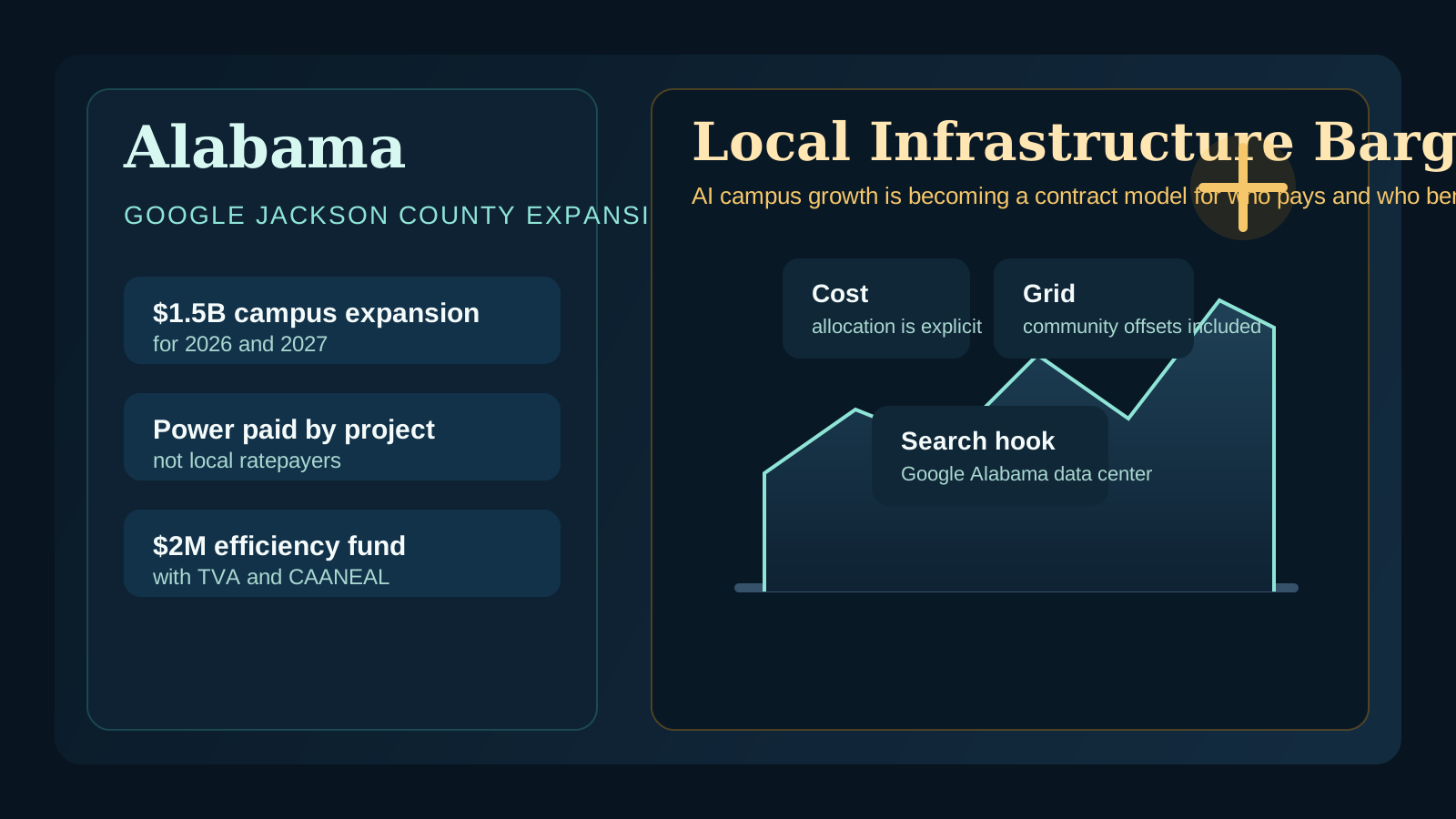
Google’s June 15 Alabama expansion clears the publish bar because it addresses one of the most politically sensitive questions in the AI infrastructure cycle: what local communities get in return when a large new data-center campus asks for more power. In its announcement, Google said it will invest $1.5 billion in 2026 and 2027 to expand its data-center campus in Jackson County, Alabama. The line that matters most is not the capital figure alone. It is Google’s claim that it is funding 100% of its own power and infrastructure costs.
That makes this an energy-grid story rather than a generic campus-growth story. Across the United States, utilities, regulators, and state lawmakers are now under pressure to show that new AI load will not simply socialize the costs of substations, wires, and supporting capacity onto existing customers. Google is trying to get ahead of that backlash by framing the project as a self-funded expansion and pairing it with a $2 million Energy Impact Fund, built with TVA and CAANEAL, to support local energy-efficiency and weatherization programs.
Google is not just expanding in Alabama. It is trying to prove that a large AI campus can come with a cleaner ratepayer story from day one.
The more useful read-through is that hyperscalers are starting to sell a local political bargain alongside compute growth. If you want to expand AI infrastructure in a region already sensitive to electricity bills, then it is no longer enough to promise jobs and tax base. You also need a credible answer on who pays for the power-side consequences. Google’s Alabama package offers a cleaner version of that answer than most campus announcements do: the company says it covers its own infrastructure and adds a visible community-side energy benefit.
This is why the Alabama site matters beyond one campus. Google says the facility has operated since 2019 on a repurposed former coal-plant site. That detail reinforces a broader pattern in the AI buildout: the winning sites are increasingly those with existing industrial power logic, not just cheap land. Reused energy sites, faster grid pathways, and stronger local utility relationships are becoming part of the competitive moat for AI capacity expansion.
Operator relevance is straightforward. Utilities and local regulators can use this as a negotiating benchmark for future large-load deals. Developers can read it as a sign that self-funding and explicit community-energy offsets may become part of the standard playbook for getting politically durable approvals. Investors should read it as evidence that the next phase of hyperscale expansion is being shaped as much by ratepayer optics and cost allocation as by chip demand.
There are still caveats. A corporate blog post is not the same thing as a full tariff filing, interconnection agreement, or public cost-of-service record. “Funding 100% of its own power and infrastructure costs” does not answer every future question about upstream grid spending, cost recovery mechanics, or how incremental system benefits and burdens are measured over time. But the statement matters precisely because companies do not make it casually. Google is signaling that the old build-first, explain-later approach is less viable in the AI power era.
That makes the story search-worthy. The useful query is not merely whether Google is expanding in Alabama. It is how large AI campus projects are beginning to structure ratepayer protection, community offsets, and self-funded power narratives to keep local political support intact.
Sources
Google, “We’re strengthening our presence in Alabama through new investments and community support,” published June 15, 2026: https://blog.google/innovation-and-ai/infrastructure-and-cloud/global-network/alabama-investment-june-2026/
Tennessee Valley Authority, homepage and mission overview, accessed June 23, 2026: https://tva.com/
Tennessee Valley Authority, “Integrated Resource Plan,” accessed June 23, 2026: https://tva.com/energy/our-power-system/integrated-resource-plan
By Nawaz Lalani
The Grid Report is written by Nawaz Lalani and focuses on source-backed coverage of AI infrastructure, grid power demand, automation systems, and market signals.
Follow the signal, not just the headline.
Get the daily Grid brief for source-backed coverage on AI power demand, infrastructure timing, automation, and market signals.