- TVA’s preliminary final 2026 integrated resource plan clears the publish bar because it moves the data-center power conversation out of generic demand rhetoric and into a live utility planning document.
- The stronger angle is not “TVA may build more gas.” That framing is too shallow to be useful.
- This belongs in the energy-grid lane because TVA sits in a part of the map that matters for the next phase of U.S.
- Section
- Energy
- Read time
- 4 min read
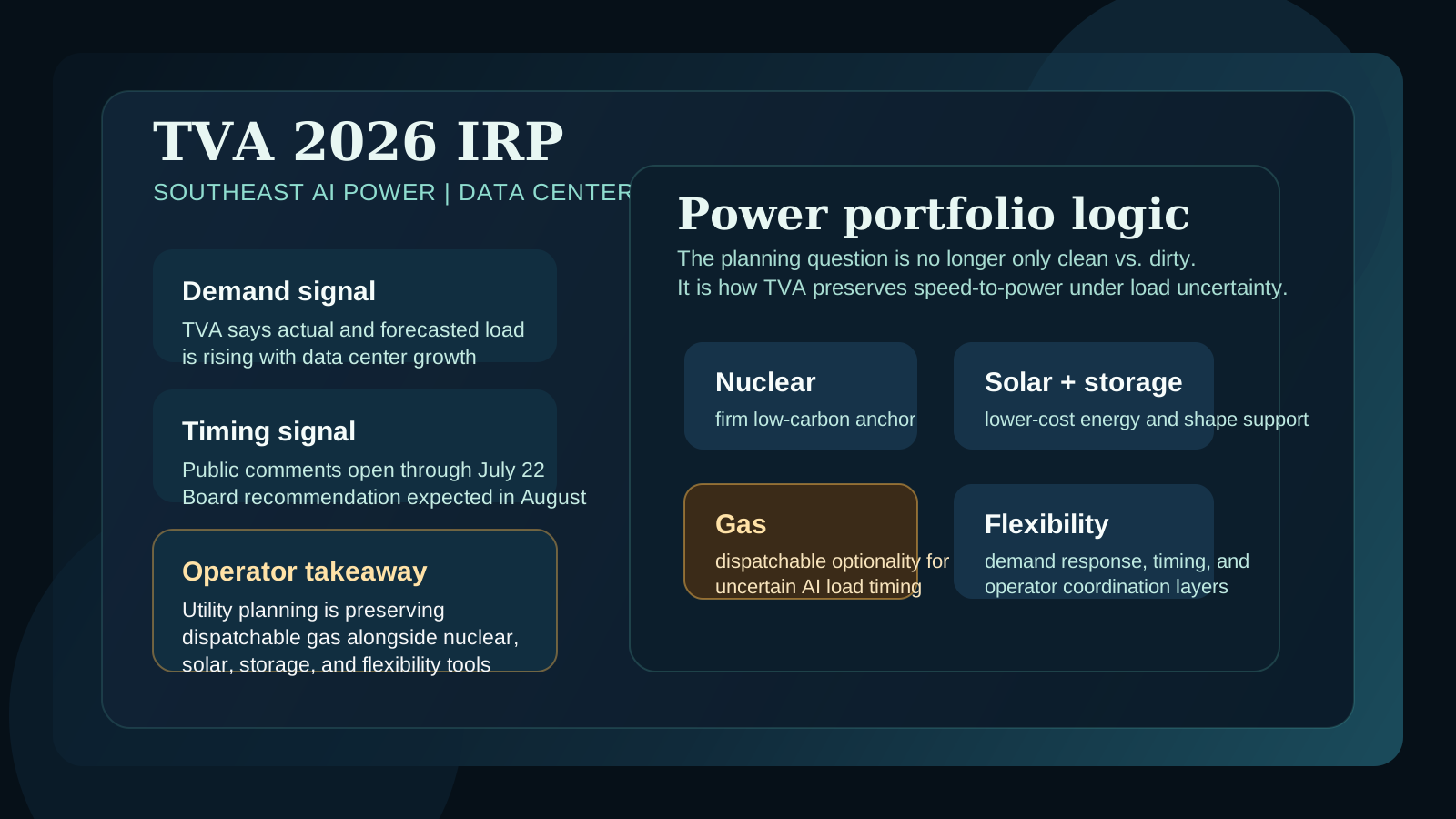
TVA’s preliminary final 2026 integrated resource plan clears the publish bar because it moves the data-center power conversation out of generic demand rhetoric and into a live utility planning document. On its IRP page, the Tennessee Valley Authority says actual and forecasted electricity demand in the Tennessee Valley continues to increase, primarily because of population growth and data center growth. That is the important signal. A major public power system in the Southeast is now naming data centers directly inside its long-range resource logic.
The stronger angle is not “TVA may build more gas.” That framing is too shallow to be useful. The better read-through is that AI-era load is pushing utilities to preserve dispatchable optionality while they still weigh nuclear, solar, storage, and demand-side tools. In other words, the real story is not a fuel headline. It is the planning premium now attached to firm, controllable capacity when large-load demand is rising faster than utilities can comfortably underwrite with one technology bet.
TVA’s new IRP matters because it shows Southeast utilities preserving dispatchable optionality as data-center demand becomes a named planning assumption.
This belongs in the energy-grid lane because TVA sits in a part of the map that matters for the next phase of U.S. data-center siting. The utility serves most of Tennessee and parts of Alabama, Georgia, Kentucky, Mississippi, North Carolina, and Virginia. When TVA changes its planning assumptions, the consequences flow through large-load negotiations, regional generation procurement, transmission strategy, and how quickly new campuses can plausibly move from announced demand to energization.
The timing also matters. TVA says comments on the preliminary final IRP and associated environmental impact statement are open through July 22, with final recommendations scheduled for the board meeting in August 2026. That means this is not a closed historical document. It is an active planning window in which utilities, industrial customers, data-center developers, and policy critics are all trying to shape what “reliable” should mean under higher AI-linked demand.
Secondary reporting has already highlighted the scale of the gas optionality under discussion. Utility Dive reported on June 23 that TVA is considering scenarios with as much as 26 gigawatts of gas-fired generation in the preliminary final plan. Even if the eventual board recommendation lands below that upper bound, the useful takeaway does not depend on the exact endpoint. What matters is that TVA is keeping a very large dispatchable range in play rather than assuming that intermittent resources and demand flexibility alone can absorb the uncertainty.
That is why this story has operator and investor relevance. For developers, the message is that Southeast speed-to-power still runs through utility comfort with firm capacity, not only through land, fiber, or a clean-power narrative. For gas and turbine suppliers, it signals that AI load is reinforcing the political and commercial case for new dispatchable build options. For policymakers and ratepayer advocates, it raises the harder question of how much optionality a public utility should procure before speculative large-load requests become real operating demand.
This also fits a broader pattern already visible across the site’s recent reporting. Texas is sorting giant loads through qualification and curtailment frameworks. PJM is turning flexibility into a capacity product. FERC is pushing large-load tariff rewrites across multiple regions. TVA adds a different but equally important layer: utility resource planning itself is being reshaped by the possibility that AI demand arrives faster, larger, and less predictably than the old load-growth playbook assumed.
There are caveats. The IRP is still preliminary, the public-comment window is open, and TVA has not published a final board-approved build list. Data-center demand forecasts also carry well-known overstatement risk because many large-load requests never convert cleanly into operating facilities. But that caveat is precisely why the gas signal matters. Utilities do not preserve large dispatchable options because the future is clear. They do it because the future is uncertain and the cost of being short on firm capacity can be politically and operationally severe.
The better conclusion is that TVA is turning Southeast AI power into a resource-optionality story. The next competition is not only over who can promise low-carbon electrons on paper. It is over which regions can offer a believable path to dependable megawatts when AI load stops looking like a forecast and starts looking like a contract.
Sources
Tennessee Valley Authority, “2026 Integrated Resource Plan,” accessed June 23, 2026: https://tva.com/environment/2026-integrated-resource-plan
Utility Dive, “TVA considers up to 26 GW of gas-fired generation,” published June 23, 2026: https://www.utilitydive.com/news/tva-proposes-7-to-26-gw-natural-gas-2026-irp/823520/
By Nawaz Lalani
The Grid Report is written by Nawaz Lalani and focuses on source-backed coverage of AI infrastructure, grid power demand, automation systems, and market signals.
Follow the signal, not just the headline.
Get the daily Grid brief for source-backed coverage on AI power demand, infrastructure timing, automation, and market signals.