AI Power Demand Hub

AI Power Demand: forecasts, load growth, and what the grid can actually absorb

A focused reading path for understanding AI electricity demand, data-center load forecasts, utility planning pressure, and the difference between announced capacity and energized capacity.

Core question

How much AI load is real, where does it show up, and what has to happen before it becomes usable capacity?

Power infrastructure and generation assets representing why AI electricity demand is now best understood as a planning range rather than a single forecast number
Start with this

The AI Power Forecast Is Now a Planning Range, Not a Single Number

The strongest AI electricity story is no longer one scary demand estimate. It is the spread between scenarios. IEA says global data center electricity use could nearly double by 2030, while EIA expects U.S. power demand to keep rising as large computing facilities expand. The operating question is which projects become real load, where they land, and whether the grid can stage capacity fast enough.

Read the anchor story
Read article: How Much Electricity Does AI Actually Use in 2026?Energy GridUtility grid infrastructure representing the core question of how much electricity AI and data centers are consuming in 2026 and where that demand is landing
Energy GridMay 13, 20267 min read

How Much Electricity Does AI Actually Use in 2026?

The honest answer is no longer “a lot” or “not that much.” AI electricity use is rising quickly, but the real story depends on the difference between training and inference, how much load lands in data centers, and how fast grids can absorb new demand.

Read article: Will Your Electricity Bill Go Up Because of AI?Energy GridResidential electricity meter and utility equipment mounted on the outside of a home
Energy GridMay 13, 20267 min read

Will Your Electricity Bill Go Up Because of AI?

The uncomfortable answer is yes in some places, but not in the simple way most people assume. Household bills are more likely to rise when utilities socialize new infrastructure costs, when capacity-market rules price in projected AI load early, or when local grid bottlenecks force expensive upgrades.

Read article: EIA’s May Forecast Shows Commercial Power Demand Becoming the AI BottleneckMarketsElectrical transmission corridor and power lines across an industrial landscape
MarketsMay 14, 20266 min read

EIA’s May Forecast Shows Commercial Power Demand Becoming the AI Bottleneck

The latest EIA forecast does not frame data centers as a side note. It shows commercial electricity demand leading growth, residential prices still rising, and data-center measurement becoming a policy problem in its own right.

Read article: Virginia’s Data Center Power Surge Is Now Showing Up in Electricity SalesMarketsTransmission infrastructure representing Virginia’s data-center boom now showing up in electricity sales and utility load forecasts
MarketsMay 7, 20266 min read

Virginia’s Data Center Power Surge Is Now Showing Up in Electricity Sales

The AI power story is getting easier to see in public data. EIA says Virginia commercial electricity sales have jumped sharply in recent years, driven by data centers, while PJM expects Dominion load growth to dominate the next wave of summer peak increases.

Read article: AI Is No Longer Just a Software Story. It Is Becoming a Power and Infrastructure Story.InfrastructureLarge network of overhead power lines and electrical infrastructure
InfrastructureApril 3, 20266 min read

AI Is No Longer Just a Software Story. It Is Becoming a Power and Infrastructure Story.

The next phase of AI growth will not be shaped only by smarter models. It will also depend on electricity demand, data center buildout, and who can actually support large-scale compute.

Latest in this lane

Fresh related reporting for faster context

Browse the archive
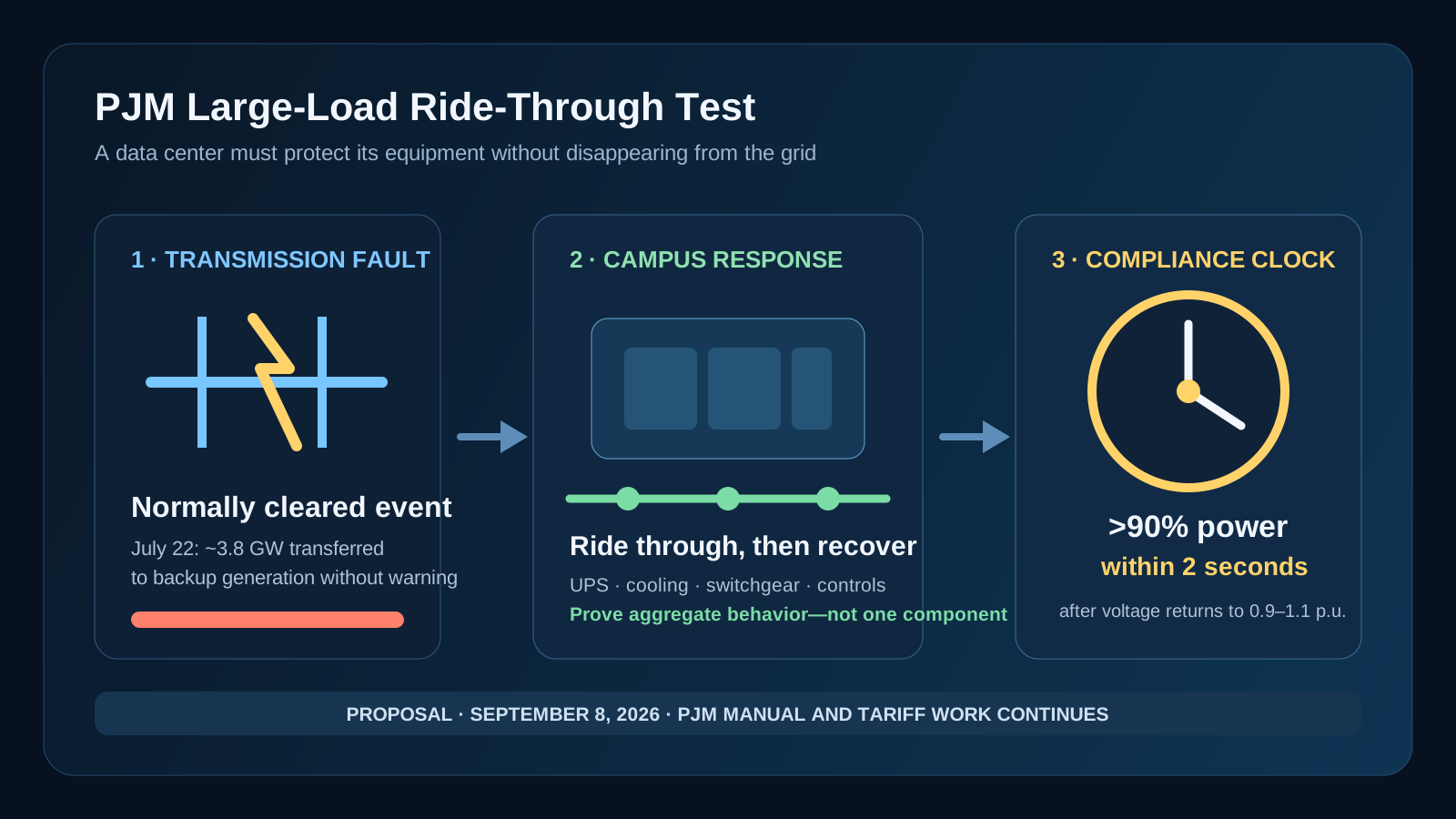
Read article: PJM’s Data-Center Load-Drop Risk Turns AI Power Quality Into a Grid-Contract ProblemEnergy GridEditorial graphic showing a PJM transmission line fault, a large AI data center dropping load to backup power, grid-frequency and voltage disturbance indicators, and a new contract layer for ride-through, telemetry, reactive support, and control settings
Energy GridJuly 24, 20264 min read

PJM’s Data-Center Load-Drop Risk Turns AI Power Quality Into a Grid-Contract Problem

This July 24, 2026 story clears the publish bar because it is not another broad article about AI power demand. The stronger signal is that grid operators are being forced to care about how hyperscale AI loads behave during faults, not just how many megawatts they want. In practice, that pushes data-center siting toward a new contract stack around ride-through, dynamic models, reactive support, monitoring, and backup-power coordination.

Read article: GE Vernova’s Q2 Turns AI Power Into a Turbine-Slot and Grid-Equipment QueueEnergy GridEditorial graphic showing GE Vernova gas turbine slots, data center power demand, transformer and switchgear backlog, and a sold-through timeline stretching into 2031
Energy GridJuly 23, 20264 min read

GE Vernova’s Q2 Turns AI Power Into a Turbine-Slot and Grid-Equipment Queue

GE Vernova’s July 22, 2026 results clear the publish bar because this is not just another industrial earnings beat. The stronger signal is that AI power buildout is hardening into a manufacturing queue for gas turbines, transformers, and switchgear, which means power readiness now depends as much on equipment-slot timing as on land, interconnection, and capital.

Read article: OpenAI’s Project Camellia Turns 3.2 GW of AI Load Into a Community Operating ContractEnergy GridEditorial graphic showing OpenAI Project Camellia in Georgia connected to 3.2 gigawatts of phased power, one gigawatt of demand reduction, ratepayer protections, closed-loop cooling, and an independent annual audit
Energy GridJuly 22, 20264 min read

OpenAI’s Project Camellia Turns 3.2 GW of AI Load Into a Community Operating Contract

OpenAI’s July 22, 2026 plan for Project Camellia clears the publish bar because it does more than announce another giant campus. The stronger grid signal is the operating package around the 3.2-gigawatt load: full infrastructure cost recovery, up to 1 gigawatt of peak demand reduction, closed-loop cooling, community benefits, and an independent annual audit.

Why this hub matters

Topic hubs turn daily coverage into authority.

Each hub gives readers and search engines a durable map of the strongest Grid Report coverage in a lane. New articles can link back here, and this page can link forward to the latest source-backed reporting, charts, and market context.