- Virginia’s June 2026 budget deal clears the publish bar because it does something more durable than produce another argument about whether data centers are popular or unpopular.
- The official budget language is unusually specific.
- That is why this belongs in the markets lane.
- Section
- Markets
- Read time
- 5 min read
Virginia’s June 2026 budget deal clears the publish bar because it does something more durable than produce another argument about whether data centers are popular or unpopular. The Commonwealth is now set to levy a statewide electricity consumption tax on data centers in the largest server market in the United States. The operator-grade takeaway is that AI site selection is gaining a new cost layer that sits directly on top of the power bill.
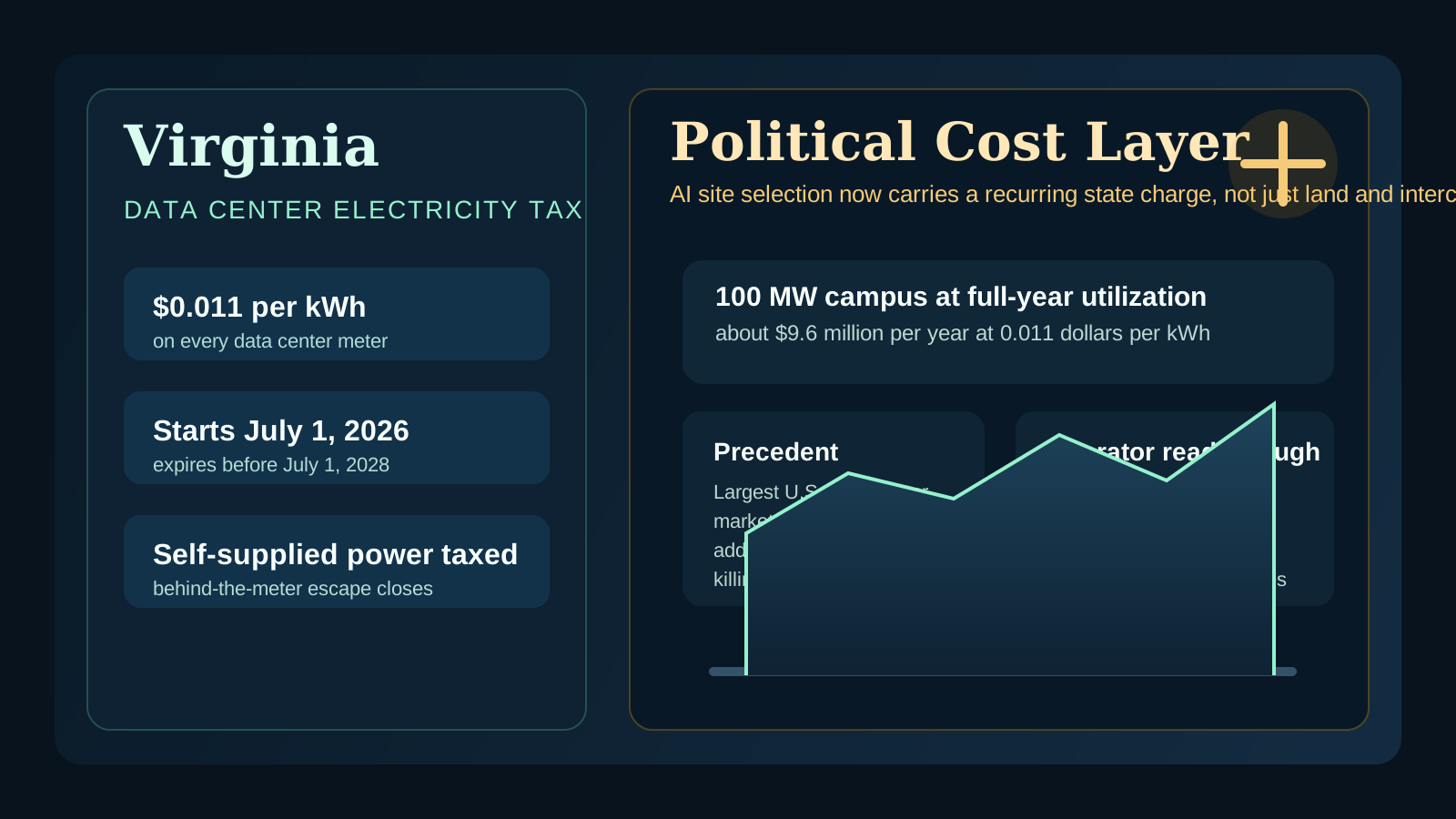
The official budget language is unusually specific. Under the conference report for House Bill 30, Virginia will impose a data center electricity consumption tax of $0.011 per kilowatt-hour on all electricity consumed at each data center beginning July 1, 2026 and before July 1, 2028. The state estimates the tax will generate up to $600 million per year. Governor Abigail Spanberger described it on June 23 as the first statewide energy consumption tax on data centers anywhere in America.
Virginia’s new data center tax matters because it adds a recurring political cost directly onto the power stack, including self-supplied electricity.
That is why this belongs in the markets lane. The important question is not whether the tax is politically clever. It is how quickly a recurring per-kWh charge becomes part of every serious site-selection model. Power was already the binding constraint in many AI builds. Virginia is now showing that politics can become a direct operating-cost variable too.
The detail that matters most is scope. The budget text says the tax applies regardless of whether electricity is supplied by an incumbent utility, a competitive provider, or is self-supplied. In plain English, behind-the-meter generation is not an easy way around it. If an operator was hoping that captive gas, private-wire arrangements, or other self-supplied structures would avoid the new charge, the budget language points the other way.
The math gets material quickly at AI scale. A 100-megawatt campus running near full-year utilization would consume roughly 876 million kilowatt-hours in a year. At $0.011 per kilowatt-hour, that implies about $9.6 million in annual tax expense before any refund mechanism. At one gigawatt, the same arithmetic points toward roughly $96 million. Those are back-of-the-envelope figures, not state guidance, but they are large enough to matter in power-stack planning, lease pricing, and return thresholds.
The stronger read-through is not that Virginia suddenly became hostile to data centers. In the same budget package, lawmakers also ordered a 2026 interim study of the state’s sales-and-use-tax exemption and broader data-center impacts, including incentives, environmental effects, utility agreements, water usage, and ways to generate direct revenue from the industry. This looks less like a shutdown move than a rewiring of the state bargain: keep the machine running, but extract a clearer cash return from the load growth it creates.
That matters far beyond Virginia because precedent is the real asset here. If the biggest U.S. data-center market can impose a statewide electricity tax without immediately walking away from the industry, other states now have a template. The next debate in AI infrastructure will not only be who has land, fiber, and substations. It will also be which states decide that hyperscale load should fund public budgets more explicitly.
For operators and investors, the implication is narrower than the headlines. This tax alone probably does not reroute every major campus, because energization timing and available capacity still dominate most decisions. But it does weaken the idea that once power is secured, the economics are mostly stable. A state can now move the operating stack after the fact and can do it in a way that reaches both utility-supplied and self-generated electricity.
There are caveats. The tax is temporary under the current language, collections above $600 million flow into a refund structure, and the state still has more to decide during the 2026 interim study. But that does not make the signal weak. It makes the signal clearer: the politics of AI power demand are maturing into direct fiscal policy.
That is enough to publish. The better search-worthy angle is not “Virginia taxes data centers.” It is that Virginia has turned AI site economics into a live political-cost calculation, and once the largest market does that, every other statehouse gets permission to consider the same move.
Sources
Virginia General Assembly state budget portal, House Bill 30 conference report Item 3-5.24 #1c, “Data Center Electricity Consumption Tax,” accessed June 23, 2026: https://budget.lis.virginia.gov/amendment/2026/2/HB30/Introduced/CR/3-5.24/1c/
Virginia General Assembly state budget portal, House Bill 30 conference report Item 1 #7c, “Joint Subcommittee on Tax Policy Study on Data Centers,” accessed June 23, 2026: https://budget.lis.virginia.gov/amendment/2026/2/HB30/Introduced/CR/1/7c/
Governor Abigail Spanberger, “Governor Spanberger Statement on Passage of Virginia’s Budget,” published June 23, 2026: https://www.governor.virginia.gov/newsroom/news-releases/2026/june-releases/name-1119973-en.html
By Nawaz Lalani
The Grid Report is written by Nawaz Lalani and focuses on source-backed coverage of AI infrastructure, grid power demand, automation systems, and market signals.
Follow the signal, not just the headline.
Get the daily Grid brief for source-backed coverage on AI power demand, infrastructure timing, automation, and market signals.