- Alphabet’s July 22 second-quarter results clear the publish bar because they say something more useful than “big tech is spending heavily on AI.” The stronger signal is financial structure.
- That is the original angle.
- This belongs in markets rather than a generic AI or infrastructure lane because the useful question is not whether Google wants more compute.
- Section
- Markets
- Read time
- 4 min read
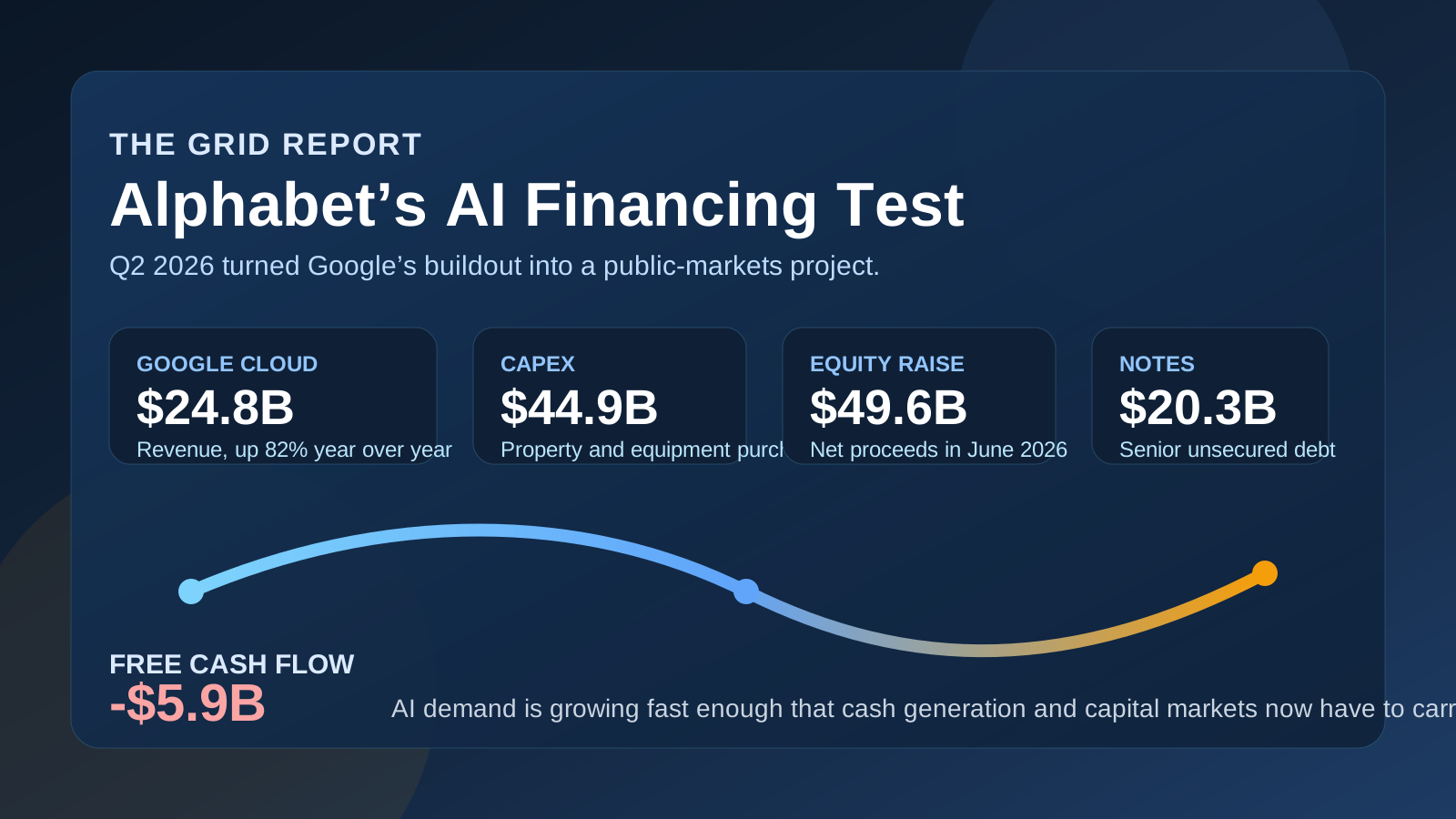
Alphabet’s July 22 second-quarter results clear the publish bar because they say something more useful than “big tech is spending heavily on AI.” The stronger signal is financial structure. Google is now carrying AI infrastructure as an openly financed buildout, where cloud demand, capex intensity, equity issuance, debt issuance, and cash-generation pressure all have to be judged together rather than as separate headlines.
That is the original angle. Alphabet reported $119.8 billion of quarterly revenue, Google Cloud revenue of $24.8 billion growing 82% year over year, and Google Cloud operating income of $8.8 billion. But the more revealing numbers sit lower in the release. Purchases of property and equipment reached $44.9 billion in the quarter, free cash flow turned negative $5.9 billion, the company raised $49.6 billion of net equity proceeds in June, and it issued $20.3 billion of senior unsecured notes in the second quarter. Read correctly, this is not only a growth quarter. It is a financing quarter.
Alphabet’s quarter mattered because AI infrastructure stopped looking like a background capex line and started looking like a public financing project.
This belongs in markets rather than a generic AI or infrastructure lane because the useful question is not whether Google wants more compute. That part is obvious. The sharper question is what public investors are now being asked to underwrite. Alphabet is effectively telling the market that AI infrastructure is important enough to justify extraordinary capital absorption before the payoff is fully matured in reported cash generation.
The numbers make that logic hard to ignore. Cloud is no longer growing like a normal enterprise-software segment. It is behaving like a demand sink for AI infrastructure, with enterprise AI solutions, enterprise AI infrastructure, and TPU system sales all driving the step-up. That gives Alphabet a credible operating reason to keep spending. But it also means the company is converting the AI race into a balance-sheet and capital-markets exercise rather than a simple margin story.
The June equity raise is the clearest tell. Alphabet said the combined Class A, Class C, and mandatory convertible preferred issuance produced $49.6 billion of net proceeds for general corporate purposes, including capital expenditures to scale AI infrastructure and global compute. It also disclosed a new at-the-market program for up to $40 billion of additional Class A and Class C stock, even though none had been sold as of June 30. That is not how a company behaves when it thinks AI expansion can be funded quietly inside ordinary operating cash flow.
This also clears the duplicate screen against the site’s last 30 days. Google’s Steel River project was about power procurement as a community grid product. Google’s 37% electricity jump was about decarbonization pressure from AI growth. Microsoft’s Wisconsin campus story was about operations-proof for hyperscale buildout. This thesis is materially different. The sharper question here is what happens when one of the world’s strongest balance sheets starts using equity and debt markets more explicitly to carry the AI build cycle.
The investor relevance is straightforward. AI exposure inside megacap tech is becoming less about who can announce the largest campus or model and more about who can keep financing infrastructure without losing market confidence. Alphabet’s quarter suggests the next valuation debate will turn on whether investors view this spending as disciplined demand capture or as a capital sink that outruns monetization.
The operator relevance matters too. If Google is willing to fund AI capacity this aggressively, suppliers across chips, power equipment, networking, construction, and utilities are being given a stronger signal that demand is not hypothetical. The financing structure itself becomes part of the procurement signal. Vendors can plan around a customer that is not merely talking about AI demand, but actively recapitalizing to support it.
There are still limits. A huge chunk of net income came from unrealized equity gains, not only operating performance, and one quarter does not settle the long-term return profile of AI capex. But those caveats do not weaken the main read-through. They sharpen it: Alphabet is now one of the clearest public examples of AI infrastructure being financed as a live capital-markets project, not just an internal R&D expansion.
That is enough to publish. Searchers looking up Alphabet’s Q2 results do not need another generic earnings story about cloud growth and AI momentum. The more useful answer is that Google has become a real-time financing test for the AI buildout, and that matters for investors, suppliers, and every other hyperscaler being judged against the same capital curve.
Sources
Alphabet, “Alphabet Announces Second Quarter 2026 Results,” published July 22, 2026: https://abc.xyz/investor/news/news-details/2026/Alphabet-Announces-Second-Quarter-2026-Results-2026-Y3uQ6H4ZJa/default.aspx
Alphabet, “Alphabet Announces Second Quarter 2026 Results” PDF, published July 22, 2026: https://s206.q4cdn.com/479360582/files/doc_financials/2026/q2/2026q2-alphabet-earnings-release.pdf
Associated Press, “Google’s Q2 earnings of $112.11B beat Wall Street’s expectations on AI boom,” published July 22, 2026: https://apnews.com/article/f914606d842d4c6848019083d667fc3a
By Nawaz Lalani
The Grid Report is written by Nawaz Lalani and focuses on source-backed coverage of AI infrastructure, grid power demand, automation systems, and market signals.
Follow the signal, not just the headline.
Get the daily Grid brief for source-backed coverage on AI power demand, infrastructure timing, automation, and market signals.