- Google’s July 14 Steel River announcement clears the publish bar because it says more than “big tech bought more clean energy.” Google said it will act as both anchor investor and offtaker for the first two phases of the Steel River Energy Center in Arkansas.
- That scale alone would make the release notable.
- This is why the story belongs in energy-grid rather than generic sustainability coverage.
- Section
- Energy
- Read time
- 4 min read
- Data included
- Steel River bundles power, politics, and local economics into one AI-era energy package
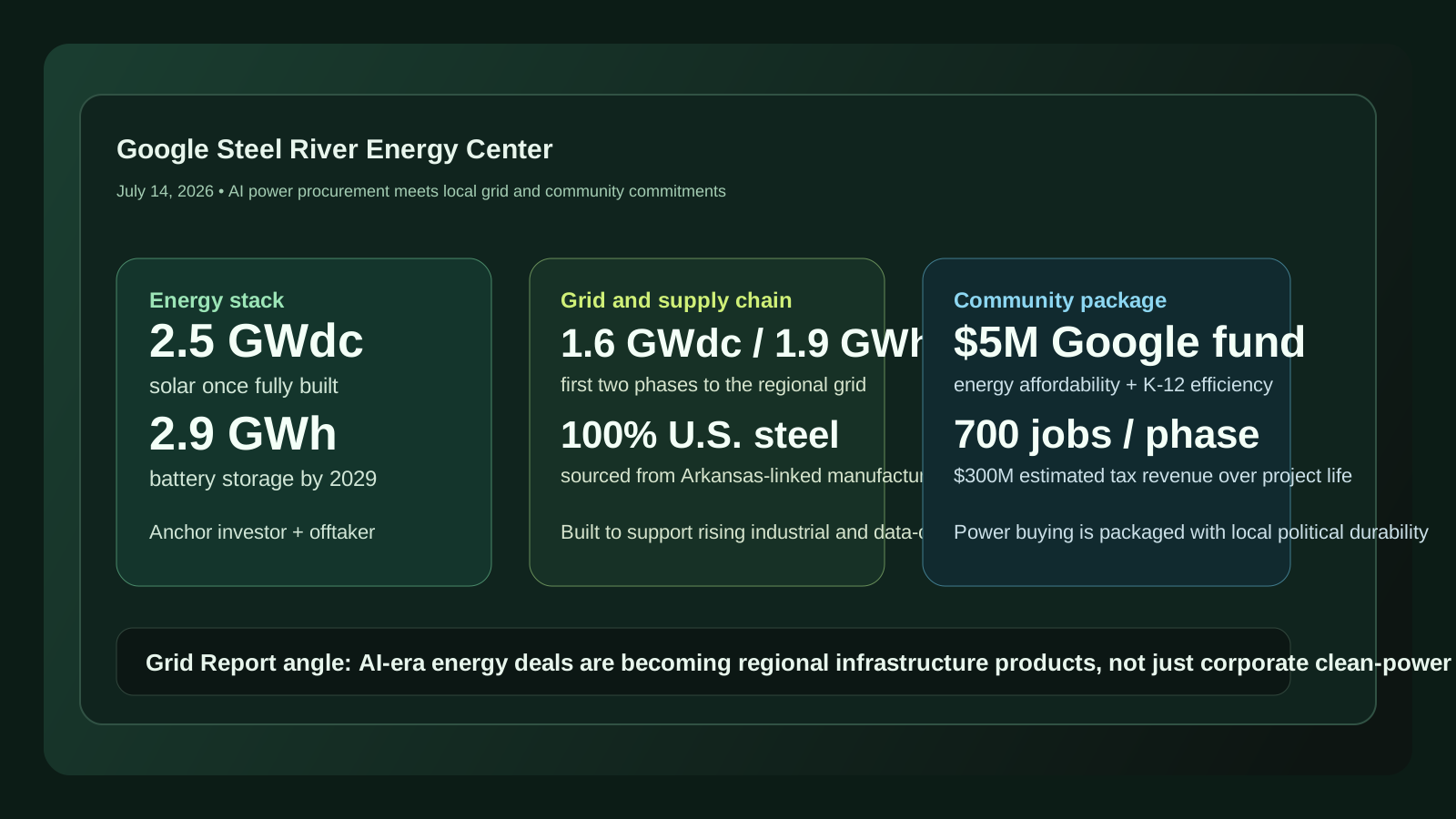
Steel River bundles power, politics, and local economics into one AI-era energy package
The deal is notable because the physical power stack and the community-benefit stack are being presented as one product.
| Layer | What Google and Cypress Creek announced | Why it matters |
|---|---|---|
| Energy stack | 1.6 GWdc solar + 1.9 GWh storage in the first two phases; 2.5 GWdc + 2.9 GWh at full buildout | Shows AI-power procurement moving toward large physical supply additions, not only paper claims. |
| Grid story | Storage will shift daytime output into periods when the grid needs it most | Frames the project as reliability support, not only a clean-energy badge. |
| Community package | $5 million from Google for affordability and school efficiency within a broader $8 million local fund | Gives the project a political and social-benefit layer around AI-related load growth. |
| Industrial framing | Arkansas steel, American-made components, and 700 construction jobs per phase | Ties the energy deal to domestic supply-chain and regional development arguments. |
Sources: Google and Cypress Creek announcements published July 14, 2026.
Google’s July 14 Steel River announcement clears the publish bar because it says more than “big tech bought more clean energy.” Google said it will act as both anchor investor and offtaker for the first two phases of the Steel River Energy Center in Arkansas. Those first phases add 1.6 GWdc of solar generation and 1.9 GWh of battery storage to the regional grid, while the full three-phase project is designed to reach 2.5 GWdc of solar and 2.9 GWh of storage by 2029.
That scale alone would make the release notable. But the stronger angle is structural. Google is packaging the deal as a grid product, a domestic-manufacturing story, and a local political-acceptance story at the same time. Its post says Steel River can store peak daytime solar output and feed it back into the grid when needed most to help meet rising electricity demand while keeping power affordable. Cypress Creek adds the local development framing: approximately 700 construction jobs per phase, an estimated $300 million in lifetime local tax revenue, and a combined $8 million in community investment funds, including Google’s $5 million for energy affordability and K-12 efficiency work in Arkansas.
The next hyperscaler power deal needs more than megawatts. It needs a grid story, a local-benefit story, and a political story that can hold together.
This is why the story belongs in energy-grid rather than generic sustainability coverage. The important signal is not only megawatts. It is that hyperscaler power procurement is being tied directly to grid support, storage timing, local cost relief, and domestic supply-chain language. In practical terms, the buyer is no longer just securing attributes on paper. It is helping build a regional energy package that is easier to defend politically while AI load keeps climbing.
That makes the story different from the site’s earlier Google coverage. The June 2 Voltus piece was about buying flexible capacity around PJM through aggregated demand response. The July 14 Steel River package is about adding a much larger block of physical generation and storage while explicitly bundling community benefits and local manufacturing into the same narrative. It is a different layer of the same power strategy.
The original read-through is that AI-era energy procurement is becoming an infrastructure-governance product. If a hyperscaler wants faster, bigger power deals to stick, it increasingly needs more than clean-energy volume. It needs storage, a local jobs story, a grid-reliability story, and some answer to the question of who in the surrounding community benefits. Google and Cypress Creek are trying to put all of those into one structure.
There are limits. Steel River is scheduled through 2029, so it does not solve every near-term data-center power bottleneck. It is also still a corporate-framed release, not an independent audit of how the project will affect local rates or Google’s wider load profile. But those caveats do not weaken the main signal. They sharpen it. This is what a more politically durable AI-power deal now looks like.
The reason this can help search is that people looking up Steel River need more than size rankings. The more useful answer is that Google is turning a power deal into a broader regional infrastructure product where the energy stack, the supply chain, and the community package all matter to AI buildout.
Sources
Google, “Our largest solar and battery storage project ever,” published July 14, 2026: https://blog.google/innovation-and-ai/infrastructure-and-cloud/global-network/steel-river-arkansas/
Cypress Creek Energy, “Cypress Creek and Google Break Ground on America’s Largest Solar Project,” published July 14, 2026: https://cypresscreekenergy.com/news/steel-river-groundbreaking/
By Nawaz Lalani
The Grid Report is written by Nawaz Lalani and focuses on source-backed coverage of AI infrastructure, grid power demand, automation systems, and market signals.
Follow the signal, not just the headline.
Get the daily Grid brief for source-backed coverage on AI power demand, infrastructure timing, automation, and market signals.