- PJM's July 10 after-action update clears the publish bar because it changes the early-July heat wave from an alert story into a harder capacity-planning signal.
- That number matters because it was not a clean victory lap.
- The planning read-through is sharper than the headline record.
- Section
- Energy
- Read time
- 5 min read
- Data included
- PJM's July 2 record was served by an operating stack
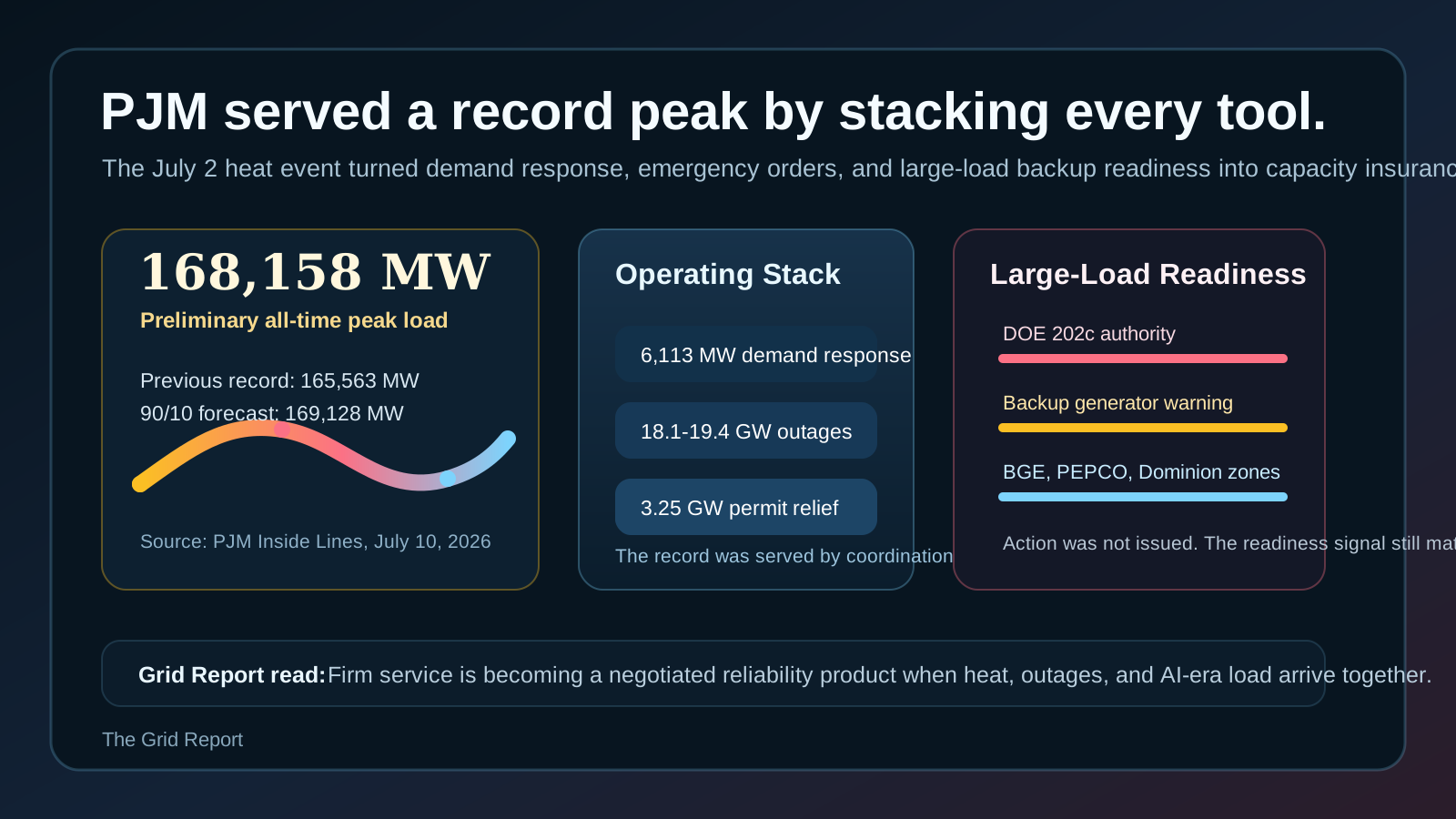
PJM's July 2 record was served by an operating stack
The after-action signal is that demand response, outage management, emergency orders, and backup-generation readiness all mattered at once.
| Operating signal | PJM July 2026 figure | Why it matters |
|---|---|---|
| Preliminary peak load | 168,158 MW between 5 and 6 p.m. on July 2 | The event topped PJM's prior 165,563 MW record from Aug. 2, 2006. |
| 90/10 planning case | 169,128 MW seasonal forecast | Actual operations came close to a one-in-ten planning scenario. |
| Emergency demand response | About 6,113 MW on July 2 and 5,037 MW on July 3 | Flexible demand materially changed the load PJM had to serve. |
| Forced generation outages | 18.1 GW to 19.4 GW from July 2 through July 4 | Outages ran above the recent top-summer-peak average while demand was setting records. |
| Emergency generation relief | About 3.25 GW of units operated beyond environmental permit limits | The system needed temporary authority to maximize available supply. |
| Large-load backup warning | Warning issued for BGE, PEPCO, and Dominion zones; action not issued | Data centers and other backup-equipped loads are now part of the emergency readiness stack. |
Sources: PJM Inside Lines July 10 after-action post, PJM July 9 Operating Committee presentation, and DOE 202c emergency orders linked by PJM.
PJM's July 10 after-action update clears the publish bar because it changes the early-July heat wave from an alert story into a harder capacity-planning signal. The grid operator says July 2 reached a preliminary all-time peak load of 168,158 MW between 5 and 6 p.m., once demand response is factored back into the load the system would otherwise have needed to serve.
That number matters because it was not a clean victory lap. PJM says the region saw its hottest-ever RTO average air temperature at 97 degrees, forced generation outages ran between 18,100 MW and 19,400 MW from July 2 through July 4, and emergency demand response performance was estimated at about 6,113 MW on July 2 and 5,037 MW on July 3. In other words, the record was served by an operating stack, not by spare capacity sitting comfortably on the shelf.
PJM did not just set a new peak-load record. It showed that demand response and large-load flexibility are becoming capacity insurance for an AI-era grid.
The planning read-through is sharper than the headline record. PJM said the July 2 load approached its 90/10 seasonal forecast of 169,128 MW, a one-in-ten planning case. That means a low-probability planning scenario effectively showed up in real operations while the region was also managing higher-than-average forced outages. For utilities, large-load customers, and regulators, that is a warning about the gap between forecast comfort and operating reality.
This is distinct from the earlier Grid Report piece on PJM preparing data-center and large-load backup generation. That July 8 article focused on the live curtailment signal. The July 10 update adds the after-action accounting: how much demand response was called, how high forced outages ran, how close the event came to the 90/10 forecast, and how much emergency authority had to sit behind the dispatch room.
The DOE 202c orders are the bridge to the AI power story. PJM says it received temporary environmental-permit relief for generating units and separately received emergency authority to direct transmission owners, as a last resort, to curtail data centers and other large loads equipped with backup generation. PJM also says it issued an Emergency Use of Backup Generator Warning for BGE, PEPCO, and Dominion zones, though the actual action was never needed.
That is the important operator question now: if record heat increasingly requires demand response, permit relief, emergency procedures, and optional large-load backup generation, what kind of new load deserves firm service at ordinary terms? AI data centers that can reduce load, bring generation, or tolerate emergency switching are becoming easier to fit into the reliability bargain than rigid load that simply assumes the bulk system will be ready.
The market implication is not that PJM failed. It is that PJM succeeded in a way that exposed the future product. Capacity is no longer just megawatts on a planning reserve spreadsheet. It is dispatchable generation, demand response performance, transmission-zone constraints, emergency permissions, and contractual load flexibility all working at the same time.
That gives the story search value. Readers looking up PJM's record July 2026 load do not only need the 168,158 MW figure. The more useful answer is that the record turned demand response and large-load flexibility into visible capacity insurance for a region where new supply is still struggling to keep pace with demand growth.
Sources
PJM Inside Lines, "PJM Serves Load Through Record-Breaking July Heat," published July 10, 2026: https://insidelines.pjm.com/pjm-serves-load-through-record-breaking-july-heat/
PJM Operating Committee presentation, "Hot Weather Update," presented July 9, 2026: https://www.pjm.com/-/media/DotCom/committees-groups/committees/oc/2026/20260709/20260709-item-04---hot-weather-update---presentation.pdf
U.S. Department of Energy Order No. 202-26-32, temporary emergency generation order linked by PJM: https://www.pjm.com/-/media/DotCom/documents/ferc/orders/2026/20260630-doe-order-no-202-26-32.pdf
U.S. Department of Energy Order No. 202-26-33, emergency order for data centers and other large loads with backup generation linked by PJM: https://www.pjm.com/-/media/DotCom/documents/ferc/orders/2026/20260630-doe-order-no-202-26-33.pdf
By Nawaz Lalani
The Grid Report is written by Nawaz Lalani and focuses on source-backed coverage of AI infrastructure, grid power demand, automation systems, and market signals.
Follow the signal, not just the headline.
Get the daily Grid brief for source-backed coverage on AI power demand, infrastructure timing, automation, and market signals.