- PJM’s June 24 emergency-procedures update clears the publish bar because it turns a temporary reliability tactic into a formal operating tool.
- That is the stronger Grid Report angle.
- The procedural detail matters.
- Section
- Energy
- Read time
- 5 min read
- Data included
- Where PJM inserted large-load backup generation in the emergency stack
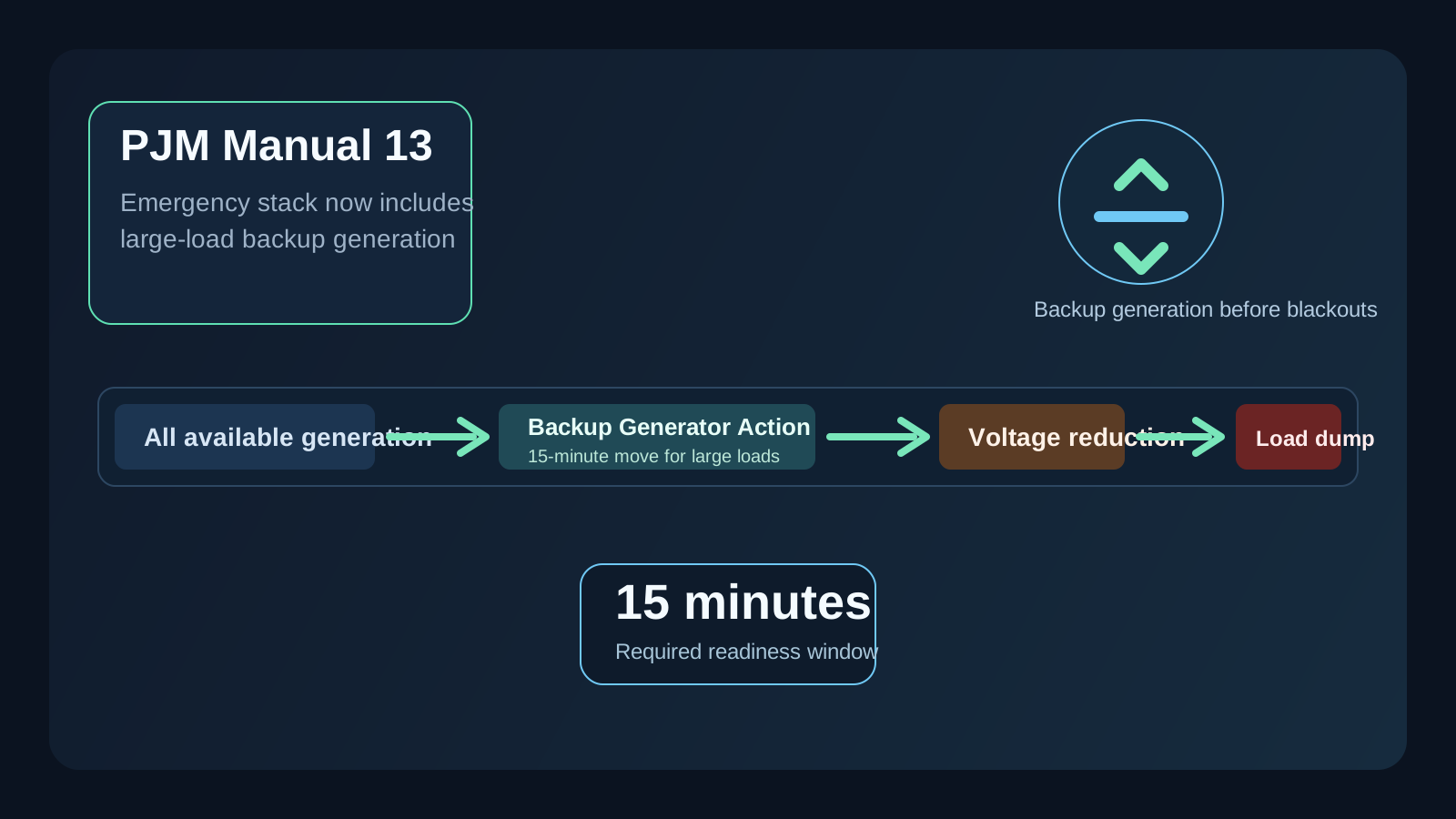
Where PJM inserted large-load backup generation in the emergency stack
The useful signal is not just that backup generation exists. It is where PJM now places it in the reliability sequence.
| Emergency stage | What PJM says happens | Why it matters |
|---|---|---|
| Available supply and load management | PJM exhausts available generation resources and load-management actions first | Keeps the new step framed as an escalation tool rather than a routine demand program. |
| Backup Generator Action | Certain large loads must be prepared to move to backup generation within 15 minutes | Turns some data centers and industrial loads into formal reliability participants before broad public service reductions start. |
| Voltage Reduction Warning | PJM moves next toward system-wide conservation and voltage actions if needed | Shows the backup-generation step is intended to protect ordinary customers from earlier, wider interventions. |
| Manual Load Dump Warning | PJM can still escalate to direct outages if conditions keep worsening | Confirms the new tool does not eliminate risk; it tries to buy time and reduce the chance of broader outages. |
| Immediate effective date | Stakeholders endorsed the Manual 13 revisions on June 24 and PJM said they became effective immediately | Signals that the rule change is operational now, not a distant planning concept. |
Source context: PJM Inside Lines June 24, 2026 update on Manual 13, plus DOE Order No. 202-26-23 background on earlier temporary backup-generation authority.
PJM’s June 24 emergency-procedures update clears the publish bar because it turns a temporary reliability tactic into a formal operating tool. The grid operator said stakeholders approved changes to Manual 13 that expand emergency procedures to better coordinate with Generation and Transmission Owners and, more importantly, add a Backup Generator Action that can require certain data centers and other large loads to move onto backup generation as a last resort before broader customer outages.
That is the stronger Grid Report angle. The useful story is not simply that reserve margins are tight or that summer reliability is getting harder. The real signal is that large loads are being written directly into the emergency stack. PJM is no longer treating some backup-equipped data centers only as passive demand that stresses the system. In emergency conditions, those sites can become dispatchable reliability assets whose operating posture affects whether the region gets to stop at a targeted intervention or has to move on to voltage reduction and manual load dump.
PJM is no longer treating some backup-equipped large loads only as demand. In emergency conditions, they now sit inside the formal pre-blackout reliability sequence.
The procedural detail matters. PJM said the Manual 13 revisions were endorsed at the June 24 Markets and Reliability Committee meeting and became effective immediately. The new Backup Generator Action would require large loads to be prepared to move to backup generation within 15 minutes. PJM also said the step would only be called after all available generation resources and load management were exhausted, and before a Voltage Reduction Warning or Manual Load Dump Warning is issued. That placement in the sequence is what makes the story search-worthy. It tells operators exactly where these facilities now sit in the grid’s escalation ladder.
This is not appearing out of nowhere. The June 24 move builds on the Department of Energy’s temporary May 18 emergency order, which authorized PJM to deploy backup generation resources at data centers and other major facilities through May 20. That order was short-lived. The more durable development is that PJM is now integrating a similar concept into its standing emergency procedures instead of leaving the idea as a one-off crisis tool tied only to a federal emergency authorization window.
Operator relevance is immediate. A site with backup generation has usually been discussed as a resilience feature for that customer. PJM’s update suggests a broader role: backup generation can also become part of the regional reliability choreography when margins get thin enough. For data-center developers, utilities, and tenants, that changes what “backup-ready” may mean in practice. It is not only a facility uptime decision. It is increasingly part of the system operator’s toolbox.
This also creates a sharper separation inside the AI power story. One branch is still about interconnection queues, new generation, and long-term cost allocation. Another is about real-time operating flexibility when the system is stressed. PJM’s Manual 13 revision belongs to the second branch. It says some large loads are now close enough to the reliability edge that their backup assets must be integrated into formal emergency operating instructions, not just into private contingency planning.
There are reasons not to overstate the conclusion. PJM did not say every large load qualifies, the action is explicitly framed as a last resort, and the actual usefulness of backup generation depends on site equipment, telemetry, fuel, and the fact-specific circumstances of the event. But those limits do not weaken the thesis. They sharpen it. What matters is that the region’s reliability plan now names this category of response and places it ahead of broader public-facing outage actions.
That is enough to publish. Search coverage around AI load in PJM usually focuses on queues, tariffs, or capacity prices. The more useful operator question is different: when the grid is short, where do data center and other large-load backup resources sit in the emergency order of operations? PJM just answered that with a formal Manual 13 change.
Sources
PJM Inside Lines, “PJM Adds Emergency Procedures to Maintain Reliability,” published June 24, 2026: https://insidelines.pjm.com/pjm-adds-emergency-procedures-to-maintain-reliability/
U.S. Department of Energy, “Federal Power Act Section 202(c): PJM Interconnection, LLC (PJM) Order No. 202-26-23,” accessed June 24, 2026: https://www.energy.gov/ceser/federal-power-act-section-202c-pjm-interconnection-llc-pjm-order-no-202-26-23
PJM Inside Lines, “PJM Issues Notice Regarding Behind the Meter Emergency Procedure for Large Loads With Backup Generation,” published January 26, 2026: https://insidelines.pjm.com/pjm-issues-notice-regarding-behind-the-meter-emergency-procedure-for-large-loads-with-backup-generation/
By Nawaz Lalani
The Grid Report is written by Nawaz Lalani and focuses on source-backed coverage of AI infrastructure, grid power demand, automation systems, and market signals.
Follow the signal, not just the headline.
Get the daily Grid brief for source-backed coverage on AI power demand, infrastructure timing, automation, and market signals.