- PJM’s June 17 update clears the publish bar because it gives a more useful answer than the usual “the queue is the problem” line.
- The core point is hidden in PJM’s own fact sheet.
- That distinction matters because AI demand is still rising fast.
- Section
- Energy
- Read time
- 5 min read
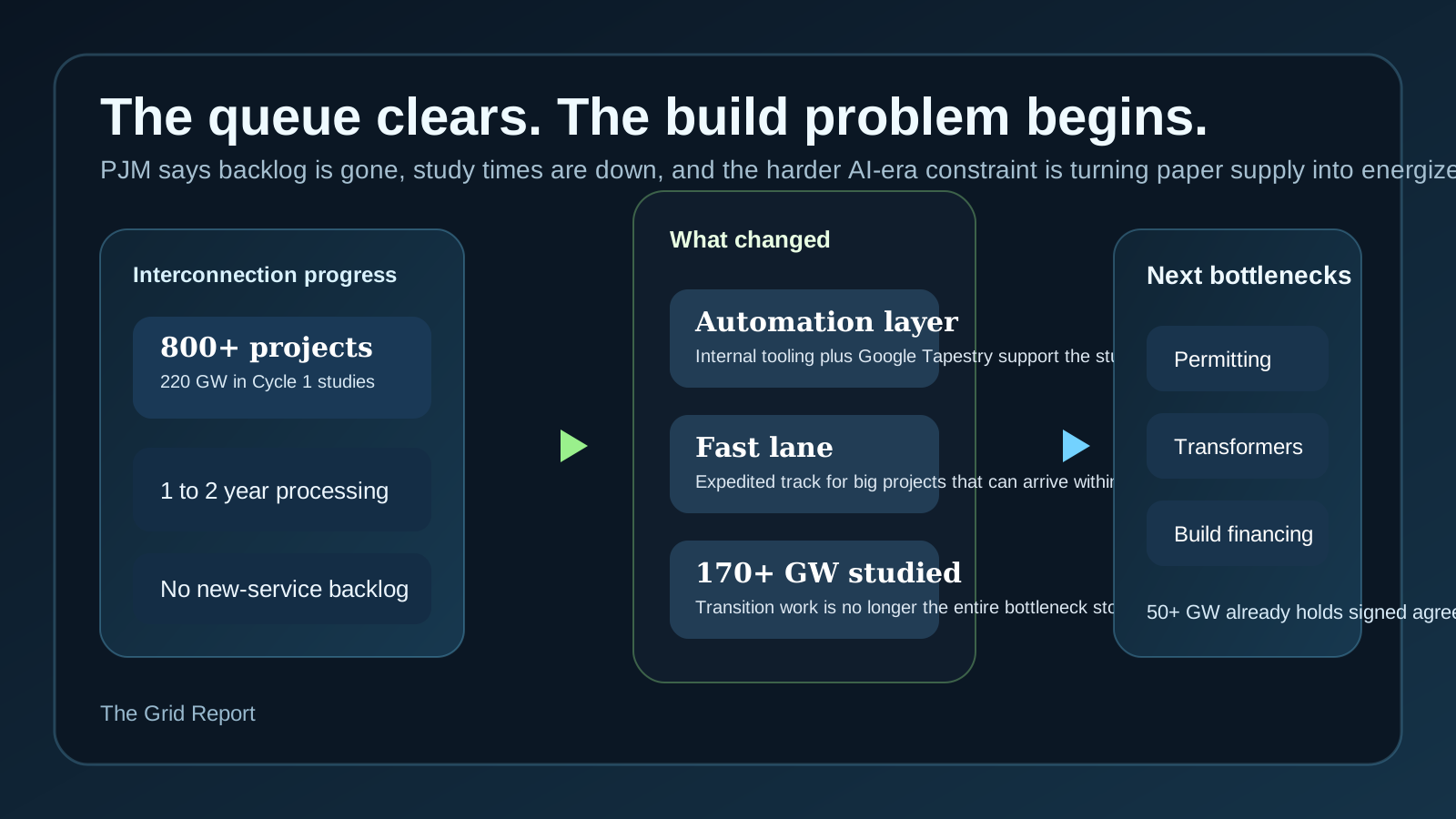
PJM’s June 17 update clears the publish bar because it gives a more useful answer than the usual “the queue is the problem” line. PJM said more than 800 projects representing about 220 gigawatts are being studied in Cycle 1 of its reformed generation interconnection process, that there is no backlog in the queue, and that the turnaround for issuing generation interconnection agreements is now roughly one to two years. On its face, that sounds like a process-success story. The stronger read-through is that the bottleneck is migrating downstream.
The core point is hidden in PJM’s own fact sheet. The grid operator says roughly 53 gigawatts of projects already have signed agreements to connect, but many are being delayed by issues beyond PJM’s control, including federal, state, and local permitting, siting, and supply-chain challenges. That changes the AI-power conversation materially. Once the queue itself becomes less clogged, speed to power depends more on whether projects can actually get built.
Once the queue backlog eases, the real AI-power race shifts to whichever projects can clear permitting, equipment, and construction fast enough to become actual supply.
That distinction matters because AI demand is still rising fast. PJM said in its April 29 Cycle 1 release that electricity demand in its region is expected to increase by more than 30 gigawatts between 2024 and 2030, driven largely by data centers. The same release showed where new supply interest is showing up: 811 projects totaling 220 gigawatts, led by natural gas, storage, and nuclear on a capacity basis. In other words, developer appetite is not the immediate issue. Converting applications into steel, transformers, turbines, and energization schedules is.
This is why the story is stronger than a generic reform piece. PJM’s new first-ready, first-served structure was designed to filter out weaker speculative projects through site-control requirements and up-front financial commitments. That reform matters, but it does not create megawatts by itself. It mostly improves the quality and predictability of the project pipeline. The harder work begins after that: studies, approvals, equipment procurement, transmission work, and construction execution across multiple jurisdictions.
PJM’s own recent actions reinforce the point. The fact sheet says the Reliability Resource Initiative attracted 11 gigawatts of shovel-ready projects and that FERC has now approved PJM’s Expedited Interconnection Track, which can take up to 10 large supported projects annually over two years. Those measures are important because they try to pull genuinely buildable resources forward. But their existence is also an admission that process cleanup alone is not enough. The market needs faster pathways for projects that can realistically deliver near-term capacity.
The AI angle is straightforward. Data-center developers keep looking for ways around grid delays, whether through co-location, self-supply, flexible loads, or private power contracts. PJM’s update shows why. Even with queue reform, regional reliability still depends on the physical project pipeline moving from agreement to operation on schedule. For data-center operators, that means “queue position” is becoming a less complete signal than “which projects in this region can actually clear permitting and procurement in time.”
This also helps explain why policy fights are intensifying at the same time as process metrics improve. FERC’s June 18 show-cause orders pushed large-load integration into a national tariff fight. PJM’s interconnection update describes the other half of the same problem. One half is governance: who gets service, under what rules, and who pays. The other half is execution: whether enough generation and supporting infrastructure can physically reach commercial operation before new large loads arrive.
There are still limits to the conclusion. A 220-gigawatt application total is not the same thing as 220 gigawatts that will actually be built. PJM itself notes that only a percentage of applicants will ultimately sign agreements and move ahead. And PJM’s materials naturally present its reforms in the best light. The narrower and more defensible conclusion is that queue reform is working better than before, but it is exposing the next bottleneck rather than solving the whole problem.
That is enough to publish. Search coverage often stops at “PJM fixed its queue” or “data centers need more power.” The more useful operator read is that AI power in PJM is now a project-execution story, where the winning regions and developers will be the ones that can turn signed pathways into built supply fastest.
Sources
PJM Inside Lines, “New Interconnection Process Delivers,” published June 17, 2026: https://insidelines.pjm.com/new-interconnection-process-delivers/
PJM, “New, Faster Generation Interconnection Process” fact sheet, updated May 21, 2026: https://www.pjm.com/-/media/DotCom/about-pjm/newsroom/fact-sheets/interconnection-reform-progress-fact-sheet.pdf
PJM Inside Lines, “Over 800 New Generation Projects Seek To Connect Under PJM’s Reformed Process,” published April 29, 2026: https://insidelines.pjm.com/over-800-new-generation-projects-seek-to-connect-under-pjms-reformed-process/
PJM Inside Lines, “FERC OKs Temporary Process To Fast-Track Large Capacity Projects,” published June 10, 2026: https://insidelines.pjm.com/ferc-oks-temporary-process-to-fast-track-large-capacity-projects/
By Nawaz Lalani
The Grid Report is written by Nawaz Lalani and focuses on source-backed coverage of AI infrastructure, grid power demand, automation systems, and market signals.
Follow the signal, not just the headline.
Get the daily Grid brief for source-backed coverage on AI power demand, infrastructure timing, automation, and market signals.