- Meta’s Alberta project matters for a narrower reason than the usual hyperscaler headline.
- That product is not simply cheap land or cold weather.
- Alberta’s own strategy makes the posture explicit.
- Section
- Energy
- Read time
- 6 min read
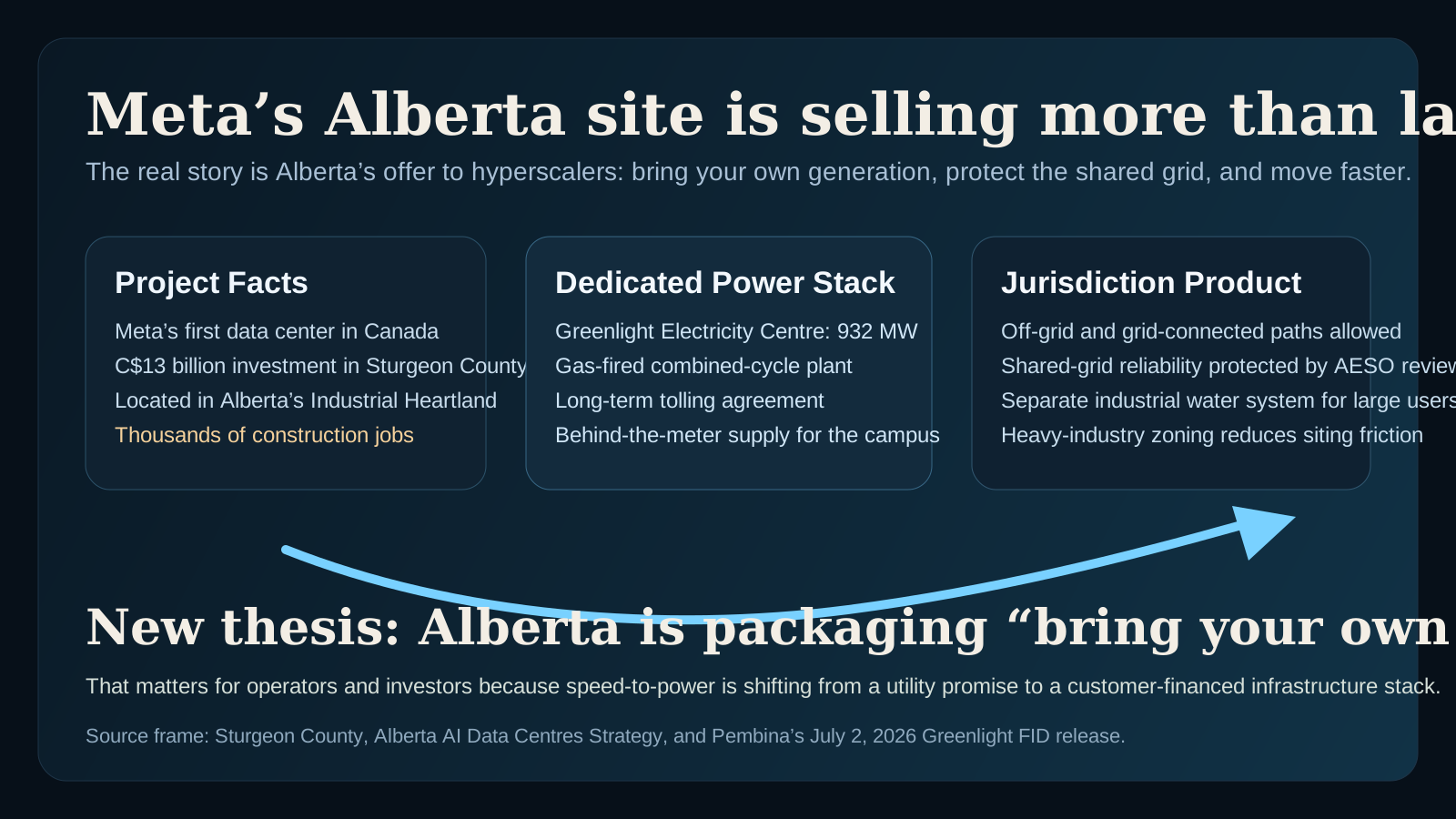
Meta’s Alberta project matters for a narrower reason than the usual hyperscaler headline. Sturgeon County says Meta is making a C$13 billion investment in Alberta’s Industrial Heartland for its first data center in Canada, with thousands of construction jobs and long-term operating roles. That is large enough on its own. But the stronger Grid Report angle is that Alberta is trying to productize a particular way of serving AI load.
That product is not simply cheap land or cold weather. It is a jurisdictional pitch: large AI campuses can move faster if they bring their own generation, stay inside a heavy-industry corridor, and avoid dumping the full cost and reliability burden onto the shared grid. In an AI build cycle increasingly constrained by energization timing, that is more useful than another generic announcement about a future campus footprint.
Alberta is not only offering hyperscalers land. It is offering a rule set: bring your own power, protect the shared grid, and move faster.
Alberta’s own strategy makes the posture explicit. The province says its AI data-centre plan is focused on keeping electricity affordable and reliable while attracting new investment, and specifically calls for prioritizing both off-grid and grid-connected power solutions that avoid compromising affordability and reliability. It also highlights natural gas, streamlined regulation, and reduced red tape as part of the offer.
Sturgeon County translates that strategy into operating terms. Its data-center development page says projects are encouraged to generate their own power on-site and are not required to connect to the provincial grid. Any grid connection still has to be approved by the Alberta Electric System Operator, and the county explicitly argues that large industrial projects that bring their own generation reduce pressure on the shared system. That is not normal marketing copy. It is a site-selection thesis.
Pembina’s July 2 Greenlight release fills in the infrastructure stack behind that thesis. The company and its partners took final investment decision on a 932 MW gas-fired combined-cycle plant in Sturgeon County to serve a major data-center development under a long-term tolling agreement, with an anticipated in-service date in the second half of 2030. Pembina says the project is the first of its kind in Canada, that it will act as the customer’s long-term behind-the-meter power provider, and that the site can expand to 1,864 MW over time.
That combination changes how the Meta story should be read. This is less a pure real-estate or cloud-region story than a coordinated power-and-campus stack: industrial land, zoning built for heavy infrastructure, onsite or dedicated generation, regulatory permission for self-supplied load, and a financing model that treats power as part of the customer contract instead of an external dependency. In practical terms, Alberta is trying to convert a grid constraint into a competitive product.
The county’s water design adds another part of the pitch. Sturgeon says it is separating potable and industrial process-water systems so high-volume industrial users do not strain residential drinking supplies, while growth-related infrastructure costs stay with developers. That matters because local opposition to data centers increasingly starts with two questions: will they take my power and will they take my water? Alberta’s answer is to ringfence both.
The useful search question now is not just why Meta chose Alberta. It is whether Alberta’s bring-your-own-power model becomes a repeatable template for AI infrastructure elsewhere. If that answer is yes, jurisdictions that can package dedicated generation, industrial siting, water separation, and faster approvals may win more real AI load than places still offering only land and ambition.
Sources
Sturgeon County, “Data centre development in Sturgeon County,” accessed July 8, 2026: https://www.sturgeoncounty.ca/building-development/data-centre-development/
Government of Alberta, “Artificial Intelligence Data Centres Strategy,” accessed July 8, 2026: https://www.alberta.ca/artificial-intelligence-data-centres-strategy
Pembina Pipeline, “Pembina Pipeline Announces Positive Final Investment Decision on the Greenlight Electricity Centre,” published July 2, 2026: https://www.pembina.com/media-centre/news/details/3403fb77-2257-466b-a8e2-f043f4cd4650
By Nawaz Lalani
The Grid Report is written by Nawaz Lalani and focuses on source-backed coverage of AI infrastructure, grid power demand, automation systems, and market signals.
Follow the signal, not just the headline.
Get the daily Grid brief for source-backed coverage on AI power demand, infrastructure timing, automation, and market signals.