- EIA’s May 19 data-center server forecast clears the publish bar because it is not another vague headline about AI using a lot of electricity.
- The headline number is large enough to matter.
- That is why this belongs in the energy-grid lane.
- Section
- Energy
- Read time
- 5 min read
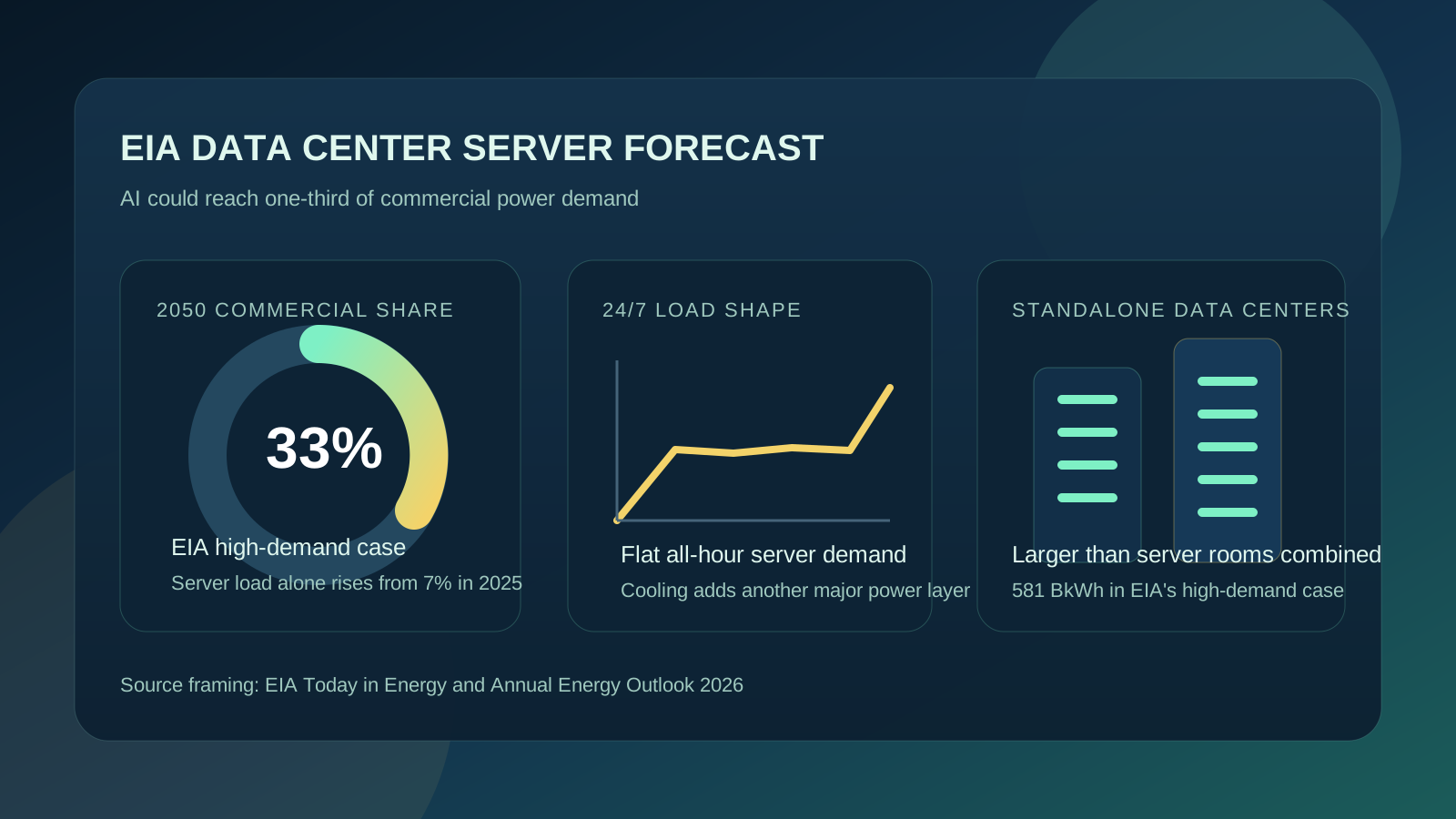
EIA’s May 19 data-center server forecast clears the publish bar because it is not another vague headline about AI using a lot of electricity. The stronger Grid Report angle is that EIA is now modeling data center servers as a distinct commercial end use with their own load shape, cooling burden, and long-run planning range. That turns the AI power debate from a general demand story into a more operational question about what kind of load utilities are being asked to serve.
The headline number is large enough to matter. In its Today in Energy analysis based on Annual Energy Outlook 2026, EIA says data center server electricity use grows to 22% to 33% of all commercial-building electricity use by 2050 across its cases. Servers alone accounted for an estimated 7% of commercial-sector electricity consumption in 2025. In the high-electricity-demand case, server consumption reaches 818 billion kilowatthours by 2050, while standalone data centers inside EIA’s “other buildings” category consume 581 billion kilowatthours on their own.
EIA is no longer treating AI as background commercial growth. It is modeling data center servers as a distinct, flat, always-on load that could claim up to one-third of commercial power demand.
That is why this belongs in the energy-grid lane. The useful signal is not just that AI load could get big. It is that the load EIA is describing is structurally hard on the system. EIA says data center server demand is essentially flat across all hours of the day. That means AI infrastructure does not behave like a peaky commercial customer that fades overnight. It looks more like an always-on industrial block that keeps pressure on generation, transmission, and local delivery assets continuously.
Cooling makes the story even more physical. EIA says data center floorspace can be as much as 2.9 times as energy intensive for space cooling as non-data-center floorspace, on average. Under the same population and weather assumptions, space-cooling electricity use in the high-electricity-demand case is 84 billion kilowatthours higher in 2050 than in the counterfactual baseline case. In other words, the AI load question is not just about servers. It is also about the extra electrical system required to keep those servers operating.
The planning implication is more useful than a single scary number. EIA’s narrative for AEO2026 says the entire economy would need to grow at the pace of its high-economic-growth case to match the data-center-related electricity growth in the high-electricity-demand case. That is a strong way of saying AI server demand is no longer a side variable inside commercial forecasts. It is becoming one of the main variables.
This also sharpens the regional story without repeating recent coverage. EIA says data center server electricity use grows fastest in the South Atlantic and West South Central census divisions, home to Virginia and Texas. The site has already covered Virginia electricity sales and Texas fuel-supply dynamics. This forecast sits one level underneath those stories by showing why those regions keep surfacing: they are where EIA sees the server-heavy load growth concentrating fastest over time.
There are limits, and they matter. This is a modeled range, not a promise, and EIA says AEO2026 generally reflects laws and regulations in place as of December 2025. The high-demand case also assumes no extra efficiency step-down after 2040 beyond historical trends, while the baseline case does assume stronger efficiency gains. So the right read is not that one-third of commercial power demand is guaranteed. The right read is that the federal reference model now treats data center servers as large enough to deserve their own explicit load architecture.
That is enough to publish. Searchers looking for EIA’s data center server forecast do not need another generic AI-energy explainer. The more useful answer is what changed in the federal framing: AI is now being modeled as a flatter, more persistent, and cooling-intensive commercial load that can reshape the grid planning stack if the high-demand case comes close to reality.
Sources
U.S. Energy Information Administration, “Data center server energy use grows across the commercial building stock,” published May 19, 2026: https://www.eia.gov/todayinenergy/detail.php?id=67704
U.S. Energy Information Administration, “Annual Energy Outlook 2026,” released April 8, 2026: https://www.eia.gov/outlooks/aeo/
U.S. Energy Information Administration, “Annual Energy Outlook 2026 Narrative,” for data-center growth and regional concentration context: https://www.eia.gov/outlooks/aeo/narrative/
U.S. Energy Information Administration, “Assumptions to the Annual Energy Outlook 2026,” for the new treatment of data center server energy use as a distinct commercial end use: https://www.eia.gov/outlooks/aeo/assumptions/
By Nawaz Lalani
The Grid Report is written by Nawaz Lalani and focuses on source-backed coverage of AI infrastructure, grid power demand, automation systems, and market signals.
Follow the signal, not just the headline.
Get the daily Grid brief for source-backed coverage on AI power demand, infrastructure timing, automation, and market signals.