- National Grid Ventures’ July 1 investment in Joulent clears the publish bar because it is not just another AI-power headline number.
- The primary-source facts are unusually concrete.
- That matters because the useful signal is not simply “more money for AI infrastructure.” The useful signal is that power delivery itself is being reorganized into a specialist developer stack.
- Section
- Infrastructure
- Read time
- 5 min read
- Data included
- Why the National Grid-Joulent deal matters
Why the National Grid-Joulent deal matters
The important shift is not just the stake size. It is the buildout of a private delivery platform for large-load power that combines capital, infrastructure execution, and customer contracts.
| Layer | Primary-source detail | Why it matters |
|---|---|---|
| Stake and scale | National Grid Ventures will invest $1.75 billion for a 35% stake in Joulent | A major grid operator is treating private large-load power delivery as a strategic platform, not a side bet. |
| Delivery model | Joulent packages co-located gas generation, battery storage, renewables integration, and Across-the-Meter grid connections | The company is selling an integrated path to power rather than a single asset class or interconnection service. |
| Anchor project | Project Kilby is a 2.67 GW West Texas facility supplying a Microsoft-operated data center under a 20-year PPA | The model is already tied to a named hyperscale customer, long-duration revenue, and multi-gigawatt execution. |
| Execution readiness | National Grid said critical equipment is secured, EPC capacity is reserved, and first power is targeted for 2028 | This is a real delivery schedule, not just a conceptual response to AI demand. |
| Strategic overlap | National Grid expects to connect more than 10 GW of data-center demand across the U.K. and U.S. over the next five years | The buyer is using insight from regulated connections to back private infrastructure that can move faster where the queue is slow. |
Sources: National Grid release and PR Newswire distribution published July 1, 2026.
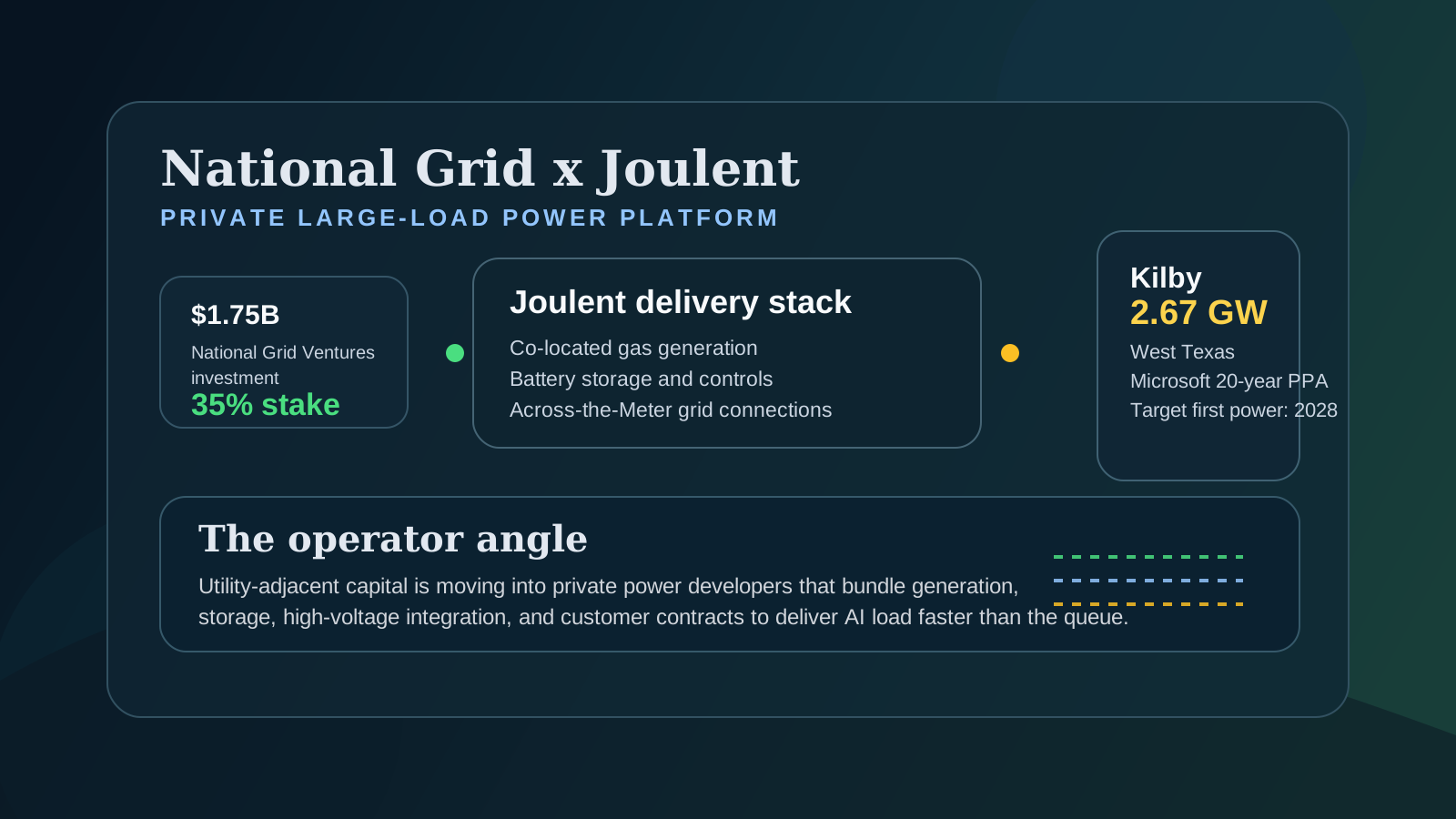
National Grid Ventures’ July 1 investment in Joulent clears the publish bar because it is not just another AI-power headline number. National Grid said it will invest $1.75 billion for a 35% stake in Joulent, a company built to develop contracted power and electrical infrastructure solutions for large-load customers. The stronger Grid Report angle is that a major transmission-and-utility operator is now backing a specialist private power-delivery platform rather than waiting for the normal grid build cycle to do all the work.
The primary-source facts are unusually concrete. National Grid said Joulent is developing integrated solutions for U.S. large-load customers, including co-located gas generation, battery storage, renewables integration, and what it calls Across-the-Meter grid connections. The company also said the investment will support Project Kilby, a 2.67 gigawatt co-located power facility in West Texas that Joulent is developing in a 50/50 partnership with Chevron to supply a Microsoft-operated data center under a 20-year power purchase agreement.
The strongest National Grid-Joulent signal is not the $1.75 billion headline. It is that utility-adjacent capital is now backing private developer platforms built to deliver large-load power faster than the standard grid process.
That matters because the useful signal is not simply “more money for AI infrastructure.” The useful signal is that power delivery itself is being reorganized into a specialist developer stack. Joulent is not framed as a single plant owner or a merchant generator. It is framed as a company that combines generation, storage, controls, interconnection architecture, and customer contracting so AI campuses can get dedicated power on timelines the traditional queue often cannot meet.
This is also why the story belongs in infrastructure rather than only markets. Brookfield and Bloom showed that fast onsite generation can be financed as an investable product. The National Grid-Joulent deal pushes the structure one layer further into execution. National Grid is not just funding equipment. It is buying into a delivery company that sits between hyperscale demand and the slower public grid process, with explicit expertise in high-voltage networks, system integration, balancing, and project execution.
Project Kilby makes the thesis easier to defend. National Grid said development is already advanced, critical equipment including GE Vernova turbines is secured, EPC capacity is reserved, and first power is targeted for 2028. That means this is not another vague memorandum about future AI demand. It is tied to a named, multi-gigawatt project with a large customer, a long-duration contract, and a real delivery schedule.
The most important strategic read-through is that utility-adjacent capital is moving toward private large-load infrastructure because AI demand is arriving faster than conventional service timelines. National Grid said the partnership should also strengthen its own data-center connection program, where it expects to connect more than 10 gigawatts of demand across the U.K. and U.S. over the next five years. In other words, the company is learning from both sides of the bottleneck: the regulated connection queue and the private workaround built to bypass part of that queue.
For operators, the attraction is straightforward. A parallel power platform can compress the distance between a signed campus and first energized capacity by bundling generation, storage, controls, and high-voltage integration under one delivery model. For policymakers and utilities, the implication is less comfortable. If enough demand migrates toward dedicated private infrastructure, the public grid risks becoming the slower fallback layer instead of the default first path for new large loads.
That is what makes this genuinely different from the site’s June 22 Microsoft Pecos story. That piece was about one hyperscale campus and its dedicated power stack. This story is about who is now underwriting and scaling the developer layer behind that model. National Grid is effectively betting that AI-era power bottlenecks are durable enough to support an entire class of private grid-services companies.
That is enough to publish. Searchers looking for National Grid and Joulent do not need a generic recap of AI electricity demand. The more useful answer is that this investment marks a structural shift: established grid operators are starting to buy into the private developer platforms that can deliver large-load power faster than the standard process.
Sources
National Grid, “National Grid Ventures to invest $1.75bn to accelerate power solutions for U.S. data centers and AI,” published July 1, 2026: https://www.nationalgrid.com/national-grid-ventures-invest-175bn-accelerate-power-solutions-us-data-centers-and-ai
PR Newswire, “National Grid Ventures to invest $1.75bn to accelerate power solutions for U.S. data centers and AI,” published July 1, 2026: https://www.prnewswire.com/news-releases/national-grid-ventures-to-invest-1-75bn-to-accelerate-power-solutions-for-us-data-centers-and-ai-302815750.html
By Nawaz Lalani
The Grid Report is written by Nawaz Lalani and focuses on source-backed coverage of AI infrastructure, grid power demand, automation systems, and market signals.
Follow the signal, not just the headline.
Get the daily Grid brief for source-backed coverage on AI power demand, infrastructure timing, automation, and market signals.