- The Naval Postgraduate School’s July 22 commissioning of an NVIDIA DGX GB300 clears the publish bar because it says something more useful than the usual “the Pentagon needs AI” headline.
- That is the original angle.
- The hardware still matters.
- Section
- Infrastructure
- Read time
- 4 min read
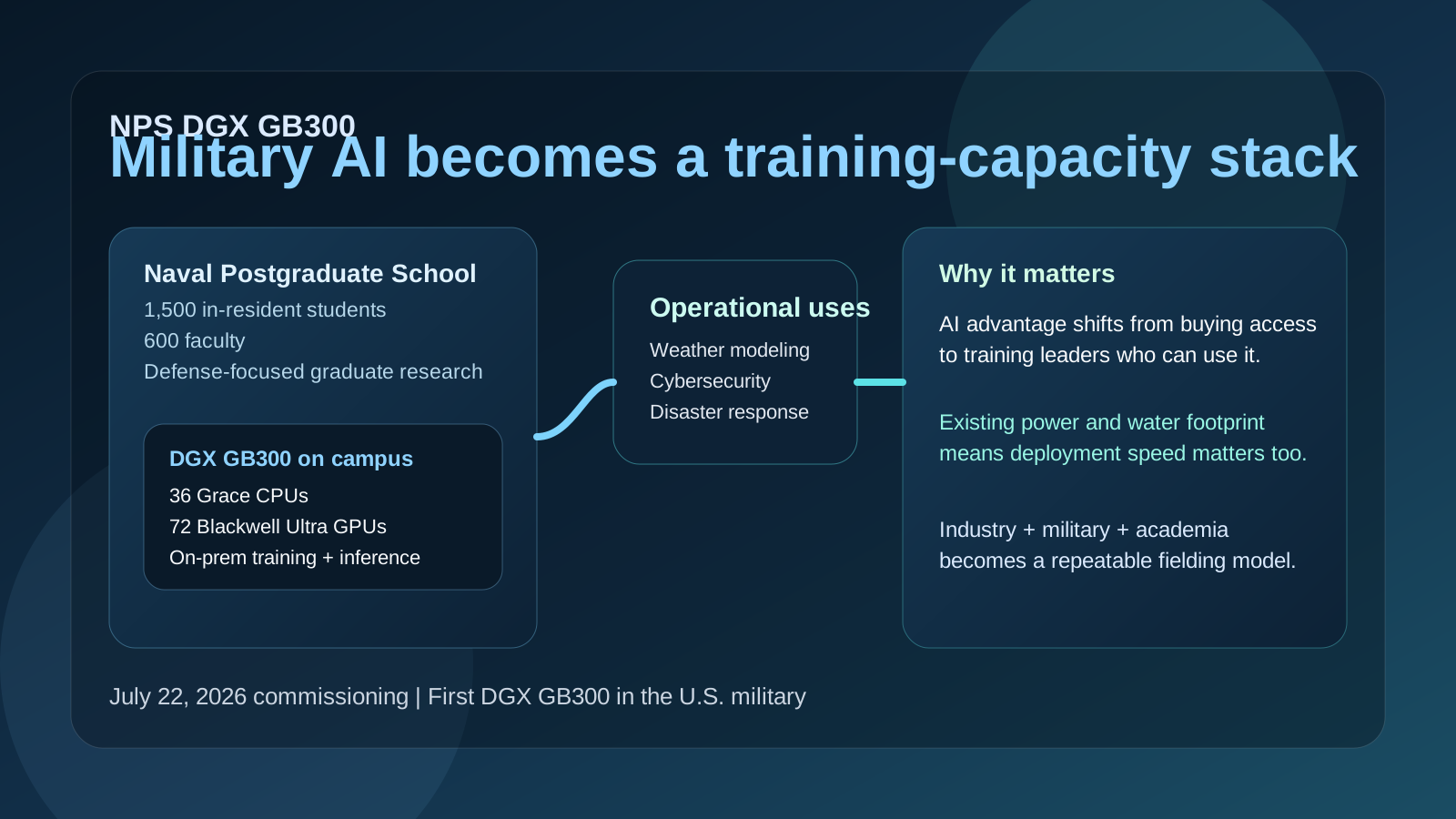
The Naval Postgraduate School’s July 22 commissioning of an NVIDIA DGX GB300 clears the publish bar because it says something more useful than the usual “the Pentagon needs AI” headline. The stronger signal is institutional design. NPS is treating military AI advantage as a local training-and-experimentation capacity problem: put advanced compute where officers, faculty, and defense researchers already work, then use that system to shorten the distance between theory, testing, and operational judgment.
That is the original angle. NVIDIA says the DGX GB300 gives NPS more than 1,500 in-resident students and 600 faculty on-premises access to large-scale AI computing for model training and inference. NPS says it is the first DGX GB300 in the U.S. military and that the system will support approved research partners working on defense-focused applications. Read correctly, this is less about a single machine and more about where the military wants AI fluency to live.
The useful signal is not just that the military got a powerful box. It is that AI advantage is being treated as a local training-and-experimentation capacity problem.
The hardware still matters. NPS says the system pairs 36 NVIDIA Grace CPUs with 72 NVIDIA Blackwell Ultra GPUs. But the more important detail is deployment context. The school says the DGX GB300 was installed within its existing high-performance computing environment and can deliver a substantial increase in computational capacity while operating inside the school’s existing power and water infrastructure. That changes the operator lesson. The practical win is not only raw performance. It is fielding advanced capability quickly inside a real institutional workflow.
NVIDIA and NPS frame the use cases in operational terms rather than abstract innovation language. The system is being positioned for weather modeling, oceanic and operations research, cybersecurity, disaster resilience, and response planning. That matters because the AI race inside government is often described as a procurement or policy contest. Here, the sharper story is cycle time. If military students and faculty can train, test, and refine models locally, they can pressure-test ideas faster and with more operational context than if AI remains mostly a distant service procured elsewhere.
This is why the NPS setting matters more than a normal campus announcement. The school exists to educate officers and defense leaders who then return to the fleet and the joint force. Admiral Samuel Paparo made that link explicit, saying today’s officers will return ready to lead AI-enabled formations. The useful read-through is that military AI advantage is increasingly being built through leader training throughput, not just through central acquisition programs or large cloud relationships.
The partner structure reinforces that interpretation. NPS says the deployment sits on top of a Cooperative Research and Development Agreement announced with NVIDIA in December 2024, and that Vertiv, DDN, and VAST Data also contributed infrastructure, storage, and technical expertise. In other words, this is a compact model of how military AI capability may actually spread: a defense institution, a frontier compute vendor, and enabling infrastructure partners building a deployable local stack rather than waiting for one giant national platform to solve everything.
This also clears the duplicate screen against the site’s last 30 days. Japan’s national AI infrastructure story was about industrial policy and national platform construction. OpenAI’s Genesis push was about scientific demand aggregation across labs and universities. Savannah River was about federal siting and counterparty credibility. This thesis is materially different. NPS turns AI advantage into an education-and-operations throughput question inside the military itself.
The next watchpoint is whether this becomes a one-off showcase or a repeatable pattern. If NPS can convert the system into visible research output, faster experimentation, and a pipeline of officers who actually know how to evaluate AI in operational settings, other military and public-sector institutions will have a clearer template to copy. If not, it risks becoming a symbolic hardware ribbon-cutting. For now, the stronger bet is that the useful signal is real: the U.S. military is starting to treat frontier AI compute as something leaders need to train on directly, not just buy access to indirectly.
Sources
NVIDIA, “NVIDIA AI Supercomputer Comes Online at Naval Postgraduate School,” published July 22, 2026: https://blogs.nvidia.com/blog/naval-postgraduate-school-dgx-ai-supercomputer/
Naval Postgraduate School, “NPS Launches First NVIDIA DGX GB300 AI Supercomputer in U.S. Military to Advance Leadership Through Education and Research,” published July 22, 2026: https://nps.edu/-/nps-launches-first-nvidia-dgx-gb300-ai-supercomputer-in-u.s.-military-to-advance-leadership-through-education-and-research
By Nawaz Lalani
The Grid Report is written by Nawaz Lalani and focuses on source-backed coverage of AI infrastructure, grid power demand, automation systems, and market signals.
Follow the signal, not just the headline.
Get the daily Grid brief for source-backed coverage on AI power demand, infrastructure timing, automation, and market signals.