- NVIDIA’s July 16 Japan announcement clears the publish bar because it says something more specific than “countries want sovereign AI.” NVIDIA and Noetra said they will build a 140 megawatt Vera Rubin AI factory with 13,750 Vera CPUs and 27,500 Rubin GPUs, supported by Japan’s Ministry of Economy, Trade and Industry through the FRONTia Project.
- That distinction matters.
- This is why the story belongs in infrastructure rather than generic AI geopolitics.
- Section
- Infrastructure
- Read time
- 4 min read
- Data included
- Japan’s launch ties compute to industrial deployment, not only model access
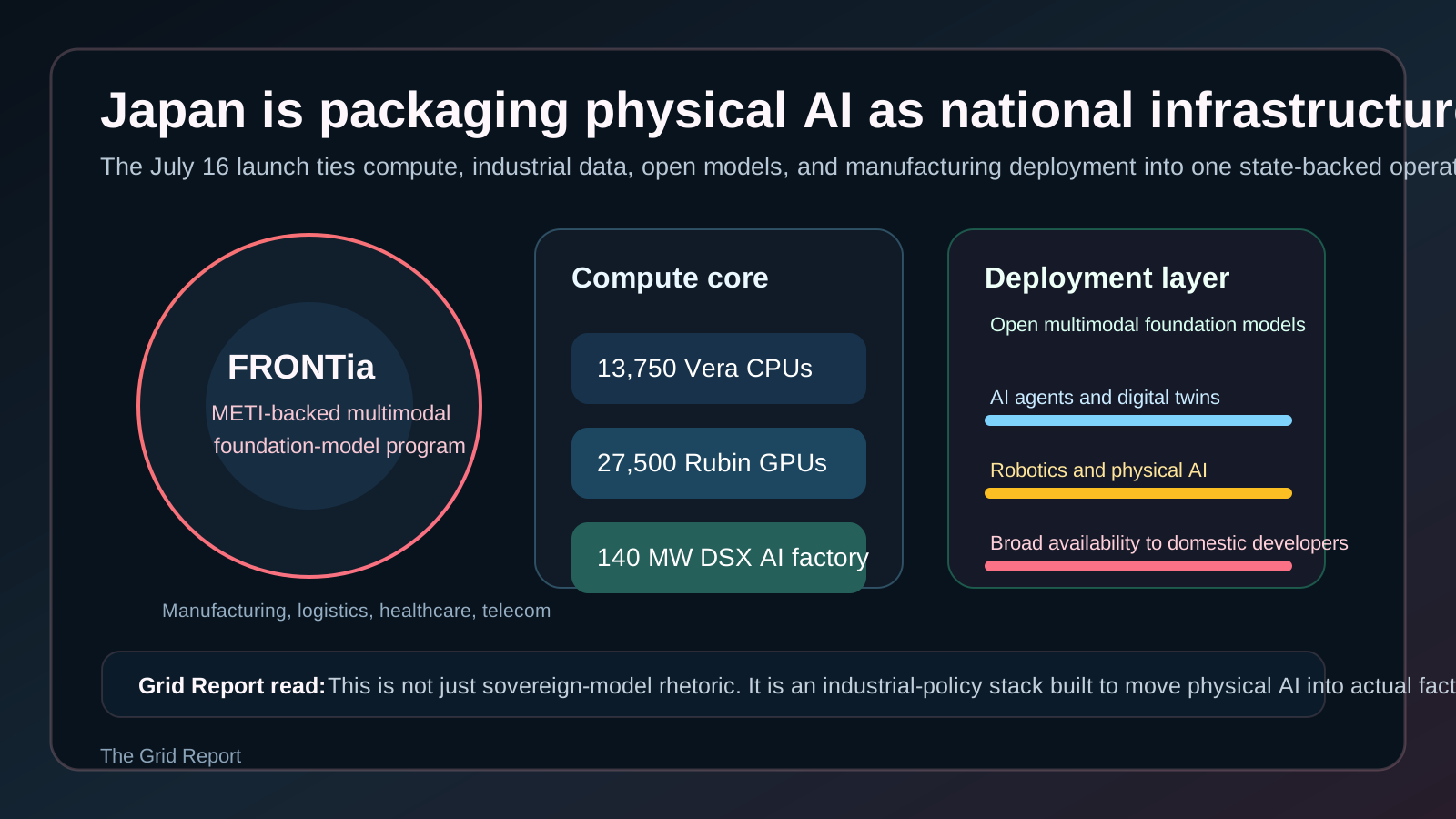
Japan’s launch ties compute to industrial deployment, not only model access
The state-backed structure matters because each layer points toward factory and logistics use rather than a standalone national showcase cluster.
| Stack layer | What the launch includes | Why it matters |
|---|---|---|
| Policy layer | METI-backed FRONTia Project | Puts physical AI inside a formal industrial program instead of a loose commercial partnership. |
| Compute layer | 140 MW AI factory with 13,750 Vera CPUs and 27,500 Rubin GPUs | Signals national-scale commitment large enough to matter for real model training and deployment. |
| Platform layer | DSX architecture and Spectrum-X networking | Makes the launch a systems stack, not just a hardware purchase order. |
| Model layer | Open multimodal foundation models and widely available pretrained weights | Improves the odds that domestic firms can actually build on top of the capacity. |
| Deployment layer | Agents, digital twins, robotics, and physical AI applications | Connects compute investment to manufacturing and logistics outcomes that can change the real economy. |
Source: NVIDIA July 16, 2026 press release and related July 15 ecosystem blog post.
NVIDIA’s July 16 Japan announcement clears the publish bar because it says something more specific than “countries want sovereign AI.” NVIDIA and Noetra said they will build a 140 megawatt Vera Rubin AI factory with 13,750 Vera CPUs and 27,500 Rubin GPUs, supported by Japan’s Ministry of Economy, Trade and Industry through the FRONTia Project. The more useful angle is that Japan is not treating AI capacity as a prestige asset alone. It is packaging compute, industrial data, and deployment pathways into a national stack for physical AI.
That distinction matters. A lot of sovereign-AI talk still centers on access to models, cloud capacity, or national control over data. Japan’s structure is different. The official release says the infrastructure will support open multimodal foundation models for AI agents, digital twins, robotics, and other physical AI applications across manufacturing, logistics, healthcare, and telecommunications. In other words, the target is not mainly chatbot usage. It is industrial execution.
Japan is not only buying AI capacity. It is assembling a national stack meant to push physical AI into factories, logistics, and industrial systems.
This is why the story belongs in infrastructure rather than generic AI geopolitics. The infrastructure stack is explicit: Vera Rubin systems, DSX platform architecture, Spectrum-X networking, domestic industrial data, and a state-backed program meant to make pretrained weights broadly available to local developers and enterprises. That is closer to an industrial platform than to a standard compute-cluster procurement. Japan is trying to reduce the gap between national compute investment and real factory-floor deployment.
The original read-through is that physical AI is becoming an industrial-policy object. Countries already know how to subsidize fabs, battery plants, and transmission lines. What Japan is signaling here is a new version of that playbook: build the compute layer, tie it to sector-specific data and robotics workflows, and distribute the resulting model base widely enough that domestic firms can ship against it. That is a more serious operating model than simply declaring AI a strategic priority and waiting for private labs to fill in the rest.
It also extends current Grid Report coverage without repeating it. The site already covered France’s AI buildout as a power-and-campus execution story and OpenAI’s national-security principles as a trusted-access story. Japan is a different layer. It is about how a country with existing industrial depth tries to turn physical AI into a coordinated national production system rather than a loose collection of software initiatives.
The reason this can help search is that readers looking up the launch will want more than the hardware counts. The more useful answer is what kind of infrastructure Japan is actually building. The July 16 release suggests the country is using national AI investment to move models closer to robots, digital twins, manufacturing systems, and deployed industrial workflows. That makes the story about industrial policy design, not only compute scale.
Sources
NVIDIA, “Japan Government, Industrial Leaders and NVIDIA Launch the World’s First National AI Infrastructure,” published July 16, 2026: https://investor.nvidia.com/news/press-release-details/2026/Japan-Government-Industrial-Leaders-and-NVIDIA-Launch-the-Worlds-First-National-AI-Infrastructure/default.aspx
NVIDIA Newsroom archive entry for the same announcement, accessed July 18, 2026: https://nvidianews.nvidia.com/news/japan-government-industrial-leaders-and-nvidia-launch-the-worlds-first-national-ai-infrastructure
NVIDIA blog context, “NVIDIA and Japan Bring Full-Stack AI and Robotics to Every Industry,” published July 15, 2026: https://blogs.nvidia.com/blog/japan-ecosystem-2026/
By Nawaz Lalani
The Grid Report is written by Nawaz Lalani and focuses on source-backed coverage of AI infrastructure, grid power demand, automation systems, and market signals.
Follow the signal, not just the headline.
Get the daily Grid brief for source-backed coverage on AI power demand, infrastructure timing, automation, and market signals.