- NVIDIA’s July 1 capital-partner announcement clears the publish bar because it is not another demand-is-strong infrastructure post.
- The primary-source details are unusually direct.
- That matters because the bottleneck is no longer only chip supply.
- Section
- Markets
- Read time
- 5 min read
- Data included
- Why NVIDIA’s new model is different
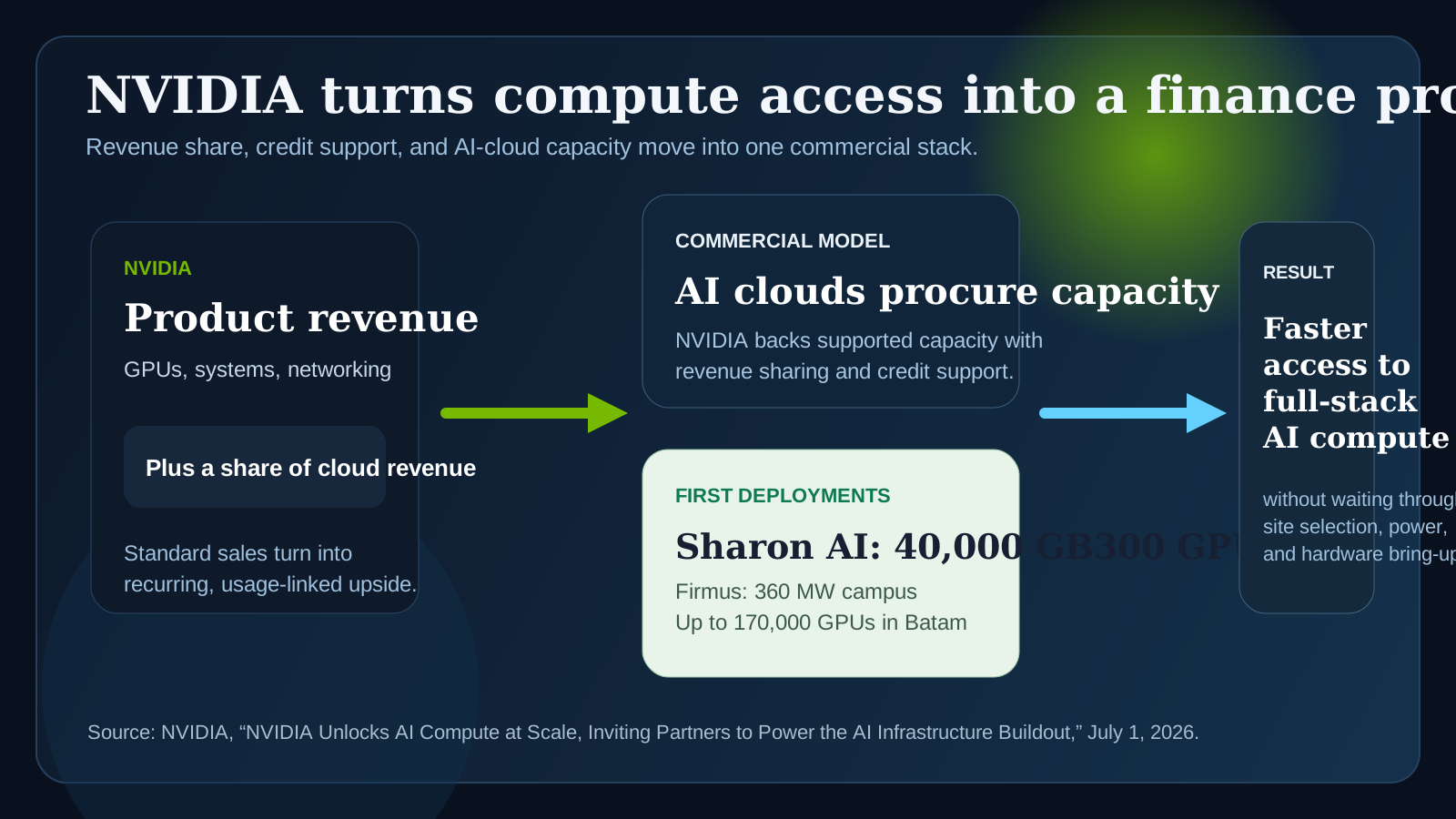
Why NVIDIA’s new model is different
The important shift is not more AI-cloud demand alone. It is the move from one-time system sales toward supported, usage-linked capacity economics.
| Layer | Primary-source detail | Why it matters |
|---|---|---|
| Commercial structure | NVIDIA says AI clouds can procure infrastructure through a revenue-sharing and credit-support model | Capacity financing becomes part of the sales motion instead of an external obstacle. |
| Revenue model | NVIDIA says it will earn standard product revenue plus a share of cloud revenue on supported capacity | The company is tying part of its upside to utilization, not only shipment volume. |
| Demand constraint | NVIDIA says emerging AI companies have struggled to unlock financing for capital-intensive infrastructure | The bottleneck is partly balance-sheet access, not only chip supply or customer interest. |
| Early deployments | Sharon AI is deploying up to 40,000 GB300 GPUs and Firmus is building a 360 MW campus with up to 170,000 GPUs | The model is being pointed at hyperscale-style assets, not small experiments. |
| Operator benefit | NVIDIA says the structure can speed access to full-stack compute without waiting through every physical build step first | Commercial intermediation may pull forward capacity for AI-native operators that need faster ramp. |
Sources: NVIDIA posts published July 1, 2026.
NVIDIA’s July 1 capital-partner announcement clears the publish bar because it is not another demand-is-strong infrastructure post. NVIDIA says it is introducing a new business model that lets AI clouds procure NVIDIA infrastructure through a revenue-sharing and credit-support structure. The stronger Grid Report angle is that compute access itself is being reshaped into a finance product for the AI buildout.
The primary-source details are unusually direct. NVIDIA says AI clouds will sell NVIDIA-powered cloud services while NVIDIA earns both standard product revenue and a share of cloud revenue on the supported capacity. That is a meaningful change in commercial posture. Instead of stopping at the hardware sale, NVIDIA is tying part of its economics to actual usage on the deployed capacity.
The useful NVIDIA signal is not that demand stays hot. It is that the company is starting to treat AI-cloud capacity as a supported finance product with recurring, usage-linked economics.
That matters because the bottleneck is no longer only chip supply. NVIDIA explicitly says emerging AI companies have had limited access to capital-intensive infrastructure, and that even long-term commitments were often not enough to unlock financing. In other words, some demand has not been blocked by model ambition or customer interest. It has been blocked by the ability to fund large-scale compute before utilization is proven.
This is why the story belongs in markets rather than a generic infrastructure bucket. The useful change is not simply that more GPUs may ship. The useful change is that NVIDIA is moving closer to underwriting the commercialization path for AI capacity. Revenue share and credit support turn capacity deployment into something more financeable for AI clouds, while also giving NVIDIA a recurring, usage-linked earnings stream rather than only one-time system revenue.
The first examples make the thesis more concrete. NVIDIA says Sharon AI is deploying up to 40,000 Grace Blackwell GB300 GPUs, while Firmus is building a DSX AI factory campus in Batam, Indonesia that is expected to scale to 360 megawatts and up to 170,000 NVIDIA GPUs. Those are not toy pilots. They are the kind of assets that normally require confidence in demand, financing, power, and customer ramp all at once.
There is a second-order infrastructure implication too. NVIDIA says the model can give model builders, inference providers, agent platforms, and enterprises faster access to full-stack accelerated computing without waiting through site selection, power procurement, construction, and hardware bring-up. That does not remove the physical bottlenecks. It means NVIDIA is trying to intermediate them commercially by helping AI clouds lock in capacity sooner.
This is materially different from the site’s July 1 manufacturing story and from the recent Brookfield-Bloom piece. The 43-state post was about how broad the U.S. AI supply chain has become. Brookfield and Bloom were about financing the power layer for AI campuses. This new NVIDIA model sits one level higher: it is about financing the commercialization of compute capacity itself once the physical stack is in motion.
There are obvious caveats. NVIDIA is describing its own model, the economics of supported capacity are not fully disclosed, and recurring upside only matters if customer utilization holds up. But the narrower conclusion is strong enough to publish: NVIDIA is trying to turn AI-cloud buildout into a supported financial product, not just a server-order cycle.
That is enough to publish. Searchers looking for NVIDIA’s new compute model do not need a generic “AI demand keeps rising” rewrite. The more useful answer is that NVIDIA is experimenting with a structure that aligns hardware sales, cloud utilization, and financing support into one usage-linked capacity business.
Sources
NVIDIA, “NVIDIA Unlocks AI Compute at Scale, Inviting Partners to Power the AI Infrastructure Buildout,” published July 1, 2026: https://blogs.nvidia.com/blog/nvidia-unlocks-ai-compute-at-scale-capital-partners-to-power-ai-infrastructure-buildout/
NVIDIA, “NVIDIA and Partners Build in America, for America,” published July 1, 2026, for same-day context on the broader infrastructure push: https://blogs.nvidia.com/blog/nvidia-and-partners-build-in-america-for-america/
By Nawaz Lalani
The Grid Report is written by Nawaz Lalani and focuses on source-backed coverage of AI infrastructure, grid power demand, automation systems, and market signals.
Follow the signal, not just the headline.
Get the daily Grid brief for source-backed coverage on AI power demand, infrastructure timing, automation, and market signals.