- NVIDIA’s June 21 liquid-cooling piece clears the publish bar because it exposes a constraint that still gets treated like a side engineering detail.
- The stronger angle is that AI factories are turning thermal design into a profit-and-permitting variable.
- Water use is the more undercovered part of the story.
- Section
- Infrastructure
- Read time
- 4 min read
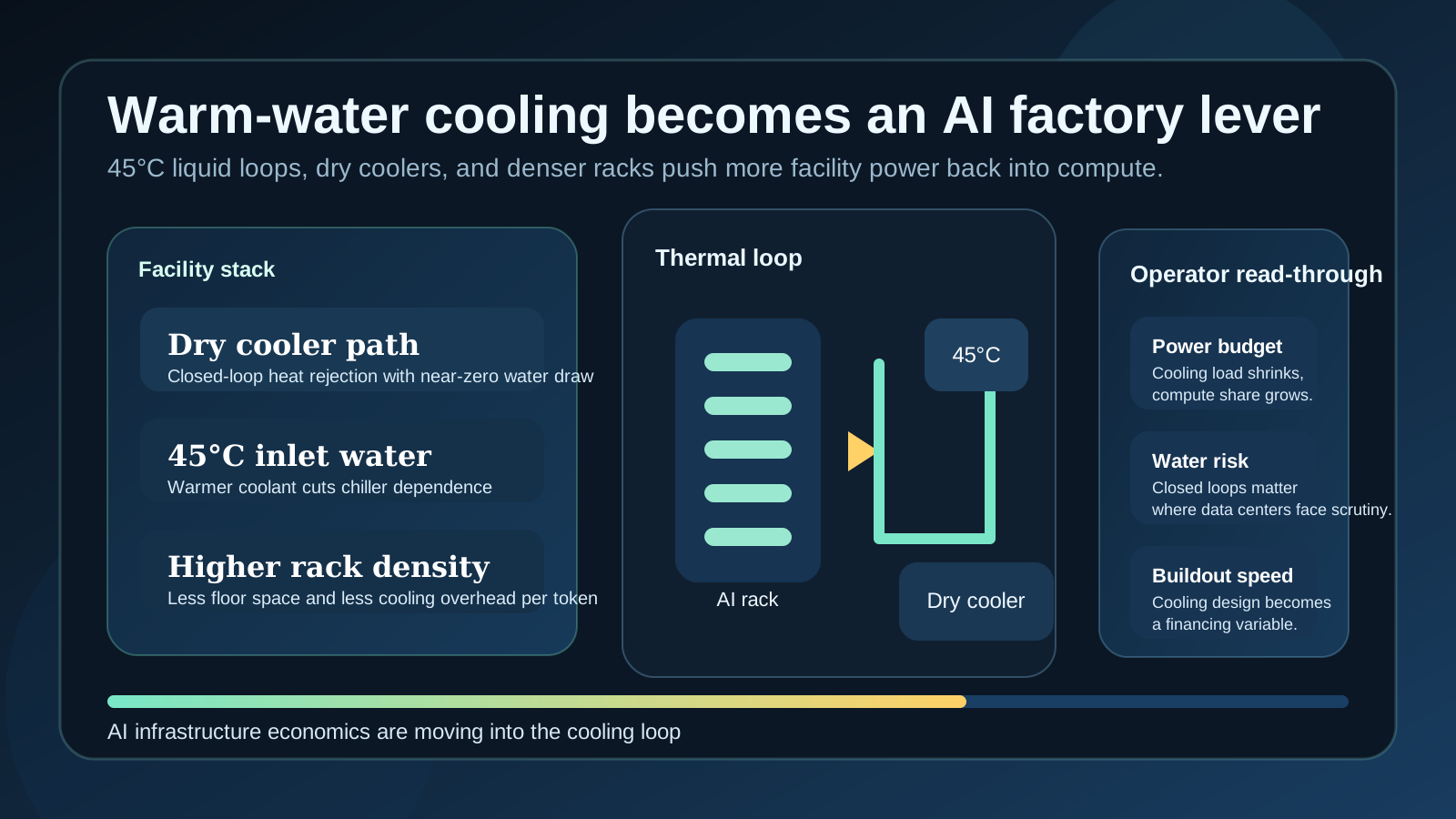
NVIDIA’s June 21 liquid-cooling piece clears the publish bar because it exposes a constraint that still gets treated like a side engineering detail. NVIDIA said its latest AI servers can run liquid cooling at up to 45 degrees Celsius, that the Rubin generation is its first 100% liquid-cooled AI infrastructure stack, and that the design can support dry-cooler-based operation with near-zero facility water consumption in favorable conditions. That matters because cooling is becoming one of the cleanest ways to separate serious AI infrastructure from slideware.
The stronger angle is that AI factories are turning thermal design into a profit-and-permitting variable. NVIDIA’s claim is not simply that warm-water liquid cooling is elegant. It is that higher coolant temperatures reduce chiller dependence, shrink cooling overhead, and let more of a facility’s total power budget flow to compute instead of support equipment. Once operators think in tokens, throughput, and megawatts, that shift is no longer cosmetic. It changes the economics of the site.
Cooling architecture is becoming an AI infrastructure control point because every megawatt spent on thermal overhead is a megawatt not spent on compute.
Water use is the more undercovered part of the story. NVIDIA said its DSX reference design can run as a closed loop with dry coolers and eliminate nearly all water use in many climates, compared with conventional cooling-tower-based systems that consume millions of gallons per megawatt per year. That is a meaningful infrastructure signal because community opposition, local water constraints, and ESG scrutiny are increasingly part of the data-center siting conversation. A cooling architecture that cuts water intensity can affect not just opex, but political durability.
The June 21 post also fits with the company’s June 1 GTC Taipei update, where NVIDIA said the third-generation MGX rack architecture for Vera Rubin was engineered for 100% liquid cooling at 45-degree-Celsius warm-water inlet temperatures. Read together, the message is that this is not a one-off marketing flourish. NVIDIA is trying to make warm-water liquid cooling a default design assumption for the next generation of AI factories.
Operators should care because this changes how facility readiness gets priced. A site with enough power but the wrong thermal architecture can still be economically inferior to a site that converts more of its electrical budget into usable compute. Investors should care for the same reason. Cooling design is becoming part of the underwriting logic for AI campuses, colocation retrofits, and rack-scale deployments. It affects capex, retrofit complexity, ongoing water exposure, and the ceiling on density growth.
There is also a speed-to-power implication. If higher-temperature liquid cooling lets more projects use ambient-air dry coolers and simpler closed-loop designs, then it can reduce one class of infrastructure friction at the same time that utilities are struggling with another. The AI factory bottleneck is not one thing. It is a stack of interacting constraints, and cooling is moving higher on that list.
There are limits. This is still NVIDIA describing the benefits of its own architecture, and the economics will vary by climate, building type, and retrofit difficulty. Warm-water cooling does not erase the need for enough grid power, enough electrical distribution, or enough supply-chain execution. But those caveats do not weaken the thesis. They explain why the story is useful: AI infrastructure competition is broadening into the facility layer.
The better conclusion is that AI infrastructure is becoming more thermally optimized and more politically exposed at the same time. The next winners may be the operators who can turn better cooling design into more compute per megawatt and fewer local water fights.
Sources
NVIDIA Blog, “Hotter Than a Hot Tub: The 45°C Breakthrough to Cool AI’s Biggest Machines,” published June 21, 2026: https://blogs.nvidia.com/blog/liquid-cooling-ai-factories/
NVIDIA Blog, “NVIDIA GTC Taipei at COMPUTEX: Live Updates on What’s Next in AI,” updated June 1, 2026: https://blogs.nvidia.com/blog/nvidia-gtc-taipei-computex-2026-news/
By Nawaz Lalani
The Grid Report is written by Nawaz Lalani and focuses on source-backed coverage of AI infrastructure, grid power demand, automation systems, and market signals.
Follow the signal, not just the headline.
Get the daily Grid brief for source-backed coverage on AI power demand, infrastructure timing, automation, and market signals.