- Coherent’s June 16 announcement clears the publish bar because it identifies an AI infrastructure choke point that still gets less attention than GPUs, power, or cooling.
- That is the stronger angle because AI systems do not scale on compute alone.
- The manufacturing details are what make the story useful for operators and investors.
- Section
- Infrastructure
- Read time
- 4 min read
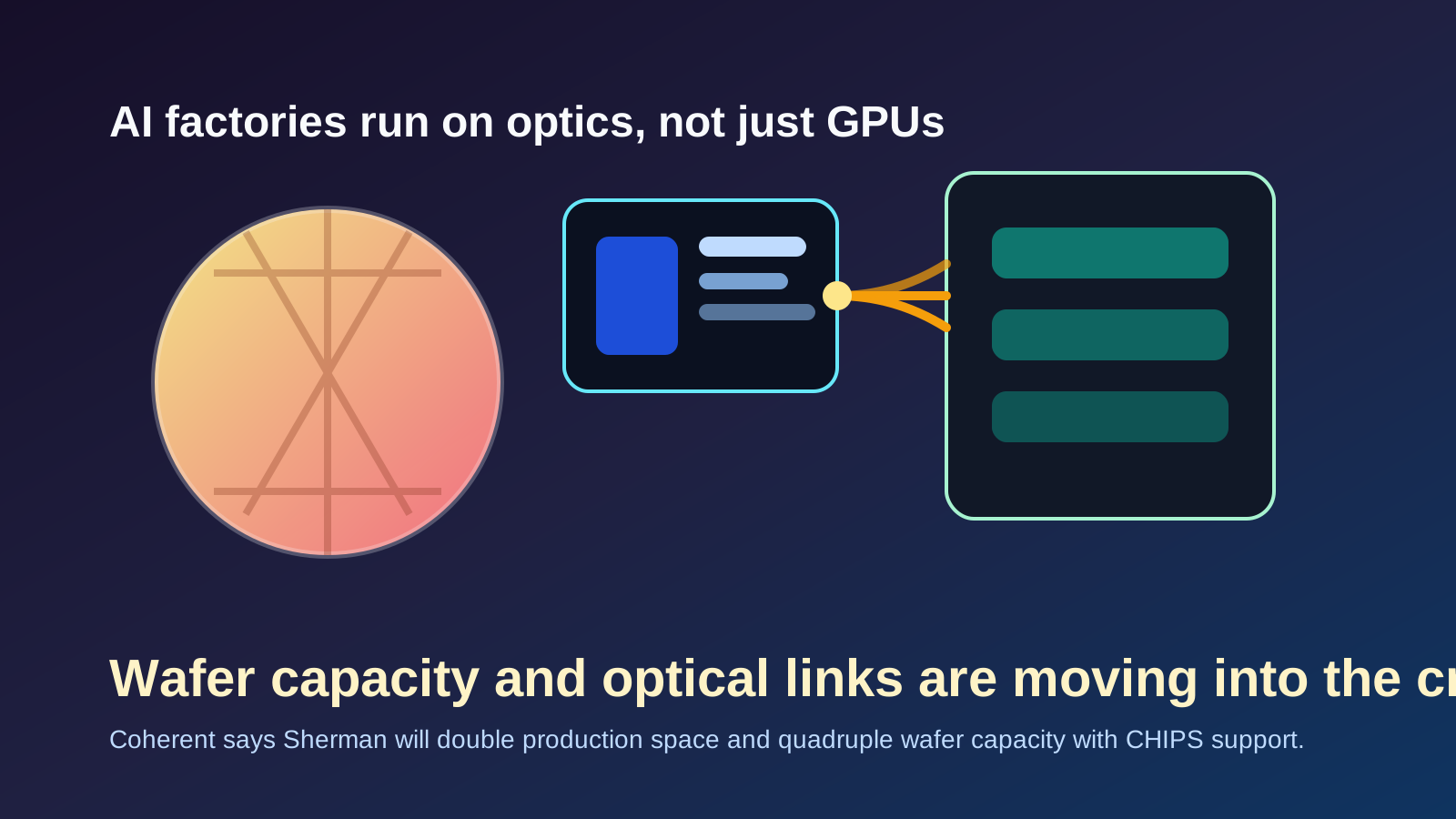
Coherent’s June 16 announcement clears the publish bar because it identifies an AI infrastructure choke point that still gets less attention than GPUs, power, or cooling. The company said it signed a letter of intent for up to $50 million in CHIPS Act funding to expand its 6-inch indium phosphide manufacturing facility in Sherman, Texas. The important read-through is not merely that another supplier won industrial-policy support. It is that optical networking hardware is moving into the critical path of AI capacity.
That is the stronger angle because AI systems do not scale on compute alone. Once clusters grow, the economic question becomes how fast data can move among chips, memory, servers, and fabrics without wasting power or stalling throughput. Coherent said the Sherman expansion will support the optical networking technologies that power next-generation AI datacenters. NVIDIA’s June 16 post made the same point more plainly: these wafers form the optical backbone that carries data through modern AI infrastructure at the speed of light.
The next AI bottleneck is not only more GPUs. It is whether the optical layer linking those systems can be manufactured at the same pace as the compute buildout.
The manufacturing details are what make the story useful for operators and investors. Coherent said the Sherman project will double manufacturing production space and quadruple wafer production capacity. That means this is not a symbolic ribbon-cutting around a vague future market. It is a capacity expansion tied to a specific component class that AI networks increasingly depend on as rack density rises and interconnect performance becomes a harder constraint.
The March 2 NVIDIA-Coherent partnership announcement makes the June 16 expansion more consequential. NVIDIA said it committed to a multiyear agreement that includes a multibillion-dollar purchase commitment, future access and capacity rights for advanced laser and optical networking products, and a $2 billion investment in Coherent to support research, future capacity, and U.S.-based manufacturing. Read together, the March and June announcements show a deeper pattern: hyperscale AI infrastructure is starting to lock up optical supply the way it previously locked up advanced compute.
That matters because optics are not an accessory layer. NVIDIA said optical interconnects and advanced package integration are foundational to the next phase of AI infrastructure because they enable ultrahigh-bandwidth, energy-efficient connectivity across AI factories. If that framing is right, then more token output per megawatt does not depend only on better chips. It also depends on whether the network linking those chips can be manufactured at scale, on time, and close enough to the buildout cycle.
The domestic-manufacturing angle is also stronger than the usual subsidy headline. Coherent said the CHIPS support builds on roughly $20 million from the Texas Semiconductor Innovation Fund and the Sherman Economic Development Corporation, while the project is expected to create more than 1,000 jobs, including more than 550 direct advanced manufacturing, engineering, and technical roles. That combination turns the story into a localized industrial-capacity build rather than a purely financial transfer.
This is why the article is worth publishing even after several recent infrastructure stories on chips and memory. Those pieces focused on compute supply or fab automation. Coherent is different because it highlights the communications layer inside AI systems. As model clusters get larger, the constraint shifts from acquiring accelerators to making sure the system can move information efficiently enough to keep them busy.
There are still limits. The CHIPS funding is a letter of intent, not completed capacity. Company press releases also describe the opportunity from the seller’s perspective, so the right conclusion is not that optics replace all other bottlenecks. The narrower and more defensible conclusion is that photonics manufacturing is becoming one of the next bottlenecks sophisticated AI investors and operators need to track.
That is enough to clear the bar. Search coverage around AI infrastructure still over-indexes on chips and megawatts. The more useful update is that the networking layer underneath those systems is now important enough to attract both federal industrial policy and long-duration purchase commitments from NVIDIA.
Sources
Coherent, “Coherent Announces a CHIPS Letter of Intent for $50 Million to Expand World-Leading Manufacturing Facility for AI Infrastructure,” published June 16, 2026: https://www.coherent.com/news/press-releases/a-chip-letter-of-intent-for-50m-to-expand-world-leading-manufacturing-facility-for-ai-infrastructure
NVIDIA Blog, “Coherent Breaks Ground on Expanded Texas Facility, Scaling AI’s Optical Backbone,” published June 16, 2026: https://blogs.nvidia.com/blog/coherent-texas-ai-optical/
NVIDIA Newsroom, “NVIDIA and Coherent Announce Strategic Partnership to Develop Optics Technology to Scale Next-Generation Data Center Architecture,” published March 2, 2026: https://nvidianews.nvidia.com/news/nvidia-and-coherent-announce-strategic-partnership-to-develop-optics-technology-to-scale-next-generation-data-center-architecture
By Nawaz Lalani
The Grid Report is written by Nawaz Lalani and focuses on source-backed coverage of AI infrastructure, grid power demand, automation systems, and market signals.
Follow the signal, not just the headline.
Get the daily Grid brief for source-backed coverage on AI power demand, infrastructure timing, automation, and market signals.