- AMD’s July 23 Advancing AI rollout clears the publish bar because the useful signal is not just that AMD launched new parts.
- That is the original angle.
- The hardware still matters, but mostly because it sits inside that stack.
- Section
- Infrastructure
- Read time
- 4 min read
AMD’s July 23 Advancing AI rollout clears the publish bar because the useful signal is not just that AMD launched new parts. The stronger story is operating model. Frontier AI infrastructure competition is becoming a co-design-and-deployment clock, where the winner is not the vendor with the cleanest keynote slide but the one that can translate model feedback into silicon, software, and real deployments quickly enough to matter.
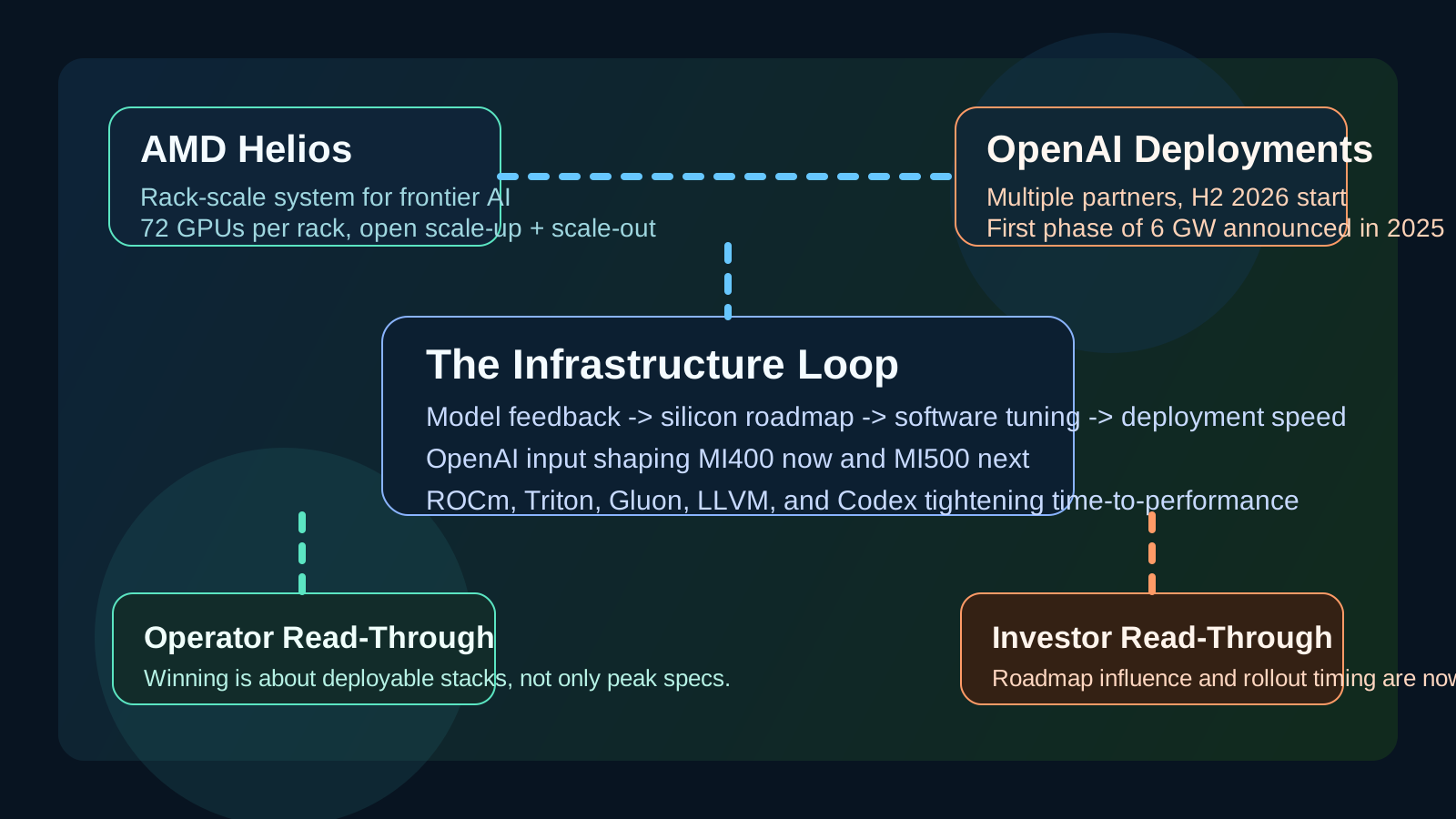
That is the original angle. AMD says OpenAI expects to begin bringing AMD Helios online through multiple deployment partners in the second half of 2026, with deployments accelerating through 2027. AMD also says that rollout is the first phase of the 6-gigawatt AMD GPU deployment the companies announced in October 2025. Read correctly, that is a timing story as much as a hardware story. Searchers looking up these announcements do not just need another benchmark summary. They need to know that the competition is shifting toward how fast a stack becomes operational at scale.
The real competition signal is not just a new GPU. It is whether model feedback, software readiness, and deployment partners can turn a roadmap into live capacity fast enough to matter.
The hardware still matters, but mostly because it sits inside that stack. AMD says Helios combines MI455X GPUs, 6th Gen EPYC CPUs, Pensando networking, and ROCm software in one rack-scale architecture. The company also says a single rack delivers up to 2.9 exaflops peak FP4, 31 terabytes of HBM4 memory, and 1.7 petabytes per second of memory bandwidth. Those numbers are headline material, but the more durable operator lesson is that AMD is no longer selling only components. It is trying to sell a repeatable rack-and-cluster building block that customers can actually deploy across growing campuses.
The OpenAI relationship is what pushes this beyond a normal product launch. AMD says OpenAI has had access to Helios systems for several months, that the companies are optimizing GPT-class workloads together, and that OpenAI input has helped shape the MI400 generation while continuing toward MI500. That matters because it turns a frontier-model customer into a roadmap input. In practice, that compresses the feedback loop between emerging workload behavior and the hardware-and-software decisions meant to serve it.
The software layer makes the thesis stronger. AMD says its work with OpenAI now spans Triton, Gluon, LLVM, and ROCm, and that Codex is becoming more useful for writing and adapting GPU code. Separately, AMD introduced ROCm.ai as a more agentic developer surface that brings AMD-specific guidance into Claude, Cursor, and Codex while automating parts of inference optimization. The read-through is that infrastructure competition is moving below the benchmark chart and into developer throughput: how quickly teams can install, debug, port, and tune workloads on a new platform without burning months of specialist time.
This is why the story belongs in infrastructure rather than generic AI or markets coverage. The question here is not whether AMD has a new GPU family. It is whether AMD can turn an open ecosystem pitch into a deployable alternative for frontier labs and hyperscale operators that want leverage against vertically integrated incumbents. Helios, MI400, and ROCm.ai only matter if they shorten time-to-performance in real customer environments.
This also clears the duplicate screen against the site’s last 30 days. AMD and Anthropic’s 2-gigawatt deal was about vertical lock-in and strategic alignment between a lab and a chip vendor. Wistron’s Fort Worth story was about assembly throughput. Spectrum-6 was about networking economics. This thesis is materially different. The sharper question here is whether AMD and OpenAI can turn roadmap intimacy and software preparation into faster live deployment at multi-gigawatt scale.
The investor and operator takeaway is the same. AI infrastructure competition is becoming harder to judge from silicon specs alone. The more important variables are whether a frontier customer is influencing the roadmap, whether the software stack is maturing fast enough to absorb that hardware, and whether deployment partners can turn those promises into online capacity on schedule. On July 23, AMD gave the market a clearer answer on all three. The next watchpoint is execution: second-half 2026 Helios bring-up and whether the first phase of that 6-gigawatt program arrives with real operational momentum rather than launch-day optimism.
Sources
AMD Newsroom, “AAI 2026: AMD Launches AMD Helios Rackscale Solution for Frontier AI,” published July 23, 2026: https://newsroom.amd.com/news/aai-2026-helios-update/
AMD Newsroom, “AMD and OpenAI: Collaborating Across Every Layer of the Stack,” published July 23, 2026: https://newsroom.amd.com/news/aai-2026-openai-update/
AMD Newsroom, “AAI 2026: AMD Launches AMD Instinct MI400 Series GPUs for Frontier AI, HPC,” published July 23, 2026: https://newsroom.amd.com/news/aai-2026-mi400-instinct-update/
AMD Newsroom, “AAI 2026: AMD ROCm.ai Accelerates AI Development Across AMD Platforms,” published July 23, 2026: https://newsroom.amd.com/news/aai-2026-rocm-ai-software/
By Nawaz Lalani
The Grid Report is written by Nawaz Lalani and focuses on source-backed coverage of AI infrastructure, grid power demand, automation systems, and market signals.
Follow the signal, not just the headline.
Get the daily Grid brief for source-backed coverage on AI power demand, infrastructure timing, automation, and market signals.