- Wistron’s July 21 Fort Worth opening clears the publish bar because it says something more useful than “AI manufacturing is coming back to America.” The stronger infrastructure signal is that AI capacity is becoming an assembly-throughput problem.
- That is the original angle.
- This belongs in infrastructure rather than generic industrial-policy coverage because the useful question is not whether domestic manufacturing sounds good.
- Section
- Infrastructure
- Read time
- 4 min read
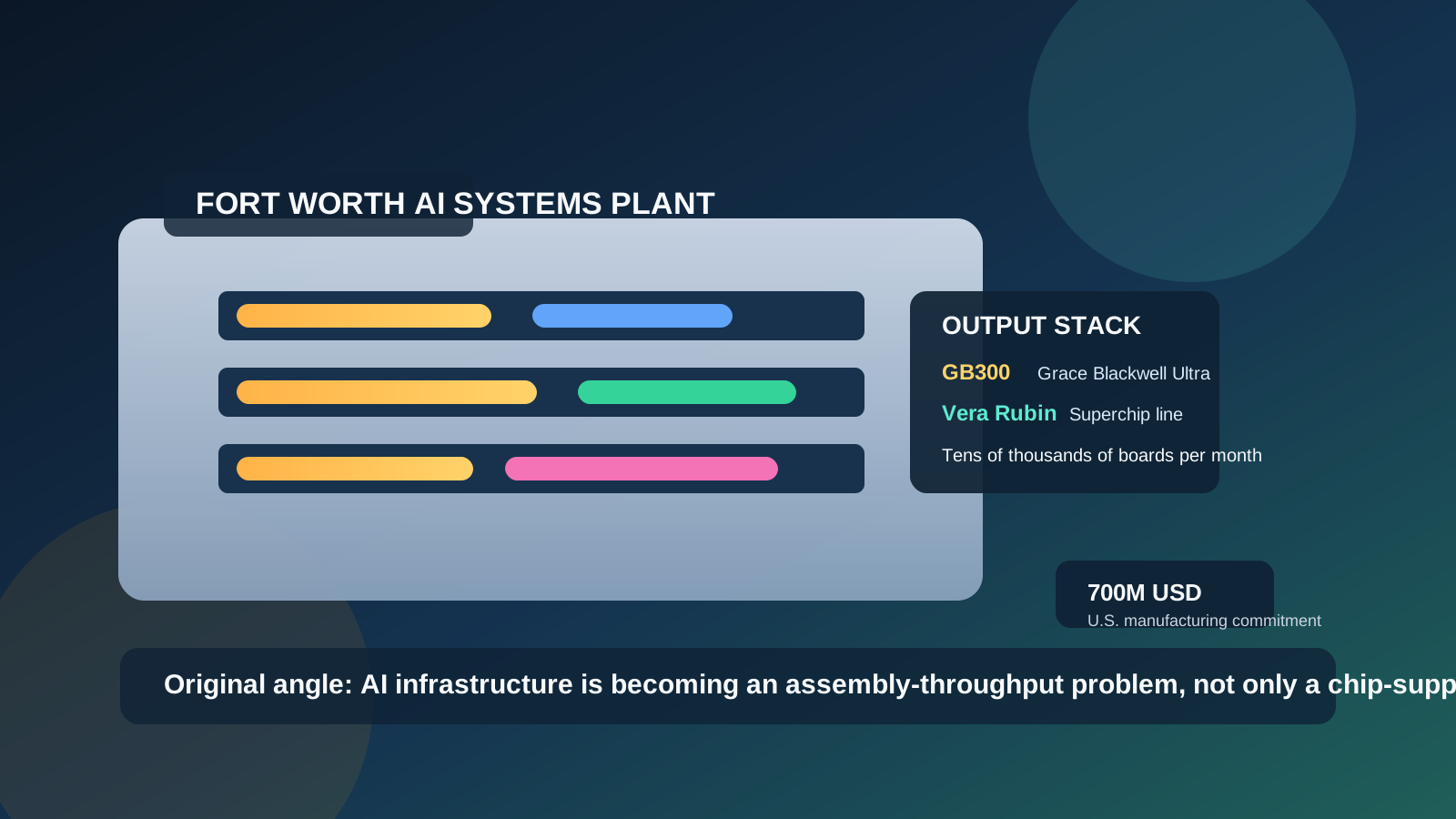
Wistron’s July 21 Fort Worth opening clears the publish bar because it says something more useful than “AI manufacturing is coming back to America.” The stronger infrastructure signal is that AI capacity is becoming an assembly-throughput problem. It is no longer enough to secure advanced chips and packaging. Somebody still has to turn those parts into finished systems, test them at scale, and ship them fast enough for cloud and enterprise deployments that are now measured in factories, not just servers.
That is the original angle. NVIDIA says Wistron’s new 324,000-square-foot D1 plant in Fort Worth is already producing Grace Blackwell Ultra systems and preparing Vera Rubin production, with the site scaling this year toward tens of thousands of boards per month. The company also ties the plant to a combined $700 million U.S. manufacturing commitment and says the facility has already created more than 500 jobs, with plans to reach 1,000 by year end. Read narrowly, that is a local factory opening. Read correctly, it is a sign that the AI bottleneck is moving downstream from chip design into systems assembly capacity.
The next AI bottleneck is not only who gets the chip. It is who can assemble, test, and ship full systems at industrial speed.
This belongs in infrastructure rather than generic industrial-policy coverage because the useful question is not whether domestic manufacturing sounds good. It is whether the U.S. can build enough assembly, testing, optics, cooling, and factory-process discipline to convert scarce silicon into deployable compute. Jensen Huang’s remarks at the opening make that read-through explicit. He framed AI systems as physical infrastructure and described building them “like phones” at volume. That language matters because it pushes the story away from one-off flagship hardware and toward repeatable manufacturing cadence.
The digital-twin layer strengthens the thesis. NVIDIA says Wistron designed and simulated the Fort Worth plant in a virtual environment before construction and used that model to validate line layouts, production processes, and worker training. That is not just branding fluff. It suggests that AI-factory buildout is starting to borrow manufacturing-speed tricks from other advanced industries: compress commissioning time, reduce line-design mistakes, and improve worker ramp before physical throughput becomes the next hard constraint.
This also clears the duplicate screen against the site’s last 30 days. The current inventory already covered chip supply, optics, networking, and fab ramps. It covered Micron as a site-speed race, TSMC as a 2-nanometer and packaging timing story, and NVIDIA Spectrum-6 as a networking utilization story. This thesis is materially different. The sharper question here is what happens after the chip exists: who can industrialize full-system assembly fast enough to keep the AI buildout moving.
The operator and investor relevance is straightforward. If the AI market is entering a phase where rack-scale systems and factory output matter more than prototype bragging rights, then manufacturing partners, test capacity, trained labor, and domestic supply-chain resilience become real compute variables. U.S. assembly capacity starts to matter not only for industrial policy, but for lead times, deployment confidence, and how much revenue hyperscalers can actually convert from booked demand.
There are still limits. This is a company-framed announcement, and Fort Worth alone does not solve the broader dependency chain across substrates, memory, optics, power gear, and grid-ready sites. But that caveat does not weaken the main read-through. It sharpens it: the AI race is becoming a volume-manufacturing contest across the entire systems stack, and assembly throughput now belongs inside serious infrastructure analysis.
That is enough to publish. Searchers looking up Wistron’s Fort Worth plant do not need another ribbon-cutting rewrite. The more useful answer is that the new constraint is increasingly the rate at which the U.S. can assemble and ship complete AI systems after the chips are already spoken for.
Sources
NVIDIA Blog, “Built in Fort Worth: Wistron Opens Advanced Manufacturing Plant to Produce NVIDIA AI Systems,” published July 21, 2026: https://blogs.nvidia.com/blog/wistron-manufacturing-texas/
NVIDIA Blog, “NVIDIA and Partners Build in America, for America,” published July 7, 2026: https://blogs.nvidia.com/blog/nvidia-and-partners-build-in-america-for-america/
By Nawaz Lalani
The Grid Report is written by Nawaz Lalani and focuses on source-backed coverage of AI infrastructure, grid power demand, automation systems, and market signals.
Follow the signal, not just the headline.
Get the daily Grid brief for source-backed coverage on AI power demand, infrastructure timing, automation, and market signals.