- Bristol Myers Squibb’s July 20 expansion clears the publish bar because it says something more useful than “big pharma is investing in AI.” The stronger signal is institutional.
- Both BMS and NVIDIA are explicit about the operational goal.
- The performance-per-megawatt claim is what pushes this into infrastructure rather than software news.
- Section
- Infrastructure
- Read time
- 4 min read
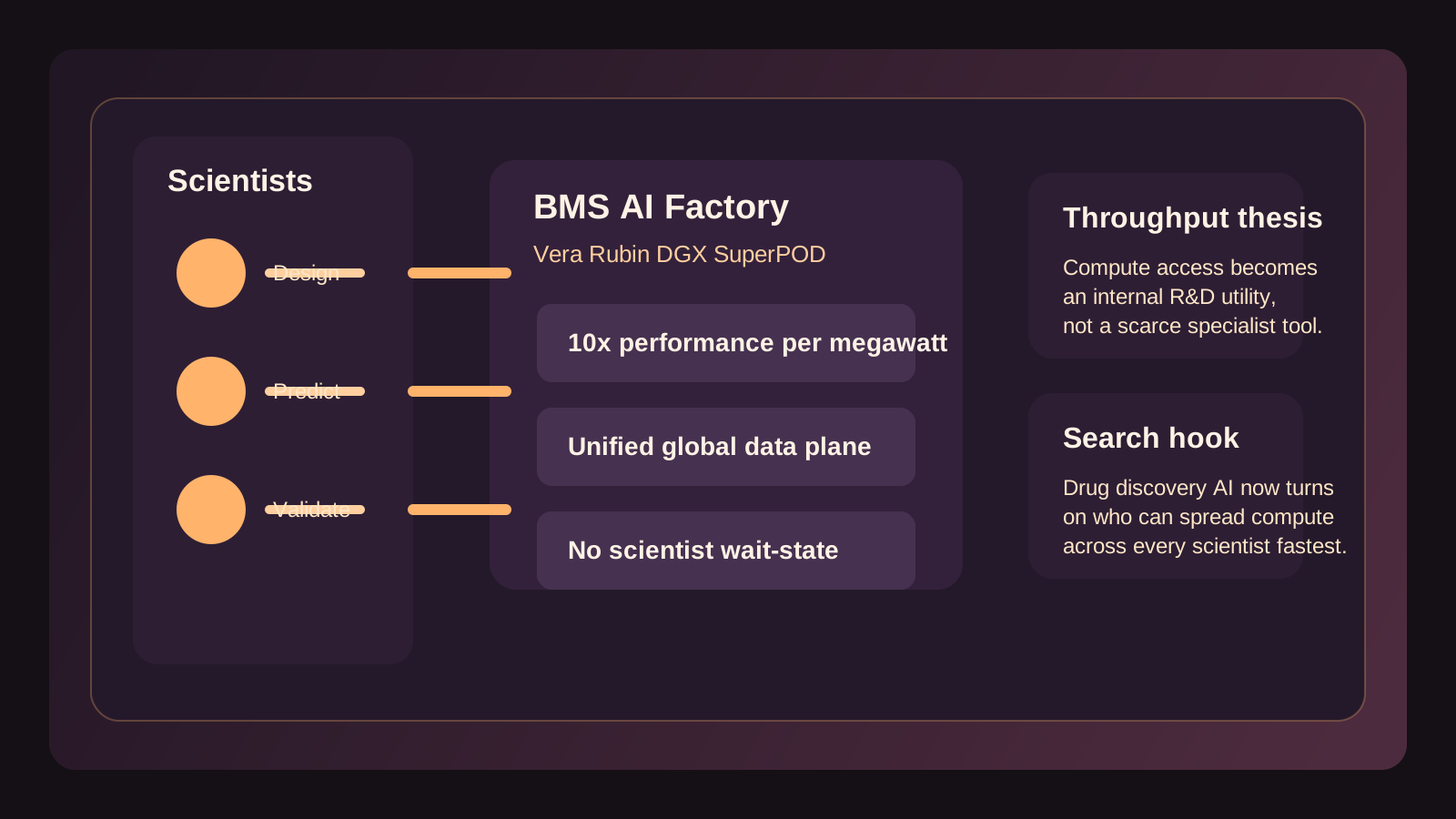
Bristol Myers Squibb’s July 20 expansion clears the publish bar because it says something more useful than “big pharma is investing in AI.” The stronger signal is institutional. BMS says it will deploy a new NVIDIA DGX SuperPOD built on eight DGX Vera Rubin NVL72 systems, giving it what the company calls the most powerful and energy-efficient single-owned NVIDIA infrastructure in life sciences. The more important read-through is that drug-discovery AI is becoming a scientist-throughput utility problem: once model quality is good enough, the bottleneck shifts to who can make high-end compute broadly usable across the research organization.
Both BMS and NVIDIA are explicit about the operational goal. BMS says the system is meant to scale proprietary models, compress discovery timelines, and widen access to predictive workflows across oncology, hematology, cardiovascular, immunology, and neuroscience programs. NVIDIA’s accompanying profile says the company is combining the new system with its existing SuperPOD into a unified environment so scientists do not have to queue behind a small specialist group. That is the useful angle. The win condition is not merely owning more GPUs. It is removing wait states between a scientist, a model, and a decision.
The real enterprise AI edge is starting to look like compute entitlement: which firms can put predictive infrastructure in front of every domain expert without making cluster access the bottleneck.
The performance-per-megawatt claim is what pushes this into infrastructure rather than software news. BMS says Vera Rubin can deliver up to ten times greater performance per megawatt than the infrastructure it is replacing. If that holds up in production, the implication is larger than one pharma headline. It suggests the next enterprise AI race in regulated, compute-heavy industries will be decided partly by how efficiently companies can turn power, racks, and orchestration into usable researcher minutes at scale.
That matters because drug discovery is not a one-team workflow anymore. BMS says AI-enabled target identification is already saving scientists weeks of manual work, and that the company is using predictive approaches to expand compound libraries and guide lead optimization. Once those loops become core to how a research organization decides what to synthesize, what to test, and what to drop, compute availability stops being a technical detail. It becomes part of institutional throughput, like lab equipment, assay capacity, or clinical data access.
The original Grid Report angle is that AI factories inside industry are increasingly built to flatten internal compute privilege. BMS executive Erin Davis told NVIDIA the goal is to open the system to “literally every scientist,” not a small elite group. Read plainly, that means frontier AI infrastructure is starting to function like a shared utility inside the firm. The companies with the strongest advantage may not be those with the flashiest model demo, but those that can make predictive computation available to thousands of domain experts fast enough to compound learning across the organization.
This also clears the duplicate screen. The site already covered NVIDIA’s July 17 Vera Rubin post-training push as a continuous-learning infrastructure story, UST’s Claude deployment as an engineering-validation layer, and Anthropic’s BMS deal in May as a shared-enterprise intelligence platform. This thesis is materially different. The signal here is that a large R&D institution is turning AI infrastructure into a high-availability internal service for scientists, with throughput and energy efficiency as the governing metrics.
There are still limits. The numbers come from BMS and NVIDIA, not an independent benchmark, and “opening access to every scientist” is harder in practice than it sounds once governance, data quality, and model reliability are factored in. More compute also does not guarantee more medicines. But those caveats do not weaken the main point. They define the next search-worthy question: which enterprises can translate frontier AI capacity into everyday operator leverage for the people who actually make decisions inside the workflow.
That is enough to publish. Searchers looking up the BMS-NVIDIA announcement do not need another AI-factory recap. The more useful answer is that drug-discovery competition is shifting toward a new infrastructure test: who can industrialize AI access across the research floor without making power, cluster scheduling, or specialist gatekeeping the next choke point.
Sources
Bristol Myers Squibb, “Bristol Myers Squibb to Build the Most Powerful AI Factory in Life Sciences with NVIDIA,” published July 20, 2026: https://news.bms.com/news/details/2026/Bristol-Myers-Squibb-to-Build-the-Most-Powerful-AI-Factory-in-Life-Sciences-with-NVIDIA/default.aspx
NVIDIA Blog, “Bristol Myers Squibb Building Life Science Industry’s Most Advanced AI Factory on NVIDIA Vera Rubin,” published July 20, 2026: https://blogs.nvidia.com/blog/bristol-myers-squibb-building-life-science-industrys-most-advanced-ai-factory-on-nvidia-vera-rubin/
Bristol Myers Squibb, “How Bristol Myers Squibb uses AI to validate drugs before they’re even in the lab,” accessed July 20, 2026: https://www.bms.com/our-science/technologies.html
By Nawaz Lalani
The Grid Report is written by Nawaz Lalani and focuses on source-backed coverage of AI infrastructure, grid power demand, automation systems, and market signals.
Follow the signal, not just the headline.
Get the daily Grid brief for source-backed coverage on AI power demand, infrastructure timing, automation, and market signals.