- Anthropic’s UST case study clears the publish bar because the useful signal is not that another services firm signed a partnership.
- Anthropic said on July 9 that UST, a technology and engineering services company working across semiconductors, automotive, manufacturing, telecom, embedded systems, and IoT, is putting Claude into the environments clients use to verify designs, validate chips, run factories, and support products after launch.
- The sharpest part of the case study is the iDEC workflow.
- Section
- AI Automation
- Read time
- 4 min read
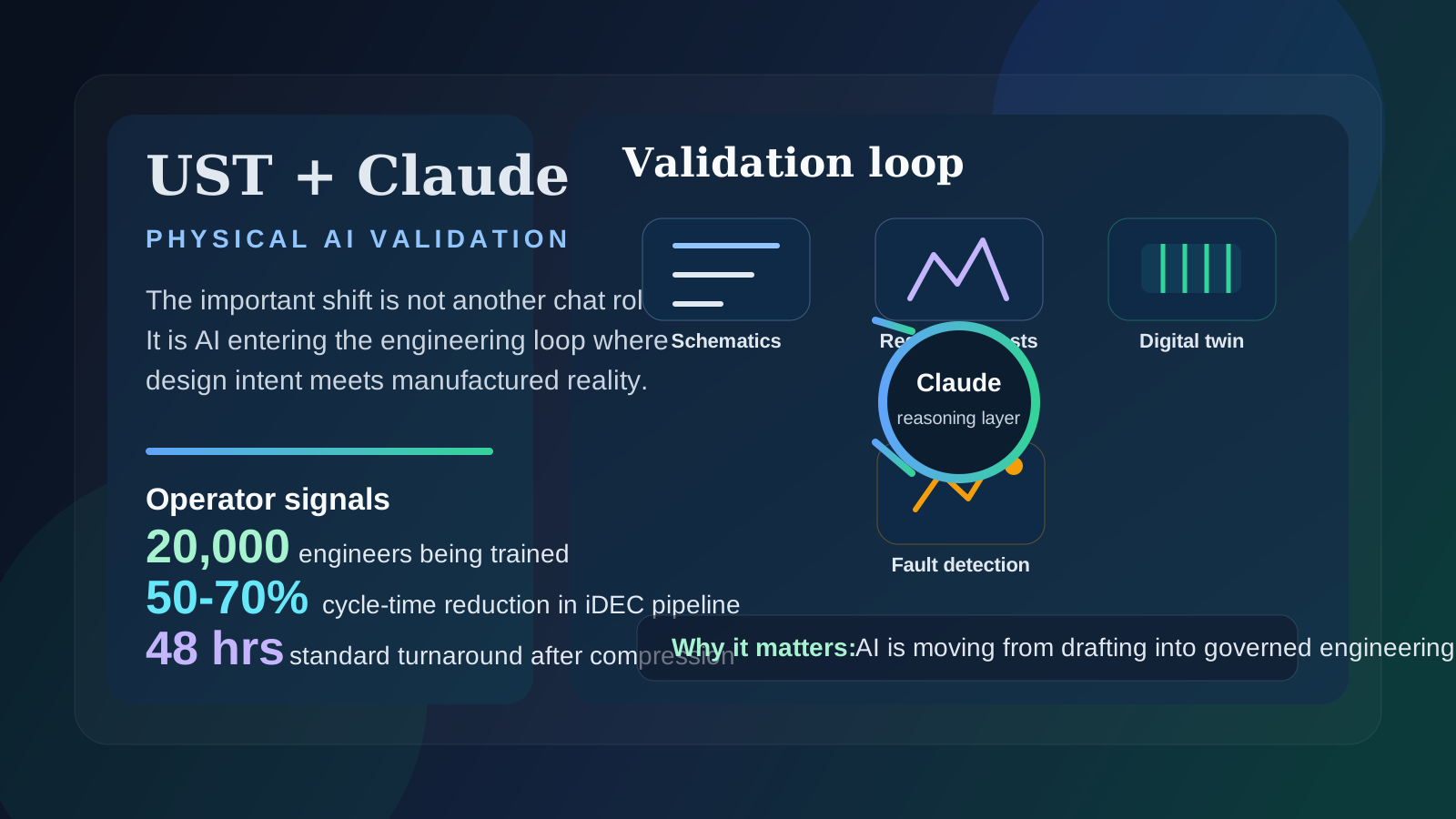
Anthropic’s UST case study clears the publish bar because the useful signal is not that another services firm signed a partnership. The stronger signal is that Claude is moving into engineering environments where the work is not just drafting or search, but validation: reading schematics, writing and running tests, comparing live equipment against digital twins, and surfacing faults before they become production problems.
Anthropic said on July 9 that UST, a technology and engineering services company working across semiconductors, automotive, manufacturing, telecom, embedded systems, and IoT, is putting Claude into the environments clients use to verify designs, validate chips, run factories, and support products after launch. It is also training 20,000 engineers, architects, and consultants on Claude worldwide. That matters because UST sits close to the systems where physical products are actually tested and shipped.
The useful shift is not AI helping engineers write faster. It is AI entering the validation loop where designs, tests, digital twins, and physical faults meet.
The sharpest part of the case study is the iDEC workflow. Anthropic says UST already uses iDEC to validate hardware and silicon before production, and that the platform’s closed-loop pipeline has cut validation cycle times by 50% to 70%, compressing standard four-day turnarounds into 48 hours. Claude is now being integrated as the reasoning layer inside that pipeline: Claude Code reads chip pinouts and hardware schematics, writes and runs regression tests, and compares live equipment data against a digital twin to flag firmware regressions and signal-integrity faults earlier.
That is the stronger thesis. AI is starting to move from office productivity into the engineering-validation loop that sits between design intent and manufactured reality. In those workflows, the economic value is not mainly faster writing. It is catching mistakes while they are still cheap, reducing hand-scripted testing, and tightening the feedback cycle between hardware, software, and real equipment behavior.
This belongs in systems because the product is the workflow. AP+ used Codex to speed payment simulations and reconciliation investigations. Deutsche Telekom used AI to reshape telco voice and network operations. UST adds a different layer: AI as a governed validation engine inside chip, factory, and device-development environments, where test generation and fault detection can materially change cycle time and defect risk.
The additional healthcare, telecom, and banking examples strengthen the case because they show UST is not treating Claude as a one-off pilot. Anthropic says Claude is also being embedded into care-management workflows, network-operations tooling, and banking modernization environments, always with human approval and audit controls. That makes the story more useful for operators evaluating whether AI can sit inside high-stakes production systems without removing human accountability.
There is an investor and infrastructure angle here too. Firms like UST can become distribution layers for industrial AI adoption because they already run the engineering and operations environments their clients depend on. If AI becomes part of validation, fault detection, and industrial workflow design, the winners may be the companies that can package model capability into governed, domain-specific systems rather than just sell more chat seats.
That gives the story search value. People looking for the UST-Anthropic announcement do not just need the partnership language. The more useful answer is that Claude is being positioned as a physical-AI validation layer inside engineering workflows where schematics, regression tests, digital twins, and production risk all meet.
Sources
Anthropic, “UST is bringing Claude to physical AI,” published July 9, 2026: https://www.anthropic.com/news/ust-claude
By Nawaz Lalani
The Grid Report is written by Nawaz Lalani and focuses on source-backed coverage of AI infrastructure, grid power demand, automation systems, and market signals.
Follow the signal, not just the headline.
Get the daily Grid brief for source-backed coverage on AI power demand, infrastructure timing, automation, and market signals.