- Anthropic’s June 23 Claude Tag launch clears the publish bar because the important signal is not that Claude can answer messages inside Slack.
- On Anthropic’s launch post, Claude Tag is presented as a way for anyone in a Slack channel to tag @Claude, delegate work, and get the result back in the thread while the whole exchange stays visible to the team.
- That matters because it changes the operating model for workplace agents.
- Section
- AI Automation
- Read time
- 4 min read
- Data included
- Claude Tag shifts the agent surface from one user to one channel
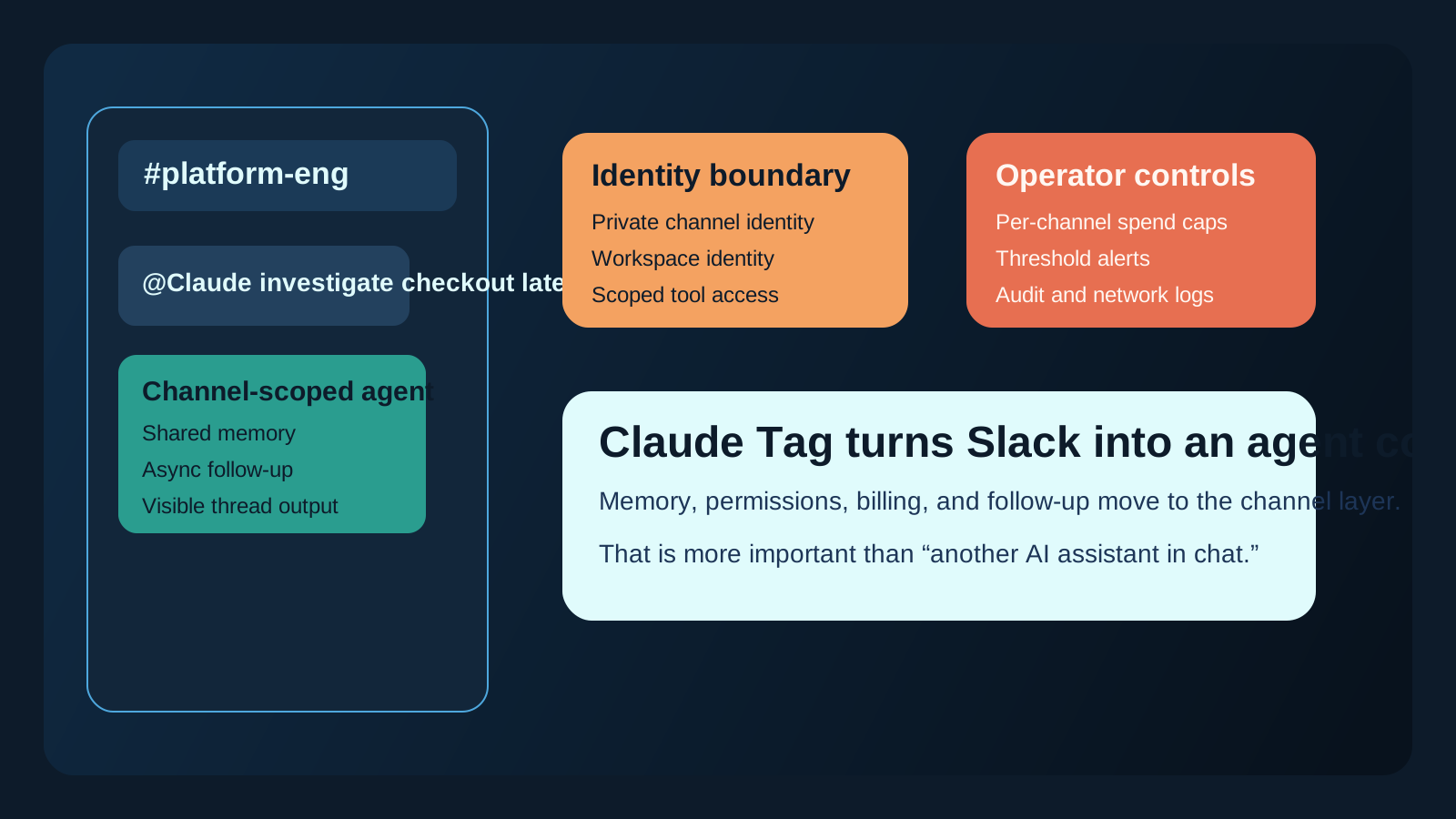
Claude Tag shifts the agent surface from one user to one channel
The system is interesting because Anthropic bundled delegation, memory, permissions, and billing into the same Slack operating surface.
| Control layer | Anthropic signal | Why operators should care |
|---|---|---|
| Invocation model | Anyone in a permitted channel can tag @Claude and assign work in-thread | The team channel becomes the unit of delegation instead of a private chat. |
| Memory model | Claude remembers relevant context at workspace and channel scope | Useful agents need continuity, but continuity has to stay bounded. |
| Identity model | Private channels get distinct identities; public channels share workspace identity | Permissions and memory stay tied to the channel boundary. |
| Governance model | Admins can set org-wide and per-channel spend limits plus threshold alerts | Agent usage turns into an operating-budget and controls question, not just adoption. |
| Audit model | Owners can review task history and network calls made through agent identity | Post-hoc review becomes possible when the agent touches code, data, and external tools. |
| Team adoption signal | Anthropic says 65% of its product-team code is created by its internal version | The product is already being framed around real production work, not lightweight assistance. |
Sources: Anthropic launch post, Claude Tag documentation, Claude Help Center documentation, and Anthropic’s agent-identity write-up.
Anthropic’s June 23 Claude Tag launch clears the publish bar because the important signal is not that Claude can answer messages inside Slack. The stronger signal is architectural: Anthropic is turning a shared channel into a governed agent workspace where memory, tools, permissions, and follow-up behavior are tied to the channel rather than to one user’s chat window.
On Anthropic’s launch post, Claude Tag is presented as a way for anyone in a Slack channel to tag @Claude, delegate work, and get the result back in the thread while the whole exchange stays visible to the team. Anthropic says the product can remember relevant context from the channels it is in, schedule work over hours or days, and proactively follow up when a thread stalls or a job finishes.
Claude Tag is not just Claude in Slack. It turns the Slack channel into the control surface for agent memory, permissions, spend, and follow-up.
That matters because it changes the operating model for workplace agents. A normal chat assistant is still mostly a one-person tool. Claude Tag moves the unit of work toward the team channel. In Anthropic’s own framing, the system is already being used internally for bug triage, product metrics, support work, and coding tasks, with the company saying 65% of its product-team code is created by its internal version of Claude Tag.
The more original angle is governance. Anthropic’s help documentation says channel tagging runs under the organization’s identity, not the individual user’s account, with separate billing from personal direct messages. Owners can set organization-wide and per-channel spend caps, receive threshold alerts, review per-channel analytics, and inspect an audit view that lists tasks and network calls made through the agent identity.
That is why this belongs in systems rather than generic AI product news. The bottleneck is no longer only model quality. Once teams want agents to chase bugs, open pull requests, pull account data, or work across repositories and internal tools, the real product becomes the control plane: who can invoke the agent, what it can reach, what memory persists, and how its spend and actions are reviewed after the fact.
Anthropic’s separate agent-identity write-up makes the boundary design explicit. Private channels get distinct identities, while public channels share a workspace-level identity. Memory and tool access stay inside those boundaries. For operators, that is the practical answer to a problem many enterprise AI pilots still dodge: an agent becomes more useful as it gains context and tools, but also more dangerous if identity and memory are not scoped tightly enough.
The story also extends current site coverage without repeating it. The Grid Report has already covered Claude Sonnet 5 as a lower-cost execution layer, Claude Science as a governed research workbench, and Alberta’s use of Claude Code in public-sector cybersecurity. Claude Tag is a different layer. It is about where the agent lives operationally once the model is good enough to be delegated real work by an entire team.
That gives the story search value. Readers looking up Claude Tag or Claude in Slack need more than a feature list. The more useful answer is that Anthropic is turning Slack into a channel-scoped agent control plane, where memory, identity, permissions, and spend management become the real product surface.
Sources
Anthropic, "Introducing Claude Tag," published June 23, 2026: https://www.anthropic.com/news/introducing-claude-tag
Claude documentation, "Work with Claude Tag": https://claude.com/docs/claude-tag/overview
Claude Help Center, "What is Claude Tag?": https://support.claude.com/en/articles/15594475-what-is-claude-tag
Claude Help Center release notes, June 23, 2026 entry: https://support.claude.com/en/articles/12138966-release-notes
Claude blog, "Agent identity: a new access model for autonomous, team-wide AI": https://claude.com/blog/agent-identity-access-model
By Nawaz Lalani
The Grid Report is written by Nawaz Lalani and focuses on source-backed coverage of AI infrastructure, grid power demand, automation systems, and market signals.
Follow the signal, not just the headline.
Get the daily Grid brief for source-backed coverage on AI power demand, infrastructure timing, automation, and market signals.