- Anthropic’s June 30 Sonnet 5 launch clears the publish bar because the useful signal is not simply that Claude got better.
- Anthropic says Sonnet 5 is the most agentic Sonnet model yet, able to plan, use browsers and terminals, and run autonomously at a level that recently required larger and more expensive models.
- The pricing is part of the story, not a footnote.
- Section
- AI Automation
- Read time
- 5 min read
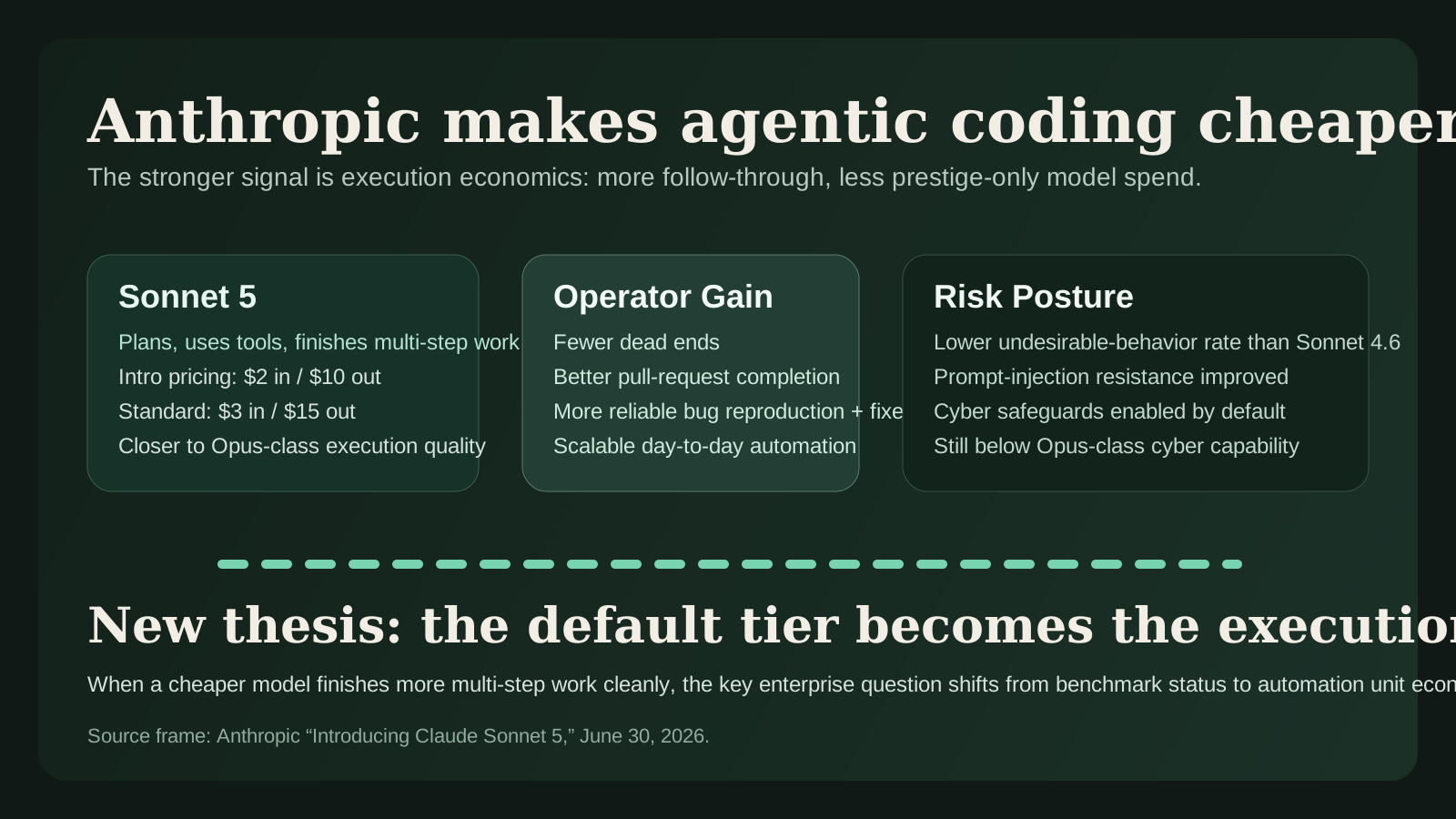
Anthropic’s June 30 Sonnet 5 launch clears the publish bar because the useful signal is not simply that Claude got better. The stronger Grid Report angle is that Anthropic is moving meaningful agentic coding and workflow execution into a cheaper tier, which makes follow-through quality and cost discipline more important than frontier prestige alone.
Anthropic says Sonnet 5 is the most agentic Sonnet model yet, able to plan, use browsers and terminals, and run autonomously at a level that recently required larger and more expensive models. It also says Sonnet 5 narrows the gap with Opus 4.8 while remaining lower priced. That combination matters because it pushes real execution capability down the cost curve instead of reserving it for the highest-end tier.
Sonnet 5 matters because it pushes credible agentic execution into a cheaper tier, turning coding automation into a practical runtime-budget decision instead of a prestige-model bet.
The pricing is part of the story, not a footnote. Anthropic launched Sonnet 5 at an introductory price of $2 per million input tokens and $10 per million output tokens through August 31, before moving to $3 and $15. Opus 4.8, by Anthropic’s own comparison, is priced at $5 and $25. For teams automating engineering, support, or operations workflows at volume, that pricing delta changes what kinds of work become economically routine.
The operator relevance is clearer in Anthropic’s early-user examples than in the benchmark tables. The company highlights users who say Sonnet 5 finished multi-step enterprise jobs end to end, carried difficult pull requests through tested results, wrote reproducing tests before fixing bugs, and stayed on plan across messy technical contexts. The consistent theme is not raw brilliance. It is lower-friction completion.
That is why this belongs in systems rather than a generic AI lane. Enterprises do not get value from a coding agent because it is impressive in a demo. They get value because it finishes more tasks cleanly, with less backtracking, at a price that can scale. Anthropic’s own framing around cost-performance curves and effort levels effectively treats agentic work as a managed execution budget.
There is also a risk-control angle. Anthropic says Sonnet 5 shows lower rates of undesirable behavior than Sonnet 4.6, resists malicious requests and prompt injection more effectively, and launches with cyber safeguards enabled by default. At the same time, it says Sonnet 5 remains substantially less capable than Opus-class models on dangerous exploit-development tasks. That matters because it gives Anthropic a commercial middle tier that is more deployable for day-to-day work without carrying the same cyber posture as its top-end models.
This angle is materially different from the site’s recent Claude Science coverage. Claude Science was about a governed research workbench. Sonnet 5 is about the execution layer underneath broader AI automation: cheaper autonomous follow-through on coding and workflow tasks that enterprises can actually run at scale.
That is enough to publish. Searchers looking for Claude Sonnet 5 do not need another benchmark summary. The more useful answer is what Anthropic is actually changing: capable agentic execution is moving into a lower-cost default tier, and that makes automation economics much more practical.
Sources
Anthropic, “Introducing Claude Sonnet 5,” published June 30, 2026: https://www.anthropic.com/news/claude-sonnet-5
Anthropic Claude Sonnet 5 system card for capability and safety context: https://www-cdn.anthropic.com/480e0bb54327b9622282e9c39a83a4f490ed377e/Claude%20Sonnet%205%20System%20Card.pdf
By Nawaz Lalani
The Grid Report is written by Nawaz Lalani and focuses on source-backed coverage of AI infrastructure, grid power demand, automation systems, and market signals.
Follow the signal, not just the headline.
Get the daily Grid brief for source-backed coverage on AI power demand, infrastructure timing, automation, and market signals.