- OpenAI Presence clears the publish bar because it says something more useful than “enterprises can deploy AI agents.” The stronger signal is operational.
- That is the original angle.
- This belongs in systems rather than generic AI product coverage because the useful question is no longer whether an enterprise agent can answer a question.
- Section
- AI Automation
- Read time
- 4 min read
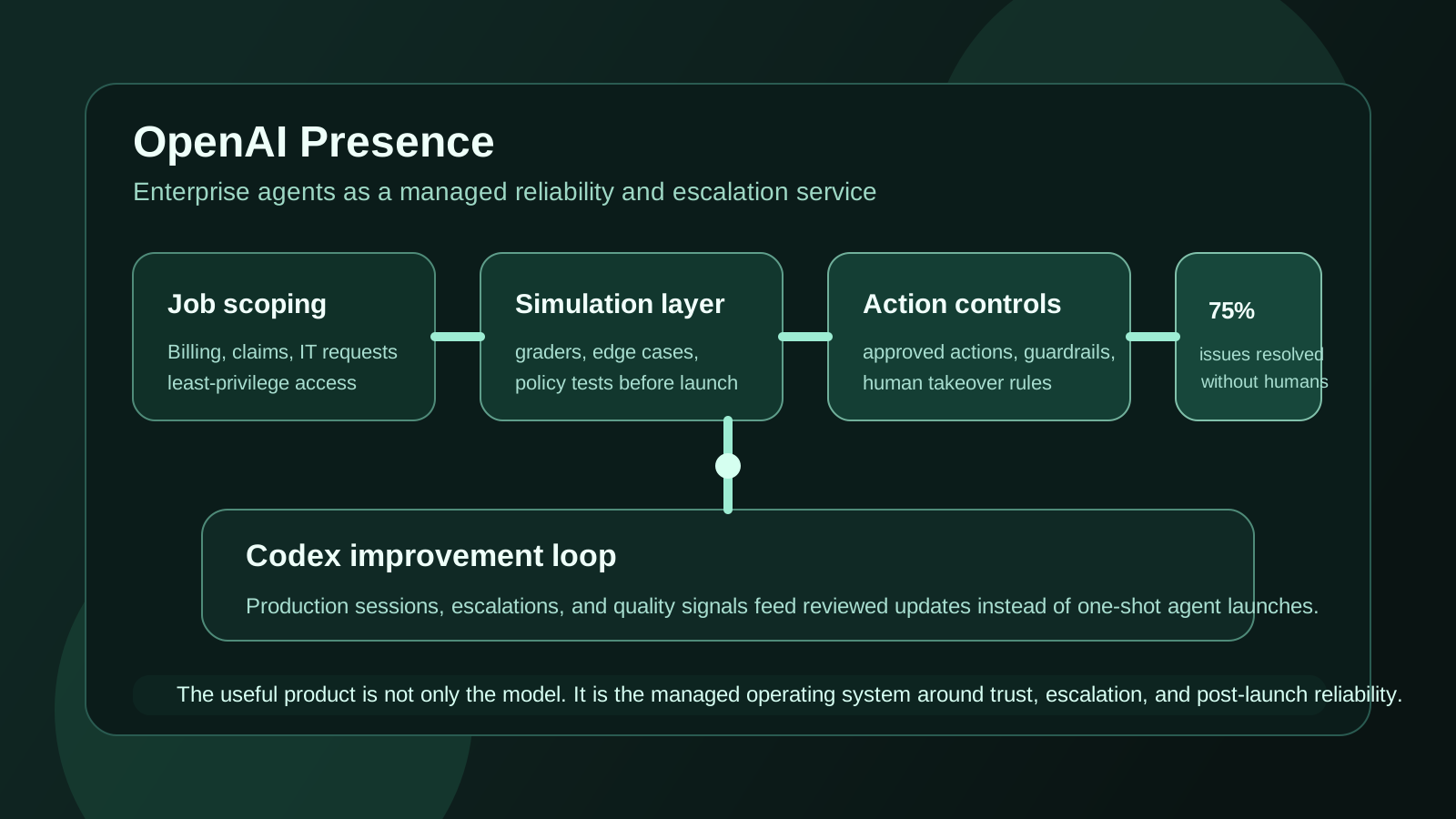
OpenAI Presence clears the publish bar because it says something more useful than “enterprises can deploy AI agents.” The stronger signal is operational. OpenAI is packaging agent deployment as a managed reliability and escalation service, not as a self-serve model feature. That means the product being sold is not only reasoning quality. It is the full operating system around scope, approvals, policy enforcement, testing, monitoring, and controlled iteration after launch.
That is the original angle. OpenAI says Presence is available today for voice and chat agents handling jobs such as billing support, insurance claims, and internal IT service requests. The company says each deployment starts with a tightly defined job, limited knowledge access, explicit rules for what the agent can do, and clear conditions for when a person should take over. Before launch, teams can run simulations and graders against edge cases and higher-risk scenarios. After launch, production sessions and escalations feed a Codex-powered improvement process that proposes updates teams can test and approve. Read correctly, this is an operations product for keeping agents dependable in production.
The enterprise agent product is maturing into a reliability service: narrow the job, test the edges, govern the actions, and keep the escalation path clean.
This belongs in systems rather than generic AI product coverage because the useful question is no longer whether an enterprise agent can answer a question. The harder question is whether it can stay within policy while products, customer behavior, and internal rules keep changing. Presence is OpenAI’s answer to that problem. It treats enterprise agents less like finished software and more like a governed service that needs continuous measurement and maintenance.
The strongest proof point is operational, not rhetorical. OpenAI says Presence now powers its own English-language phone support line at 1-888-GPT-0090, resolves 75% of inbound issues without human assistance, and cut handoffs by 15 percentage points in 10 days through the improvement loop. Those are company-reported numbers, but they matter because they frame Presence as a reliability program with measurable service outcomes rather than a bundle of agent demos.
This also explains why the launch is not materially similar to the site’s recent agent coverage. Google’s managed-agents update was about background execution and MCP control. OpenAI’s long-horizon safety post was about trajectory monitoring and rollback. Deutsche Telekom’s case study was about AI moving into the voice and network layer. This thesis is different. The sharper question here is what happens after a company decides it wants agents in production and discovers the real work is operationalizing trust, escalation, and continuous upkeep.
The limited-availability model reinforces that read-through. OpenAI says Presence is offered to eligible enterprise customers through a limited general availability program led by Forward Deployed Engineers and select global systems integrators, not as a self-serve product. That means OpenAI is implicitly acknowledging that many enterprise agent deployments still require service-heavy implementation, workflow design, and post-launch tuning. In other words, the company is monetizing the reliability layer around agents, not just the models underneath them.
The operator relevance is straightforward. Enterprise buyers should expect serious agent deployments to need narrower job definitions, explicit permission design, simulation coverage, escalation rules, and a measured post-launch update process. Vendors that cannot provide those layers may still win demos, but they will struggle to own high-value workflows where failure, policy drift, or bad handoffs carry real cost.
There are still limits. OpenAI is describing its own product on its own terms, and Presence is not yet broadly available. The design-partner logos do not prove universal product-market fit. But those caveats do not weaken the main read-through. They sharpen it: enterprise agents are maturing into a managed operations business where reliability work is part of the product, not a support function bolted on later.
That is enough to publish. Searchers looking up OpenAI Presence do not need another launch recap about voice and chat agents. The more useful answer is that OpenAI is trying to sell the reliability, escalation, and maintenance layer that stands between an impressive agent demo and a trusted production workflow.
Sources
OpenAI, “Introducing OpenAI Presence,” published July 22, 2026: https://openai.com/index/introducing-openai-presence/
By Nawaz Lalani
The Grid Report is written by Nawaz Lalani and focuses on source-backed coverage of AI infrastructure, grid power demand, automation systems, and market signals.
Follow the signal, not just the headline.
Get the daily Grid brief for source-backed coverage on AI power demand, infrastructure timing, automation, and market signals.