- Google’s July 7 managed-agents update clears the publish bar because it says something more useful than “agents can use tools.” The stronger signal is that Google is assembling the operator surfaces that make agents governable in production: long-running execution that survives disconnected clients, direct access to remote MCP servers, explicit handoff between hosted tools and local business logic, and network credential rotation without rebuilding the environment from scratch.
- The release itself is specific.
- The most important piece is background execution.
- Section
- AI Automation
- Read time
- 4 min read
Google’s July 7 managed-agents update clears the publish bar because it says something more useful than “agents can use tools.” The stronger signal is that Google is assembling the operator surfaces that make agents governable in production: long-running execution that survives disconnected clients, direct access to remote MCP servers, explicit handoff between hosted tools and local business logic, and network credential rotation without rebuilding the environment from scratch.
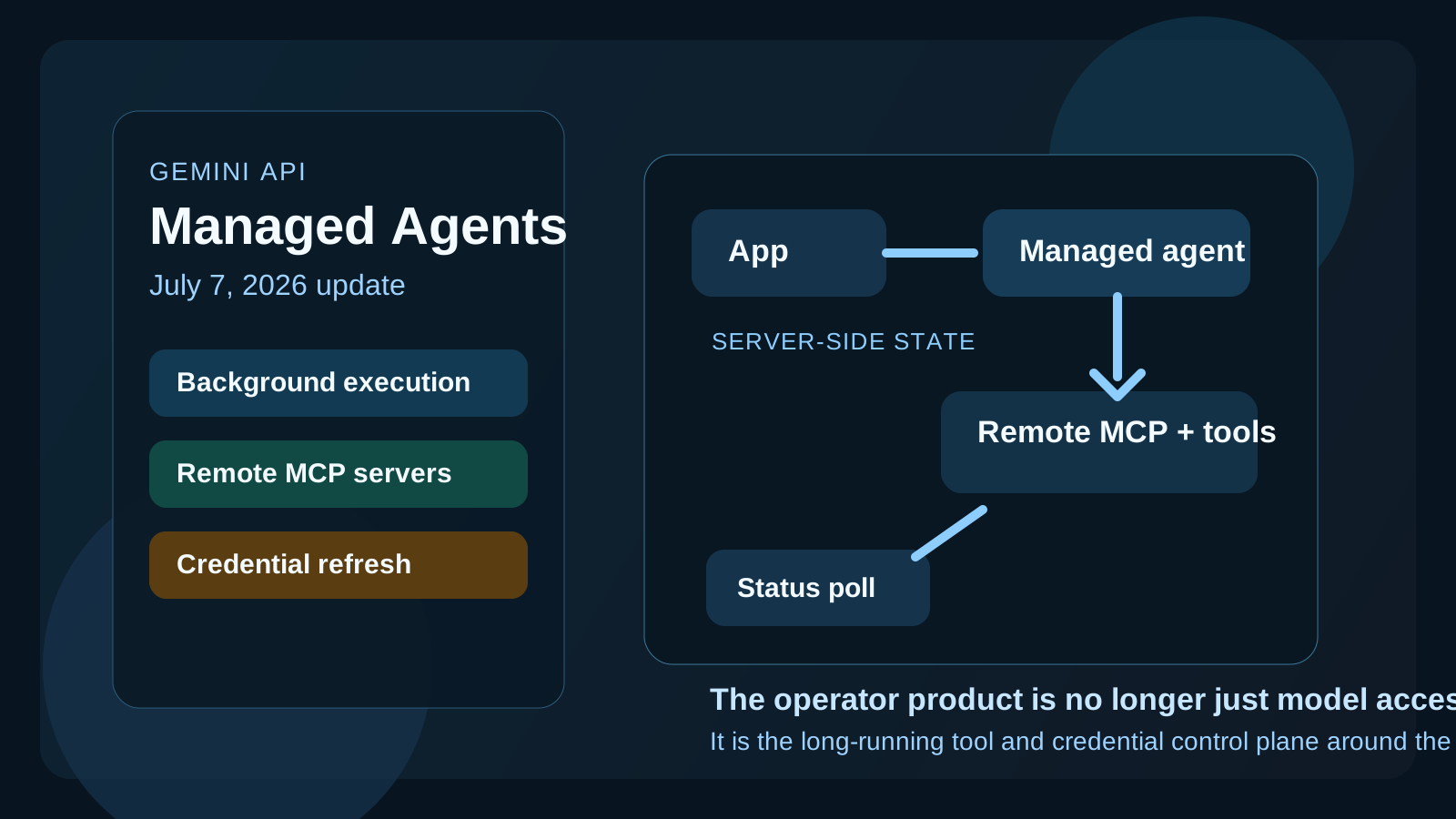
The release itself is specific. Google said managed agents in the Gemini Interactions API now support background execution, remote MCP server integration, custom function calling alongside built-in sandbox tools, and credential refresh across interactions. On its own, each feature sounds incremental. In combination, they shift the product from a short-lived coding sandbox toward something much closer to an agent runtime that can stay alive, keep state, and work against real enterprise systems.
The agent product is no longer only the model. It is the long-running runtime around the model: state, tools, credentials, and reconnectable execution.
The most important piece is background execution. Google’s example is straightforward: start an interaction with `background: true`, get back an ID immediately, then poll, stream progress, or reconnect later while the agent keeps running remotely. That matters because open HTTP connections are not the real product bottleneck for serious agents. The bottleneck is whether a task can keep running once the user closes the tab, the client restarts, or the workflow takes longer than a synchronous request budget allows.
Remote MCP support is the second layer that makes this more than a convenience release. Google now lets managed agents connect directly to remote MCP servers from the secure sandbox instead of forcing developers to build custom proxy middleware first. The operator read-through is that MCP is becoming less of a local demo protocol and more of a practical enterprise ingress layer for observability systems, internal APIs, and private data sources that agents need in order to do real work.
The credential-refresh detail is what makes the runtime thesis stronger. Google says developers can keep an environment alive while replacing expired tokens or rotating API keys on the next interaction, preserving filesystem state, installed packages, and cloned repositories. That is a much more production-shaped behavior than a stateless chatbot loop. Once credentials, environments, and long-running jobs persist across turns, the real product is not just model access. It is the operating layer around the model.
The official docs reinforce that direction. Google says the Interactions API is now generally available and recommended for all new projects, with new agentic features launching there by default. The docs also spell out why this matters operationally: observable execution steps, optional server-side state via `previous_interaction_id`, stored interactions for background execution, and retention controls for paid-tier projects. Those are control-plane concerns, not novelty-demo concerns.
This is also why the story clears the duplicate screen. The site already covered Anthropic’s Claude Tag as a channel-scoped control plane inside Slack, HPE’s AI Factory push as runtime governance, and OpenAI’s scorecard as a unit-economics discipline for enterprise adoption. Google’s July 7 update is materially different. The thesis here is not collaboration, spend discipline, or admin review inside a finished app. It is that the underlying agent runtime is becoming persistent, reconnectable, and enterprise-integrated at the API layer itself.
There are still real limits. Google’s own Interactions API docs say Gemini 3 does not yet support remote MCP, “coming soon,” which means the current implementation is narrower than a casual reading of “Gemini API” might suggest. Much of the blog post is demonstrated against Google’s managed Antigravity agent rather than generic model calls. That nuance matters. But it does not weaken the signal. It sharpens it: Google is telling developers that production-grade agent patterns will arrive first through the managed runtime path, not through bare model endpoints alone.
That is enough to publish. People searching for this release do not need another feature recap. The more useful answer is that Google is turning Gemini API into a more durable agent control plane where background work, MCP access, state, tool routing, and credential hygiene are starting to converge into one runtime product.
Sources
Google Blog, “Expanding Managed Agents in Gemini API: background tasks, remote MCP and more,” published July 7, 2026: https://blog.google/innovation-and-ai/technology/developers-tools/expanding-managed-agents-gemini-api/
Google AI for Developers, “Interactions API,” last updated July 16, 2026: https://ai.google.dev/gemini-api/docs/interactions-overview
By Nawaz Lalani
The Grid Report is written by Nawaz Lalani and focuses on source-backed coverage of AI infrastructure, grid power demand, automation systems, and market signals.
Follow the signal, not just the headline.
Get the daily Grid brief for source-backed coverage on AI power demand, infrastructure timing, automation, and market signals.