- Microsoft and Databricks’ July 23 partnership expansion clears the publish bar because it says something more useful than “two big companies are working together on AI.” The stronger signal is market shape.
- That is the original angle.
- Microsoft makes the problem statement unusually explicit.
- Section
- AI Automation
- Read time
- 4 min read
Microsoft and Databricks’ July 23 partnership expansion clears the publish bar because it says something more useful than “two big companies are working together on AI.” The stronger signal is market shape. Enterprise AI is hardening into a business-context and governance stack, where the real bottleneck is not access to a model but whether the system can understand company data, stay inside the workflow, and remain governable at scale.
That is the original angle. Microsoft says the partnership now extends into the 2030s, with Databricks deepening its use of Azure Databricks to run its own core business operations and analytics. The release also says Microsoft will keep integrating Databricks capabilities such as Genie and Unity AI Gateway across the Microsoft stack, including Microsoft 365 workflows. Read correctly, this is an admission that the next enterprise AI fight is less about who has a model and more about who controls the context layer around that model.
The next enterprise AI bottleneck is not model access. It is whether the system can understand the business, stay governed, and run cheaply enough to scale.
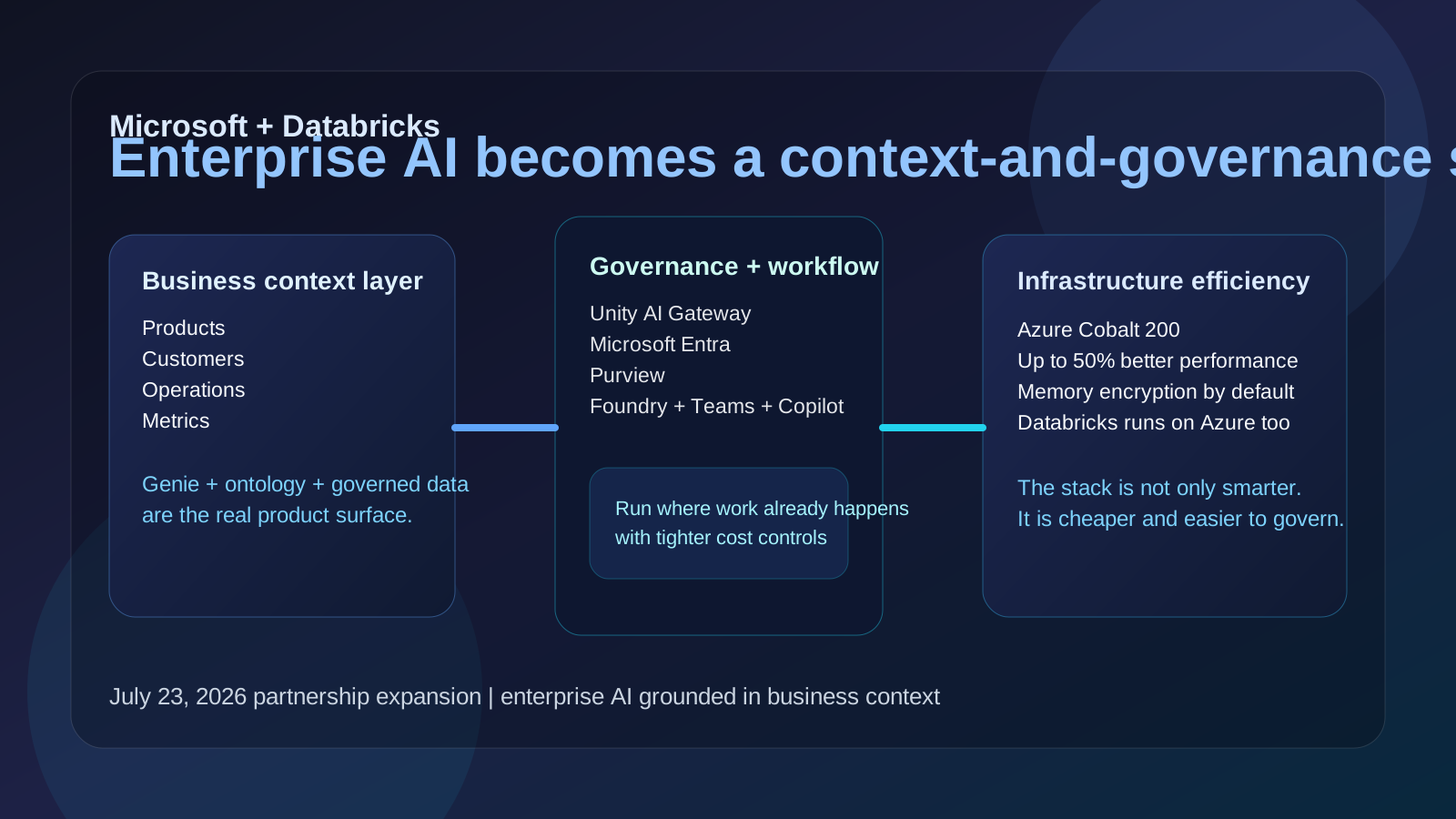
Microsoft makes the problem statement unusually explicit. The company says enterprises want AI that understands their customers, products, operations, metrics, and business processes, but still struggle to connect AI to trusted business knowledge, govern models and agents consistently, and control costs. That is why this belongs in systems rather than generic AI coverage. The important product is not just the model endpoint. It is the operating system that grounds the model in real business logic.
The tooling details reinforce that read-through. Microsoft says the integration now spans Microsoft Entra, Azure Data Lake Storage, Microsoft security tooling, OneLake, Power BI, Purview, Foundry, Power Platform, Microsoft 365, Teams, and Copilot. Databricks says Genie and Genie Ontology help ground agents on enterprise data, while Unity AI Gateway governs models, agents, and cost. In practice, this is the enterprise AI stack becoming more opinionated: identity, data access, semantic context, workflow insertion, and spend control are being bundled closer together.
There is also an infrastructure message underneath the software story. Microsoft says Databricks is increasing its use of Azure Cobalt and plans to adopt Cobalt 200. That matters because Microsoft’s own Azure Cobalt 200 launch argued that agentic and data-intensive workloads need materially different compute economics, including up to 50% better generational CPU performance and memory encryption enabled by default. The useful implication is that enterprise AI scale is now being optimized simultaneously at the ontology layer and at the infrastructure-cost layer.
This clears the duplicate screen against the site’s last 30 days. Google’s managed-agents update was about background execution and MCP control planes. OpenAI Presence was about managed reliability and escalation for enterprise agents. Microsoft and Mistral was about sovereign deployment and customer control in regulated industries. This thesis is materially different. The more important question here is how enterprise AI gets grounded in business context and governed across the systems employees already use.
The operator takeaway is straightforward. A lot of enterprise AI projects still fail because they bolt a capable model onto weak data semantics, loose identity controls, or unclear workflow boundaries. Microsoft and Databricks are signaling that those layers are becoming the product. If that stack works, enterprises get agents that understand the business well enough to be useful. If it fails, better models alone will not rescue the deployment.
That is why this is publishable. Searchers looking up the Microsoft and Databricks expansion do not need another recycled paragraph about AI transformation. The more useful answer is that enterprise AI is being redefined as a context-and-governance problem with an infrastructure-efficiency component underneath it. That is where the next durable leverage, and the next spending discipline, are likely to show up.
Sources
Microsoft, “Databricks and Microsoft expand partnership to help enterprises bring business context to enterprise AI,” published July 23, 2026: https://news.microsoft.com/source/2026/07/23/databricks-and-microsoft-expand-partnership-to-help-enterprises-bring-business-context-to-enterprise-ai/
Microsoft Azure Blog, “New Azure Cobalt 200 VMs deliver 50% performance improvement, fully optimized for modern agentic AI workloads,” accessed July 23, 2026: https://azure.microsoft.com/en-us/blog/new-azure-cobalt-200-vms-deliver-50-performance-improvement-fully-optimized-for-modern-agentic-ai-workloads/
By Nawaz Lalani
The Grid Report is written by Nawaz Lalani and focuses on source-backed coverage of AI infrastructure, grid power demand, automation systems, and market signals.
Follow the signal, not just the headline.
Get the daily Grid brief for source-backed coverage on AI power demand, infrastructure timing, automation, and market signals.