- The July 9 GPT-5.6 in Copilot announcement clears the publish bar because the useful signal is not just that Microsoft 365 gets OpenAI’s latest flagship model.
- OpenAI said on July 9 that GPT-5.6 will become the preferred model in Microsoft 365 Copilot across Word, Excel, PowerPoint, Chat, and Cowork, and that Microsoft will access the model through the OpenAI API.
- That architecture matters because it creates a new control surface for enterprise AI rollouts.
- Section
- AI Automation
- Read time
- 5 min read
The July 9 GPT-5.6 in Copilot announcement clears the publish bar because the useful signal is not just that Microsoft 365 gets OpenAI’s latest flagship model. The stronger signal is that Microsoft is turning model access inside a mainstream enterprise suite into a governed provider decision, with explicit admin controls over whether OpenAI-operated models can run there at all.
OpenAI said on July 9 that GPT-5.6 will become the preferred model in Microsoft 365 Copilot across Word, Excel, PowerPoint, Chat, and Cowork, and that Microsoft will access the model through the OpenAI API. On its own, that would still risk reading like commodity model-launch filler. Microsoft’s own documentation is what makes the story stronger. The company says OpenAI as a subprocessor became available for use on July 9, 2026, giving commercial customers a distinct path to use OpenAI-operated models inside Microsoft Online Services rather than only Microsoft-operated Azure OpenAI delivery.
Microsoft turned GPT-5.6 in Copilot into an admin decision: who gets OpenAI-operated models, when they turn on, and which compliance boundaries rule them out.
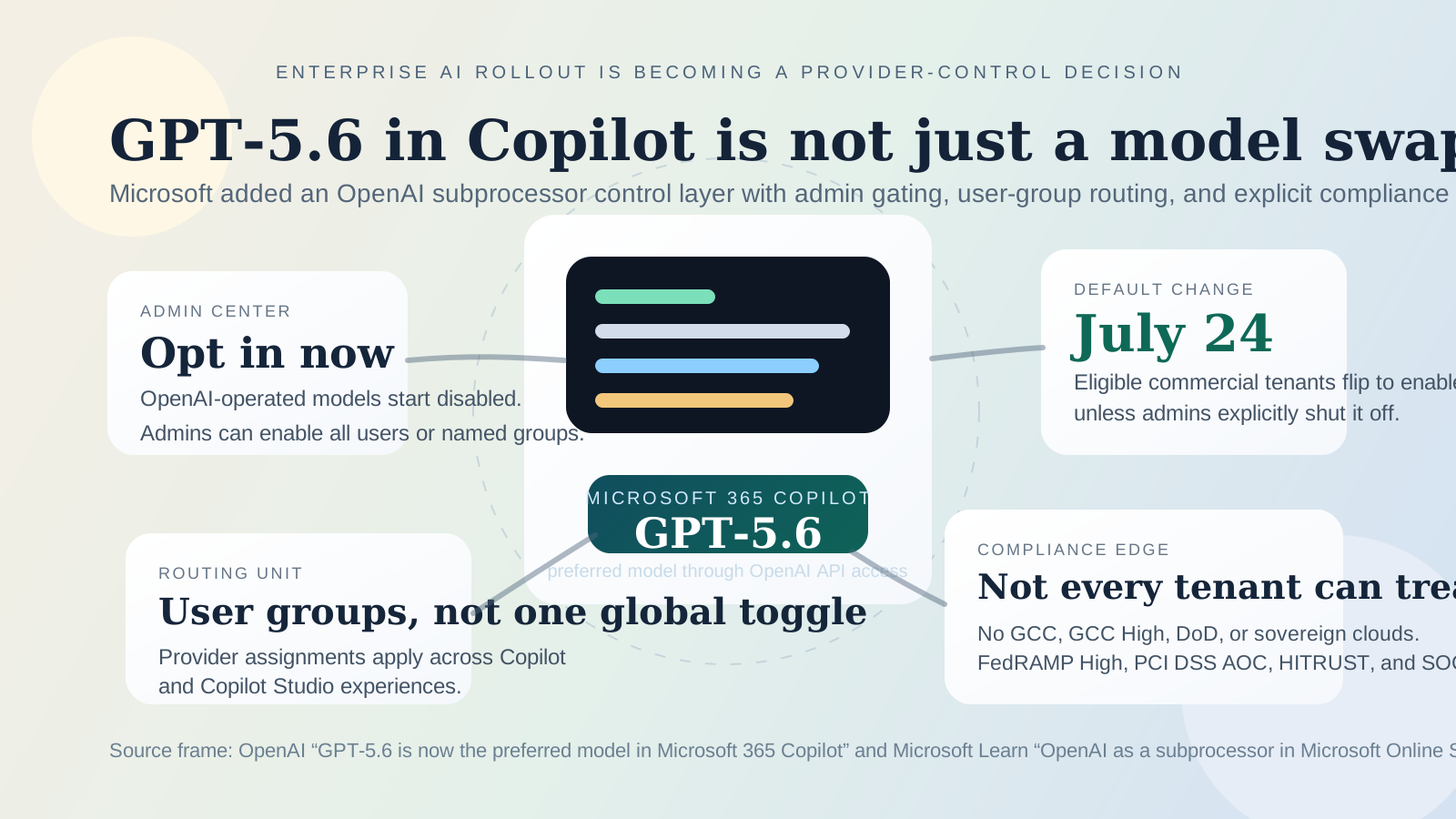
That architecture matters because it creates a new control surface for enterprise AI rollouts. Microsoft says OpenAI-operated models are currently disabled for all customers, that organizations can enable them in the Microsoft 365 admin center, and that admins can choose all users or restrict access to specific users and groups. In other words, GPT-5.6 in Copilot is not simply a universal model refresh. It is a provider-routing and permissions decision that sits inside the Microsoft 365 control plane.
The timing makes the operational implication sharper. Microsoft says that starting on July 24, 2026, OpenAI-operated models will be enabled for all users for eligible commercial customers unless admins explicitly disable them by selecting no users for the setting. That means the July 9 event is not just a feature release. It starts a short enterprise decision window. Security, compliance, and IT admins now need to decide whether they want OpenAI-operated models turned on before Microsoft flips the default behavior later this month.
That is where the article earns its systems category. The practical question is not whether GPT-5.6 is impressive in the abstract. The practical question is how enterprises want to route real work through Copilot. Microsoft says the provider assignments can be limited to specific users or Microsoft Entra ID security groups and are enforced across Microsoft 365 Copilot and Copilot Studio experiences. That turns the rollout into identity, governance, and workload segmentation work, not just prompt experimentation.
There is also a real compliance edge. Microsoft says OpenAI-operated models are excluded from in-country processing commitments when applicable, are not available in government clouds including GCC, GCC High, DoD, or sovereign clouds, and are not FedRAMP High authorized. The same documentation says a PCI DSS attestation of compliance, a HITRUST certification letter, and a SOC 1 Type 2 report are not available for these OpenAI-operated models. For regulated buyers, those exclusions matter more than benchmark deltas.
This is what separates the story from the site’s recent OpenAI coverage. The July 2 GPT-5.6 Sol preview story was about throughput, reasoning tiers, and routing work across intelligence and latency envelopes. The June 25 spend-controls story was about budget discipline. The June 24 partner-network story was about the services channel around enterprise adoption. July 9 adds a different layer: the control and compliance plumbing inside a dominant productivity suite where millions of existing users already work.
That distinction also gives the piece search value. Someone searching for GPT-5.6 in Microsoft 365 Copilot does not only need a product summary. They need the operator answer: this rollout introduces a new OpenAI subprocessor path, a July 24 default-enable deadline for eligible commercial customers, user-group controls, and a set of exclusions that will decide whether the feature is usable in real enterprise environments.
This is why the article clears the duplicate screen. It does not repeat a generic model-release argument, and it does not restate the broader ChatGPT-at-work thesis already on the site. The narrower thesis is new and specific: enterprise AI distribution is increasingly being decided by provider controls, admin settings, and compliance boundaries inside software suites that already own the daily workflow.
Sources
OpenAI, “GPT-5.6 is now the preferred model in Microsoft 365 Copilot,” published July 9, 2026: https://openai.com/index/gpt-5-6-preferred-model-microsoft-365-copilot/
Microsoft Learn, “OpenAI as a subprocessor in Microsoft Online Services,” last updated July 9, 2026: https://learn.microsoft.com/en-us/microsoft-365/copilot/openai-subprocessor
Microsoft Tech Community, “Available today: OpenAI’s GPT-5.6 in Microsoft 365 Copilot,” published July 9, 2026: https://techcommunity.microsoft.com/blog/microsoft365copilotblog/available-today-openai%E2%80%99s-gpt-5-6-in-microsoft-365-copilot/4533152
By Nawaz Lalani
The Grid Report is written by Nawaz Lalani and focuses on source-backed coverage of AI infrastructure, grid power demand, automation systems, and market signals.
Follow the signal, not just the headline.
Get the daily Grid brief for source-backed coverage on AI power demand, infrastructure timing, automation, and market signals.