- OpenAI’s June 14 Partner Network announcement clears the publish bar because it offers a better answer to a question that still sits underneath much of the enterprise AI market: who actually gets companies from interest to deployment?
- OpenAI said the Partner Network is a new global program for firms to build, sell, and deliver AI solutions with OpenAI.
- The reasoning is visible in OpenAI’s own description of the problem.
- Section
- AI Automation
- Read time
- 5 min read
OpenAI’s June 14 Partner Network announcement clears the publish bar because it offers a better answer to a question that still sits underneath much of the enterprise AI market: who actually gets companies from interest to deployment? The useful story is not that OpenAI wants more partners. It is that enterprise AI adoption is becoming a channel-and-control-layer business rather than a simple model-access business.
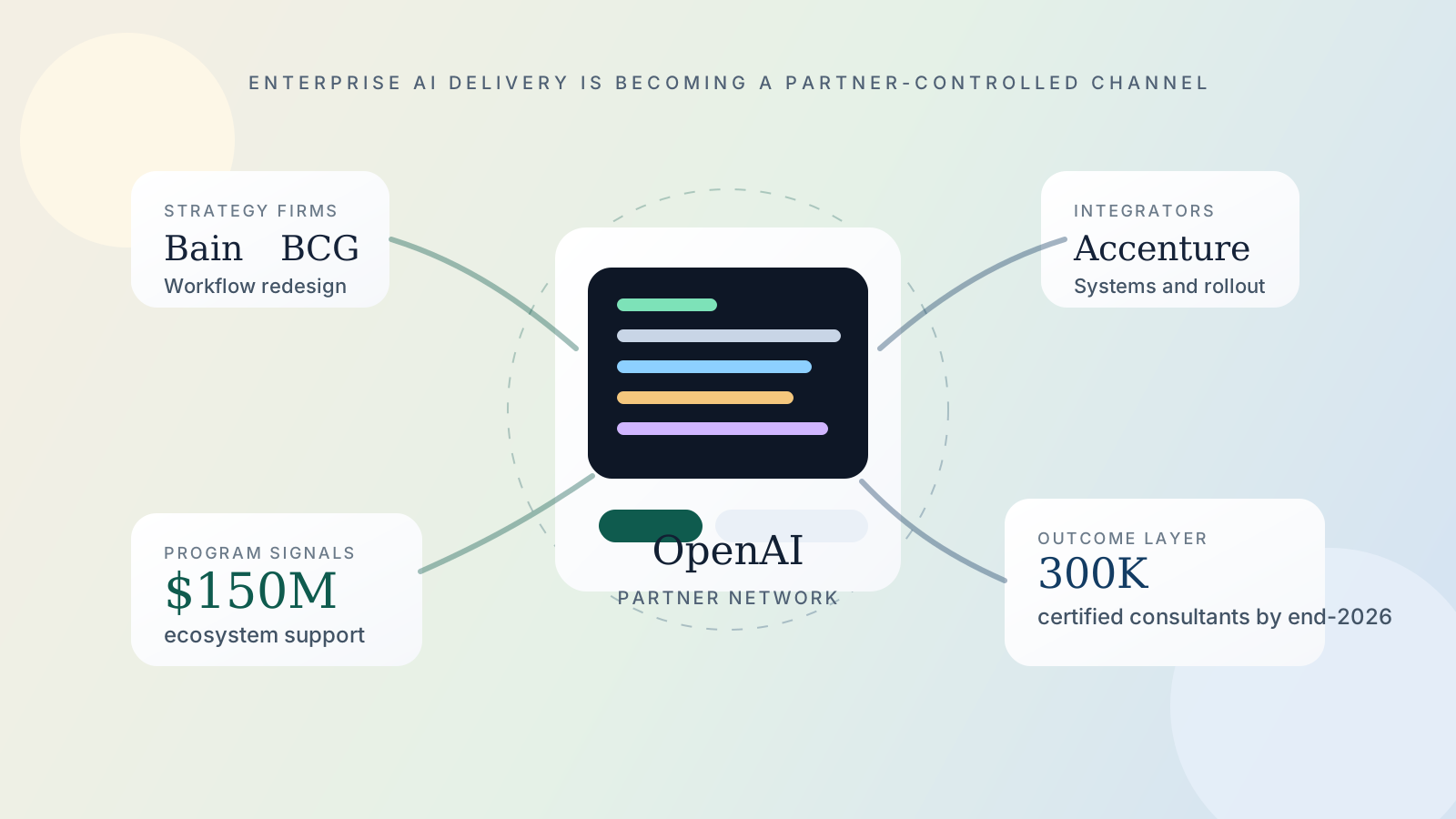
OpenAI said the Partner Network is a new global program for firms to build, sell, and deliver AI solutions with OpenAI. The company also said it is investing $150 million to support the ecosystem and aims to train and enable 300,000 certified consultants by the end of 2026. Those are concrete rollout numbers, and they matter because they imply that OpenAI no longer sees enterprise adoption as primarily a direct-sales motion.
Enterprise AI adoption is starting to scale through a partner-and-governance layer, not just through direct model access.
The reasoning is visible in OpenAI’s own description of the problem. The company said organizations need more than access to frontier models. They need strategy, secure integration with enterprise systems and data, workflow redesign, responsible deployment, and change management. That is the real hook. Once a vendor states the problem this way, the bottleneck is no longer “does the model exist?” It becomes “who has the delivery capacity and governance muscle to make the workflow stick inside a real company?”
That is why the stronger angle is channel control. OpenAI is building a market structure in which systems integrators, consultants, and specialist data firms become part of the operating layer between frontier models and enterprise workflows. For buyers, that means AI adoption increasingly arrives packaged with implementation standards, certification, governance practices, and preferred delivery partners rather than as a standalone software decision.
There is also a distribution read-through here. Training 300,000 certified consultants by the end of 2026 is not a branding exercise. It is a way to multiply implementation capacity faster than OpenAI could by hiring internal deployment teams alone. The $150 million ecosystem investment reinforces that the company is trying to scale the go-to-market and services layer around its models, not only the models themselves.
This story belongs in the systems lane because the operational question is not whether partner networks are new. They are not. The important shift is that frontier AI now appears to need a dedicated adoption stack: secure data connection, workflow mapping, role design, cost control, user training, and governance. OpenAI is effectively acknowledging that enterprise value will be won in those layers as much as in the base model.
The announcement also sits cleanly next to several of OpenAI’s recent enterprise moves. Spend controls, deployment simulation, and broader business tooling all point in the same direction: enterprise AI is hardening into a managed operating system with budgets, launch discipline, permissions, and delivery partners. The Partner Network is the channel expression of that trend.
There are obvious caveats. Ecosystem programs often look larger on launch day than they do in actual customer outcomes, and certification volume does not guarantee transformation quality. But the narrower conclusion is still well supported: OpenAI is organizing enterprise adoption as a scaled partner-and-governance motion rather than assuming model access alone will drive durable implementation.
That is enough to publish. Search coverage of partner announcements is usually too shallow to be useful. The stronger read is that the enterprise AI market is becoming legible as a services and control market, not just a model market.
Sources
OpenAI, “Introducing the OpenAI Partner Network,” published June 14, 2026: https://openai.com/index/introducing-openai-partner-network/
OpenAI, product newsroom listing for June 2026 enterprise updates, including the Partner Network and spend controls: https://openai.com/news/product-releases/
By Nawaz Lalani
The Grid Report is written by Nawaz Lalani and focuses on source-backed coverage of AI infrastructure, grid power demand, automation systems, and market signals.
Follow the signal, not just the headline.
Get the daily Grid brief for source-backed coverage on AI power demand, infrastructure timing, automation, and market signals.