- HPE’s June 16 AI Factory announcement clears the publish bar because it is more than another “enterprise agents are coming” press release.
- That is the useful read-through from the HPE and NVIDIA release.
- The announcement is also explicit about why this matters now.
- Section
- AI Automation
- Read time
- 5 min read
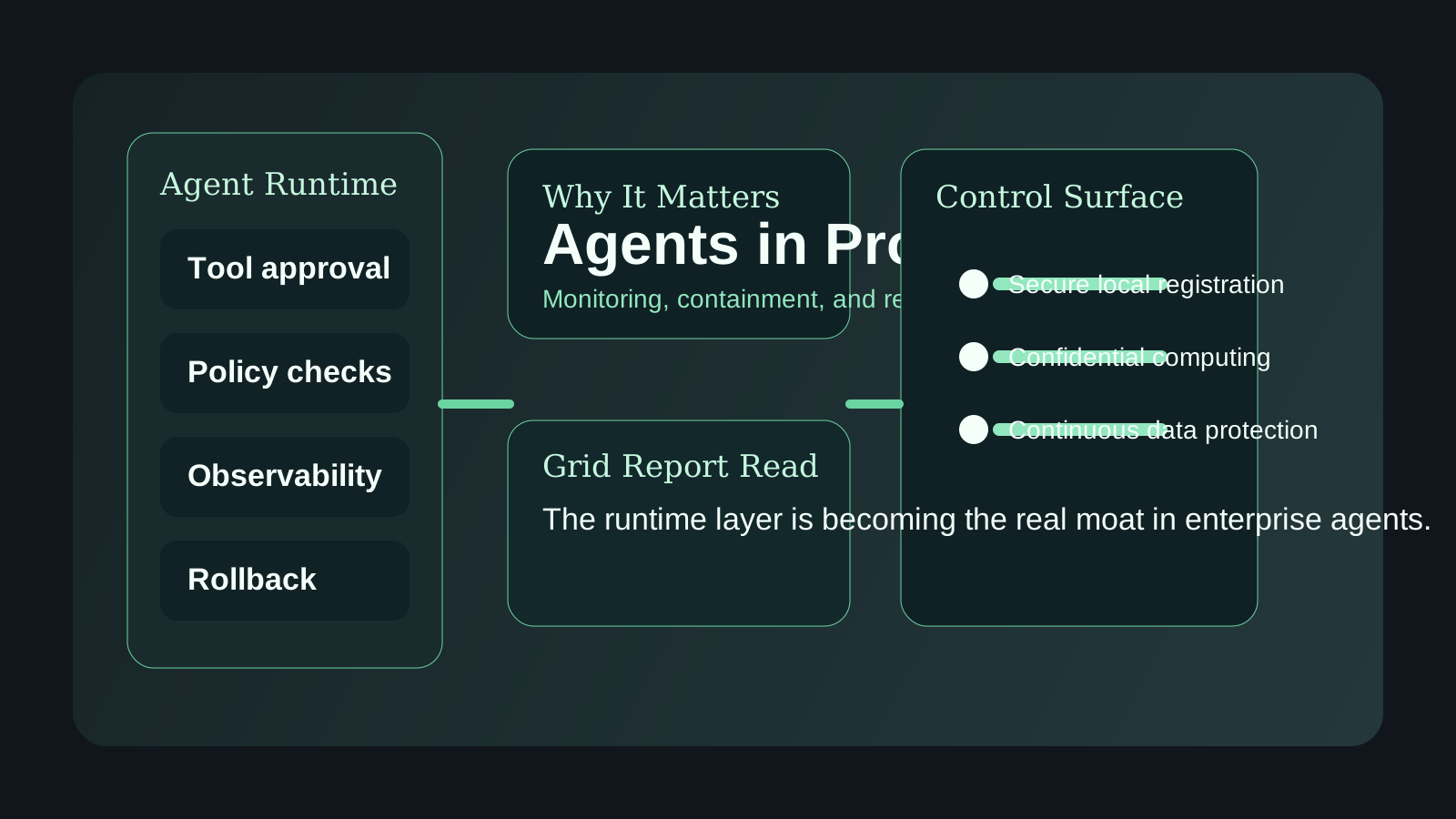
HPE’s June 16 AI Factory announcement clears the publish bar because it is more than another “enterprise agents are coming” press release. HPE is making a sharper claim: once agents move into production, the real problem is not only model quality. It is whether enterprises have a runtime that can approve tools, monitor behavior, protect data, prioritize workloads, and recover when an agent does something wrong.
That is the useful read-through from the HPE and NVIDIA release. HPE said its Private Cloud AI stack is adding secure local agent registration, support for the NVIDIA Agent Toolkit, governed frontier-model access, workload prioritization, and new observability and rollback controls through Zerto. Those are not demo features. They are the mechanics of operating semi-autonomous systems inside real businesses with security, audit, and uptime constraints.
Enterprise agents are moving out of the demo layer and into a governed runtime layer where approval, rollback, and observability matter as much as model quality.
The announcement is also explicit about why this matters now. HPE says organizations are trying to move agentic AI from experimentation into full-scale production environments, where agents are expected to automate business processes and make decisions under enterprise controls. That is a stronger story than generic agent hype because it reframes enterprise demand around operating discipline. The bottleneck is shifting from “can the model do it” to “can the company run it safely at scale.”
Several details in the release support that thesis. HPE says customers will be able to approve AI models, skills, and tools under centralized governance policies. It also says new Zerto capabilities will let customers identify rogue agent actions and use continuous data protection to rewind to a clean slate. That is a real production signal. If vendors are building rollback into the agent stack, they are acknowledging that failure management is part of the core product, not an afterthought.
There is also a sovereignty and security layer that matters for regulated operators. HPE said NVIDIA Confidential Computing will be integrated into the AI Factory for at-scale and sovereign deployments, with cryptographic attestation, encryption, and zero-trust enforcement built into the stack. That is important because many large enterprises do not just want agent performance. They want evidence that models, tools, and data can stay inside policy boundaries while still delivering useful automation.
The cost angle is just as important. HPE says the platform is adding unified model-gateway controls, multi-node inferencing up to 256 GPUs, and data-pipeline features meant to improve prompt processing efficiency and token throughput. The stronger business read is that vendors are now selling agent platforms as token-economics systems as much as AI systems. Once customers move past pilots, cost per useful action starts to matter as much as raw intelligence.
This is why the story belongs in the systems lane. The product announcement is really about enterprise operating architecture. HPE is packaging an answer to a question many CIOs and infrastructure leaders are now asking: if we give agents access to tools and workflows, what is the control plane that keeps the system governable when something drifts, overspends, or breaks?
There are limits to the claim. Much of the new functionality arrives in phases from July 2026 through 2027, and vendor announcements naturally present the stack in its best light. But the narrower conclusion holds: enterprise agent adoption is hardening into a runtime-and-governance category, with rollback, observability, model gateways, and sovereignty moving into the buying criteria.
That is enough to publish. Search coverage on agentic AI still leans too heavily on demos and not enough on runtime control. The stronger story here is that enterprise agents are starting to look less like chat features and more like governed production systems.
Sources
HPE, “HPE brings agentic AI into production with NVIDIA, delivering security, governance, scale, and sovereignty,” published June 16, 2026: https://www.hpe.com/us/en/newsroom/press-release/2026/06/hpe-brings-agentic-ai-into-production-with-nvidia-delivering-security-governance-scale-and-sovereignty.html
NVIDIA, “HPE AI Factory With NVIDIA Expands for the Era of Agents,” published June 16, 2026: https://blogs.nvidia.com/blog/hpe-ai-factory-agentic-enterprise/
By Nawaz Lalani
The Grid Report is written by Nawaz Lalani and focuses on source-backed coverage of AI infrastructure, grid power demand, automation systems, and market signals.
Follow the signal, not just the headline.
Get the daily Grid brief for source-backed coverage on AI power demand, infrastructure timing, automation, and market signals.