- NVIDIA’s July 8 Nemotron and LangChain release matters because it moves the useful agent conversation away from model-only horse races.
- NVIDIA says LangChain tuned its Deep Agents harness for Nemotron 3 Ultra and achieved leading open-model accuracy, higher throughput, and roughly one-tenth the inference cost per run compared with leading closed models on LangChain’s Deep Agents benchmark.
- That is the Grid-native signal.
- Section
- AI Automation
- Read time
- 5 min read
NVIDIA’s July 8 Nemotron and LangChain release matters because it moves the useful agent conversation away from model-only horse races. The claim is not simply that Nemotron 3 Ultra scored well. The more important point is how it got there: by tuning the agent harness around the model rather than retraining the model itself.
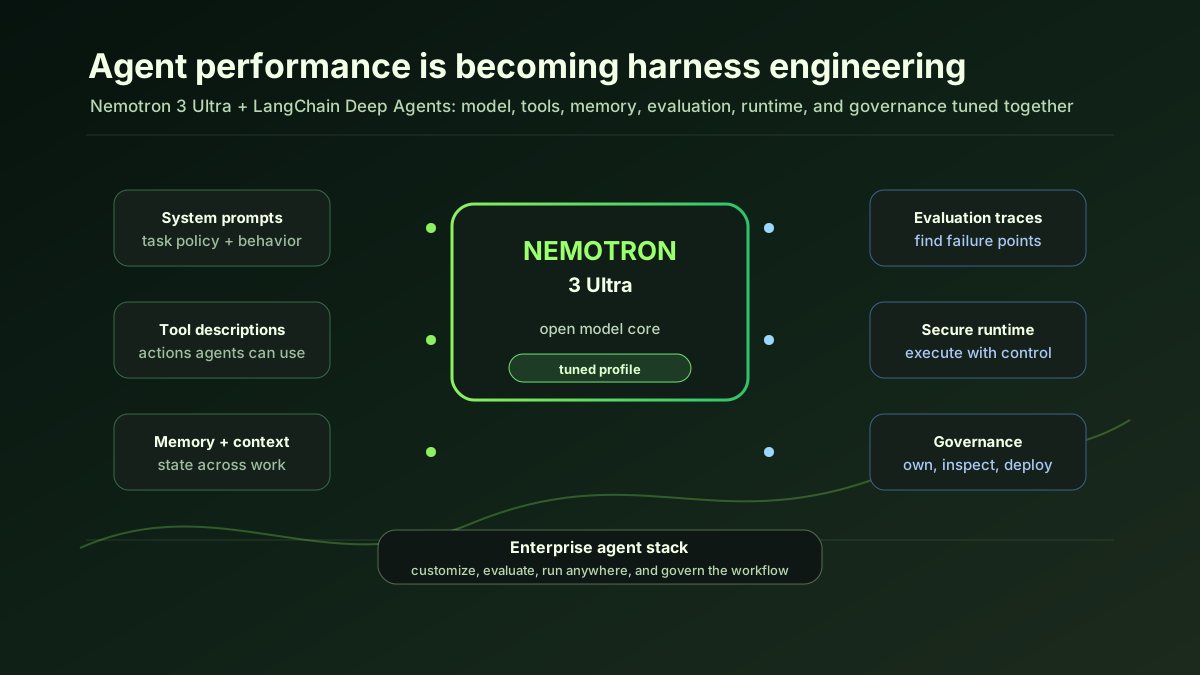
NVIDIA says LangChain tuned its Deep Agents harness for Nemotron 3 Ultra and achieved leading open-model accuracy, higher throughput, and roughly one-tenth the inference cost per run compared with leading closed models on LangChain’s Deep Agents benchmark. The company also says the gains came from the system around the model: system prompts, tool descriptions, middleware, execution traces, and evaluation loops.
The unit of competition is shifting from which model is smartest to which system can turn model capability into reliable delegated work.
That is the Grid-native signal. As agents move from demos into real workflows, the model is only one layer of the product. The operating surface now includes memory, tool use, planning behavior, task decomposition, runtime permissions, observability, evaluation, and governance. If those layers are weak, a strong model still becomes a fragile agent. If those layers are tuned, an open model can become much more useful inside a controlled enterprise stack.
NVIDIA and LangChain are packaging that idea through NemoClaw for LangChain Deep Agents, an open reference blueprint for specialized enterprise agents. NVIDIA describes the stack as LangChain Deep Agents code tuned for Nemotron 3 Ultra, combined with NVIDIA OpenShell as a secure runtime for executing agent actions. In plain language, this is an attempt to make the agent harness itself a deployable infrastructure layer.
That matters for enterprises because many valuable agent workflows are not generic chat tasks. They are multi-step operations that touch internal tools, private context, compliance boundaries, and production systems. Buyers will care less about a single leaderboard score and more about whether the stack can be inspected, customized, evaluated continuously, and run inside their own governance model.
The cost angle is also more than a pricing footnote. If an agent stack can run evaluations more cheaply, teams can test more often, tune more workflows, and catch more failure modes before deployment. That changes the economics of agent operations. Continuous evaluation becomes less like an expensive lab exercise and more like a normal part of shipping automation.
This also explains why the release names enterprise adopters and implementers such as Abridge, Amdocs, Box, and EY. The commercial lane is not only model access. It is the serviceable stack around specialized agents: blueprint, runtime, evaluation, integration, and governance. That is where systems integrators and platform companies can turn a model into a repeatable operating product.
The broader read-through is that open agent stacks are becoming more credible when they are paired with serious harness engineering. Closed models may still lead in many raw capability comparisons, but enterprise buyers now have another question to ask: can an open stack be tuned tightly enough, observed deeply enough, and governed clearly enough to win a specific workflow?
That is why this story belongs in AI automation rather than ordinary model coverage. The unit of competition is shifting from “which model is smartest?” to “which system can turn model capability into reliable delegated work?” NVIDIA and LangChain are betting that the answer will increasingly be the engineered harness.
Sources
NVIDIA Blog, “NVIDIA Nemotron Achieves Benchmark-Leading Performance With LangChain Deep Agents Harness,” published July 8, 2026: https://blogs.nvidia.com/blog/nemotron-langchain-agents-open-stack/
LangChain / PRNewswire, “LangChain and NVIDIA Launch NemoClaw Deep Agents Blueprint for Enterprise Agents,” published July 8, 2026: https://www.prnewswire.com/news-releases/langchain-and-nvidia-launch-nemoclaw-deep-agents-blueprint-for-enterprise-agents-302820446.html
NVIDIA Developer Blog, “Create a LangChain Deep Agents Harness Profile for NVIDIA Nemotron 3 Ultra to Improve Performance,” accessed July 9, 2026: https://developer.nvidia.com/blog/create-a-langchain-deep-agents-harness-profile-for-nvidia-nemotron-3-ultra-to-improve-performance/
By Nawaz Lalani
The Grid Report is written by Nawaz Lalani and focuses on source-backed coverage of AI infrastructure, grid power demand, automation systems, and market signals.
Follow the signal, not just the headline.
Get the daily Grid brief for source-backed coverage on AI power demand, infrastructure timing, automation, and market signals.