- OpenAI’s June 11 Ona announcement clears the publish bar because it says something more useful than “agents are getting better.” OpenAI said it will acquire Ona to bring secure cloud execution and orchestration technology into the Codex ecosystem.
- The primary-source details are direct.
- This is why the story belongs in systems rather than a generic AI lane.
- Section
- AI Automation
- Read time
- 5 min read
- Data included
- What OpenAI is buying with Ona
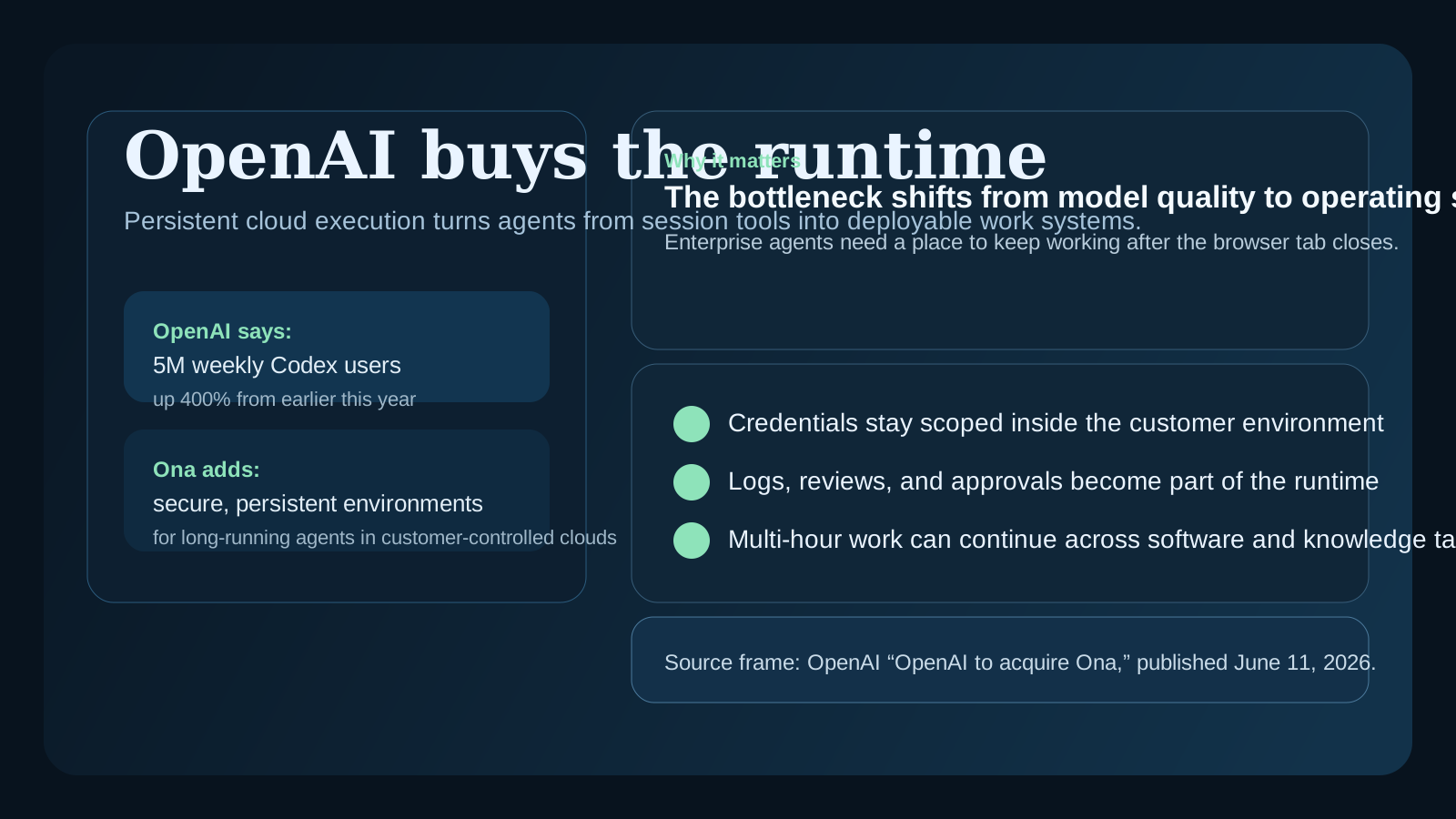
What OpenAI is buying with Ona
The useful shift is not another agent feature. It is the move toward a persistent runtime for enterprise work that lasts beyond one session.
| Layer | What OpenAI said | Why it matters |
|---|---|---|
| Usage signal | More than 5 million people use Codex each week, up 400% from earlier this year | The scale of usage helps explain why execution infrastructure is becoming a product constraint. |
| Task duration | OpenAI says Codex’s most valuable work increasingly unfolds over hours or days | Longer-duration work needs persistence, not just a smart model in a transient session. |
| Runtime capability | Ona provides secure, persistent environments where agents can access tools, systems, and context over time | This is the operating substrate for sustained, multi-step agent execution. |
| Security posture | Agents will be able to operate inside an organization’s own cloud environment | Enterprises keep tighter control over infrastructure, data, and security boundaries. |
| Commercial read-through | OpenAI provides intelligence and orchestration while the runtime stays customer-controlled | Agent vendors are moving deeper into deployment infrastructure, not just model APIs. |
Source: OpenAI, “OpenAI to acquire Ona,” published June 11, 2026.
OpenAI’s June 11 Ona announcement clears the publish bar because it says something more useful than “agents are getting better.” OpenAI said it will acquire Ona to bring secure cloud execution and orchestration technology into the Codex ecosystem. The stronger Grid Report angle is that the company is trying to solve the runtime problem behind long-running agents: not just what the model can do, but where it runs, how it keeps working over time, and how enterprises keep that work inside their own security boundaries.
The primary-source details are direct. OpenAI says more than 5 million people now use Codex each week, up 400% from earlier this year, and that Codex’s most valuable work is increasingly unfolding over hours or days rather than minutes. It also says Ona provides secure, persistent environments where agents can access the tools, systems, and context they need to make progress over time. That combination matters because it turns the bottleneck from raw intelligence into execution substrate.
The Ona deal matters because OpenAI is buying runtime infrastructure, not just more agent hype: persistent cloud execution is becoming part of the product.
This is why the story belongs in systems rather than a generic AI lane. Once work extends beyond one active browser session, the hard questions stop being only about prompt quality or model benchmarks. Enterprises need to know where credentials live, how access is scoped, what gets logged, how reviews happen, and whether an agent can keep operating when the original user is offline. OpenAI explicitly says Ona’s customer-controlled execution model will let agents run inside an organization’s own cloud environment while OpenAI provides the intelligence and orchestration layer.
That is a meaningful shift in product posture. It suggests OpenAI is moving from selling agent capability toward supplying more of the runtime infrastructure required for production deployment. The useful question is not whether cloud sandboxes already exist in some form. The useful question is whether a frontier model vendor now sees persistent, customer-controlled execution as essential enough to buy directly into the stack. The answer appears to be yes.
Operator relevance is clear. If agents are going to handle software maintenance, issue resolution, internal research, or other multi-step knowledge work over sustained periods, they need a trusted workspace more than they need another glossy demo. OpenAI says Ona has helped 2 million developers work in secure, reproducible cloud environments. It also says the technology will help Codex continue working inside a customer’s cloud environment even when laptops are closed. That is a practical deployment answer, not just branding.
This angle is materially different from the site’s recent OpenAI coverage. The Agents-at-Work story was about evidence that delegated work is spreading across roles. The Partner Network piece was about the channel and control layer for adoption. The Spend Controls piece was about budgets and approvals. Ona sits underneath those layers. It is about the execution substrate that lets long-running agent work persist securely enough for real production use.
There are still caveats. The acquisition has not closed, OpenAI and Ona remain separate until regulatory approvals are complete, and the exact product integration path is not yet disclosed. But those limits do not weaken the narrow conclusion. They clarify it. OpenAI is signaling that enterprise agent adoption will depend as much on persistent runtime infrastructure as on model capability itself.
That is enough to publish. Searchers looking for the Ona acquisition do not need a generic M&A summary. The more useful answer is what OpenAI is actually buying: a secure cloud-execution layer that can keep agents working across long-duration tasks inside customer-controlled environments.
Sources
OpenAI, “OpenAI to acquire Ona,” published June 11, 2026: https://openai.com/index/openai-to-acquire-ona/
OpenAI News index, accessed July 2, 2026 for release context: https://openai.com/news/
By Nawaz Lalani
The Grid Report is written by Nawaz Lalani and focuses on source-backed coverage of AI infrastructure, grid power demand, automation systems, and market signals.
Follow the signal, not just the headline.
Get the daily Grid brief for source-backed coverage on AI power demand, infrastructure timing, automation, and market signals.