- OpenAI’s June 25 “How agents are transforming work” release clears the publish bar because it gives the agent conversation a much stronger evidence base than the usual product-demo cycle.
- Several of the numbers are concrete enough to matter.
- That is why the stronger angle is workflow redesign.
- Section
- AI Automation
- Read time
- 5 min read
- Data included
- What changed in OpenAI’s new agent-adoption data
What changed in OpenAI’s new agent-adoption data
The signal is not only more usage. It is that work is getting longer, broader, and more cross-functional.
| Metric | What OpenAI reported | Why it matters |
|---|---|---|
| Longer work | 80.6% of sampled users made at least one request estimated above 30 minutes of human work | Agent usage is moving beyond quick answers into delegated execution. |
| Deeper delegation | 70.2% crossed one hour and 25.6% crossed eight hours | The task horizon is stretching enough to force workflow and review redesign. |
| Internal shift | Average OpenAI worker now uses Codex for more than 85% of output tokens | Within a frontier user base, agents are overtaking chat as the primary AI work interface. |
| Organizational spread | Non-developer organizational users rose 189-fold since August 2025 | The next adoption wave is not limited to engineers. |
| Parallel labor | 99th-percentile internal users generate more than 60 hours of Codex agent turns per day | Heavy users are orchestrating multiple agent streams rather than one conversational thread. |
Source: OpenAI, “How agents are transforming work,” published June 25, 2026.
OpenAI’s June 25 “How agents are transforming work” release clears the publish bar because it gives the agent conversation a much stronger evidence base than the usual product-demo cycle. The company says agentic tools are changing the unit of knowledge work from short interactions to delegated, long-horizon tasks, and it backs that claim with internal and user-adoption data from Codex. For Grid Report readers, the useful story is not simply that agents are getting more capable. It is that companies now have evidence that work itself starts to get reorganized once AI can operate across longer tasks and adjacent functions.
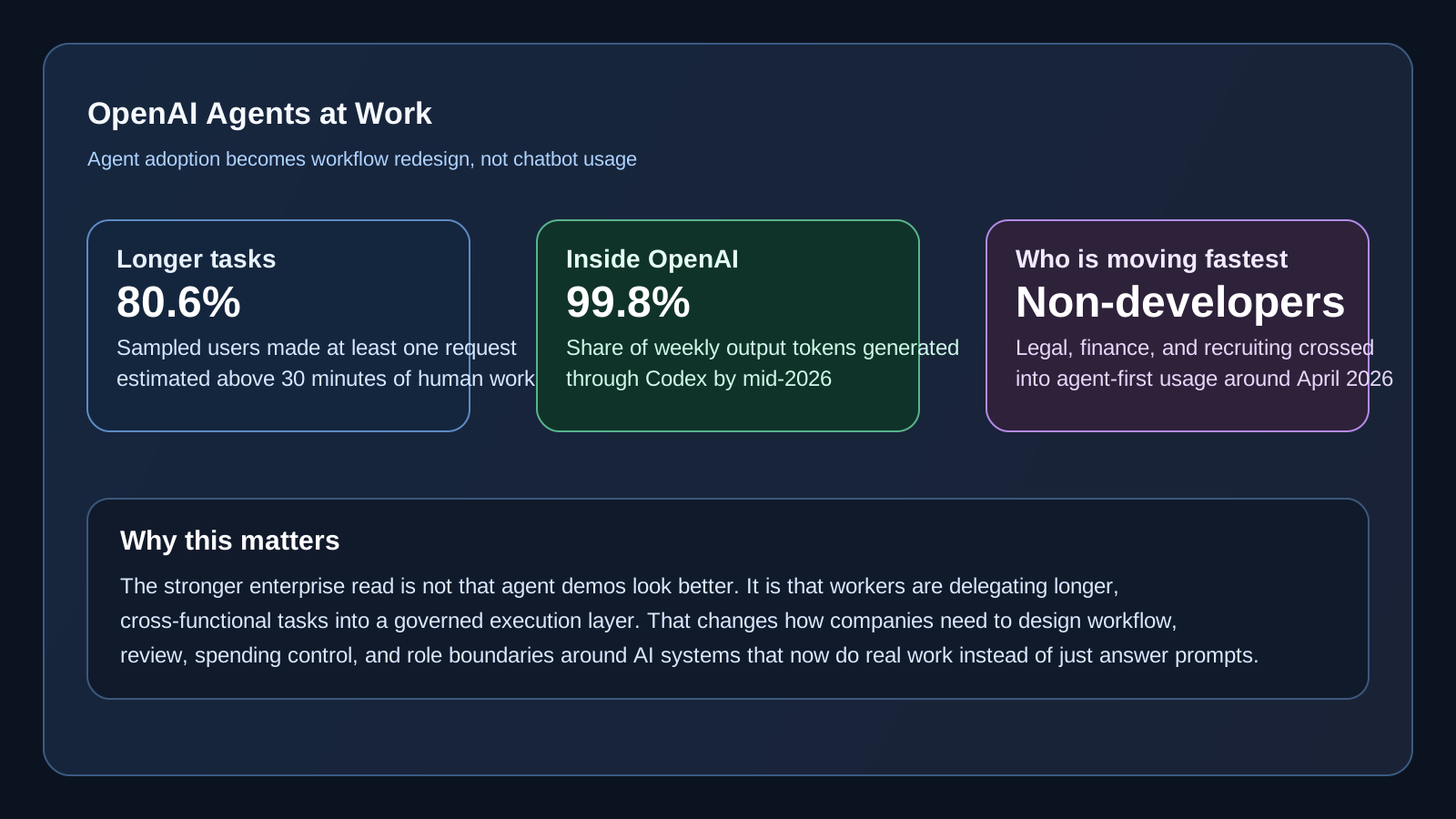
Several of the numbers are concrete enough to matter. OpenAI says that by May 2026, 80.6% of sampled individual users made at least one Codex request estimated to exceed 30 minutes of human work, 70.2% made one estimated to exceed one hour, and 25.6% made one estimated to exceed eight hours. Inside OpenAI, the company says Codex now accounts for more than 85% of output tokens for the average worker and 99.8% of weekly output tokens overall. Those numbers do not prove every enterprise will follow the same curve. They do show that the center of gravity is shifting from short-answer assistance toward delegated execution.
The useful agent signal is not better demos. It is that delegated multi-hour work is spreading fast enough to force workflow redesign.
That is why the stronger angle is workflow redesign. Once workers are offloading multi-hour tasks instead of asking for one-off completions, the relevant operating questions change. Companies need to think about review loops, access permissions, budget controls, escalation paths, and which kinds of adjacent work a role should now be allowed to perform with agent help. This becomes less a “who has the best chatbot?” market and more a “who can redesign work safely and productively?” market.
The non-developer adoption trend makes that point even sharper. OpenAI says non-developer weekly users grew faster than developer users across individual, organizational, and internal OpenAI populations, with non-developer organizational users rising 189-fold since August 2025. It also says legal, finance, and recruiting crossed into Codex being their primary AI tool around April 2026. That is not a small detail. It suggests the next phase of enterprise automation is not confined to engineering teams. It is moving into departments where workflow discipline, approval chains, and data handling rules are often stricter.
This is also what separates the story from several recent Grid Report systems pieces. The Partner Network article was about channel capacity. HPE’s AI Factory piece was about governed runtime infrastructure. Samsung’s rollout was about company-wide deployment inside one operator. The new OpenAI data is different. It is evidence that once agents are usable enough, the actual labor mix starts to shift. That gives operators a stronger basis for deciding where agent rollouts are likely to create leverage and where controls need to tighten first.
There is an economic read-through as well. OpenAI says users at the 99th percentile inside the company now regularly generate more than 60 hours of Codex agent turns per day across multiple parallel agents. The exact estimate should be treated carefully because the task-duration thresholds are model-estimated, not direct stopwatch measurements. But even as directional evidence, it matters. It implies the frontier usage pattern is not one assistant helping one person at a time. It is workers orchestrating multiple streams of delegated machine labor during a normal day.
There are real limits. The source is OpenAI’s own research, much of the evidence is based on internal usage plus sampled users, and the task-horizon estimates are not exact productivity measurements. That is enough reason to keep the claims narrow. It is not enough reason to dismiss the release. For enterprise operators, the data is valuable precisely because it points to what to instrument next: task duration, review burden, role expansion, and where delegated work starts to outperform ordinary chat.
That is enough to publish. Searchers do not need another generic “agents are the future of work” rewrite. The more useful question is what changed in the data to make that claim newly credible. The answer is that longer-horizon delegated work, non-developer adoption, and parallel agent usage are all showing up strongly enough that workflow redesign is becoming the real enterprise challenge.
Sources
OpenAI, “How agents are transforming work,” published June 25, 2026: https://openai.com/index/how-agents-are-transforming-work/
OpenAI News index, accessed June 25, 2026 for publication timing and release context: https://openai.com/news/
By Nawaz Lalani
The Grid Report is written by Nawaz Lalani and focuses on source-backed coverage of AI infrastructure, grid power demand, automation systems, and market signals.
Follow the signal, not just the headline.
Get the daily Grid brief for source-backed coverage on AI power demand, infrastructure timing, automation, and market signals.