- Samsung Electronics’ June 21 rollout clears the publish bar because it is not another generic “AI adoption” press release.
- The stronger angle is that enterprise AI is becoming a workforce standard, not a specialist tool.
- That is a more useful signal than another benchmark or model-release headline because Samsung sits at the intersection of hardware, manufacturing, consumer devices, and global operations.
- Section
- AI Automation
- Read time
- 4 min read
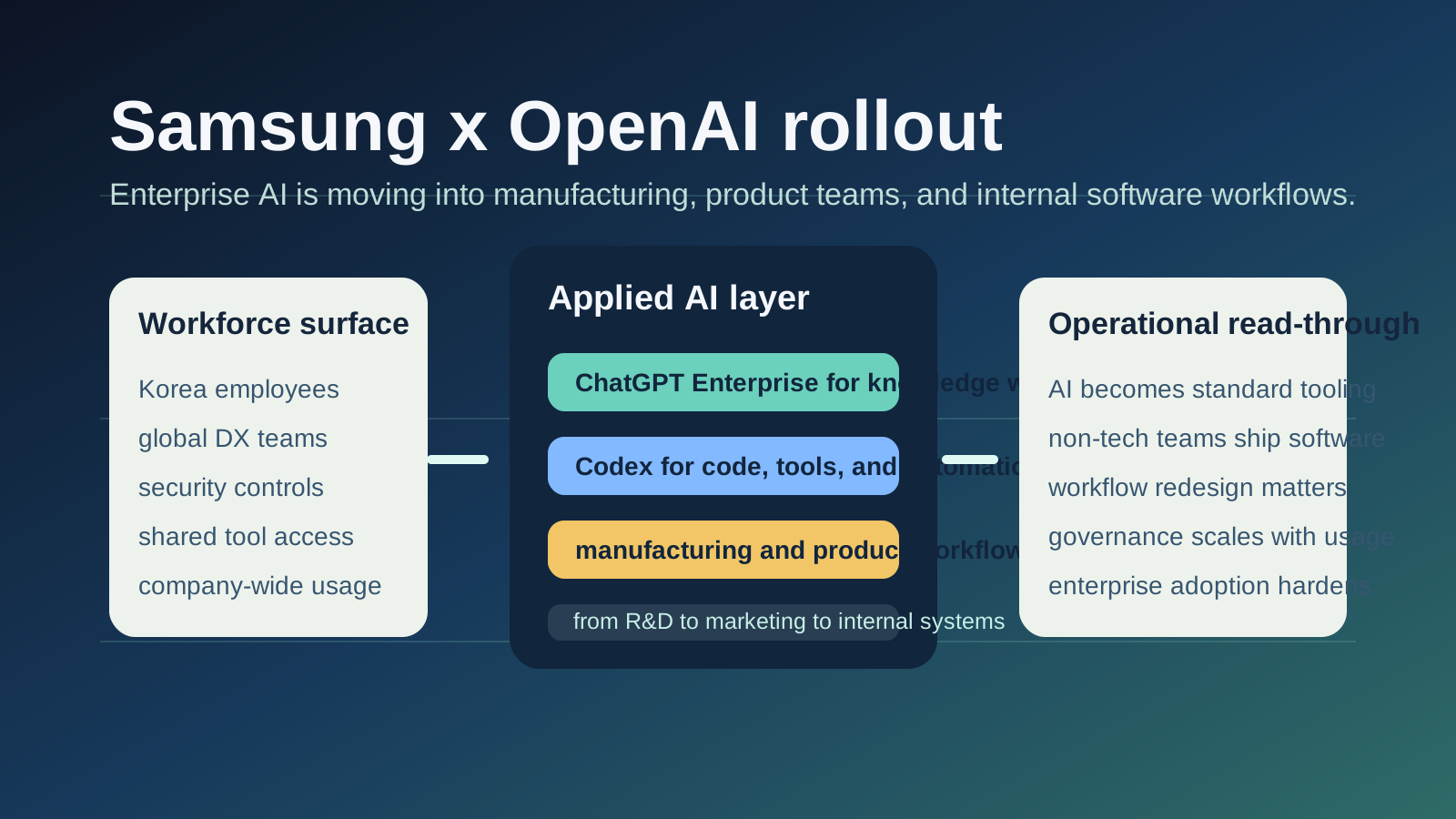
Samsung Electronics’ June 21 rollout clears the publish bar because it is not another generic “AI adoption” press release. OpenAI said ChatGPT Enterprise and Codex will be available to all Samsung Electronics employees in Korea and to all employees worldwide in the Device eXperience division. Samsung plans to use the tools across software development, marketing, product development, manufacturing, and other corporate functions. That scale matters because it pushes enterprise AI out of the narrow engineering-pilot phase and into the daily operating system of a major industrial company.
The stronger angle is that enterprise AI is becoming a workforce standard, not a specialist tool. OpenAI framed the deployment as one of its largest enterprise launches to date. More importantly, the usage scope is broad enough to matter operationally. This is not only about giving developers a coding assistant. It is about normalizing AI across knowledge work, internal software creation, data interpretation, and factory-adjacent decision support inside one of the world’s largest device manufacturers.
When a global manufacturer rolls ChatGPT Enterprise and Codex into product, marketing, software, and factory-adjacent work, AI stops looking like a pilot and starts looking like standard operating infrastructure.
That is a more useful signal than another benchmark or model-release headline because Samsung sits at the intersection of hardware, manufacturing, consumer devices, and global operations. When a company like that decides ChatGPT Enterprise and Codex belong across product teams and business functions, the message is that enterprise AI is being treated less like optional experimentation and more like baseline productivity infrastructure.
The manufacturing read-through is what makes the story publishable. OpenAI said Samsung expects teams to use Codex not only for writing and debugging code, but also for turning ideas into working software, internal tools, websites, and automated workflows. In a company with large product, operations, and manufacturing footprints, that implies the marginal software builder is no longer only the central engineering organization. More non-technical and semi-technical teams can start shipping their own lightweight systems around planning, reporting, troubleshooting, and internal process design.
Operators should care because this changes where AI leverage can show up. The value is not only faster document drafting or easier search. It is the ability to compress the time between seeing a workflow problem and building a fix for it. Once non-developer teams can create or modify internal tools with governed access, the bottleneck moves from model access toward workflow ownership, review discipline, and which parts of the company are allowed to redesign themselves.
There is also a control-layer signal here. OpenAI emphasized enterprise data protection, user and access management, and security controls. That matters because large-scale deployment only works when AI fits inside an existing governance framework. The more AI becomes a company-wide work surface, the less the deciding factor is model novelty and the more it is identity, permissions, auditability, and whether usage can spread without blowing up internal control systems.
The Samsung context reinforces that point. In its 2026 shareholder letter, Samsung said the DX division will expand AI-driven product leadership and integrate AI technologies across products, features, and service ecosystems. Read together with the OpenAI deployment, the better interpretation is that Samsung is aligning its external AI product ambition with an internal AI workflow stack. It wants AI inside the products and inside the company that builds them.
There are limits. OpenAI did not disclose pricing, seat counts beyond the stated employee scope, or the adoption curve after rollout. Company-wide availability also does not guarantee durable behavior change. But those caveats do not weaken the core signal. They clarify why the story matters now: enterprise AI is maturing from team-by-team experimentation into standard operating infrastructure at industrial scale.
The better conclusion is simple. The next phase of enterprise AI adoption will be won less by who demos the best model and more by who can embed AI into real workflows across large organizations without losing governance, speed, or accountability.
Sources
OpenAI, “Samsung Electronics brings ChatGPT and Codex to employees,” published June 21, 2026: https://openai.com/index/samsung-electronics-chatgpt-codex-deployment/
Samsung, “Letter to Shareholders,” accessed June 21, 2026: https://www.samsung.com/global/ir/governance-csr/lettertoshareholders/
By Nawaz Lalani
The Grid Report is written by Nawaz Lalani and focuses on source-backed coverage of AI infrastructure, grid power demand, automation systems, and market signals.
Follow the signal, not just the headline.
Get the daily Grid brief for source-backed coverage on AI power demand, infrastructure timing, automation, and market signals.