- OpenAI’s June 18 admin update clears the publish bar because it captures where enterprise AI adoption is actually heading.
- The stronger angle is that enterprise AI is maturing into FinOps.
- This matters because most enterprise AI deployments eventually run into the same friction: a small number of high-output users need more advanced-model capacity, finance teams want visibility, and managers do not want to either block power users or let spend drift.
- Section
- AI Automation
- Read time
- 4 min read
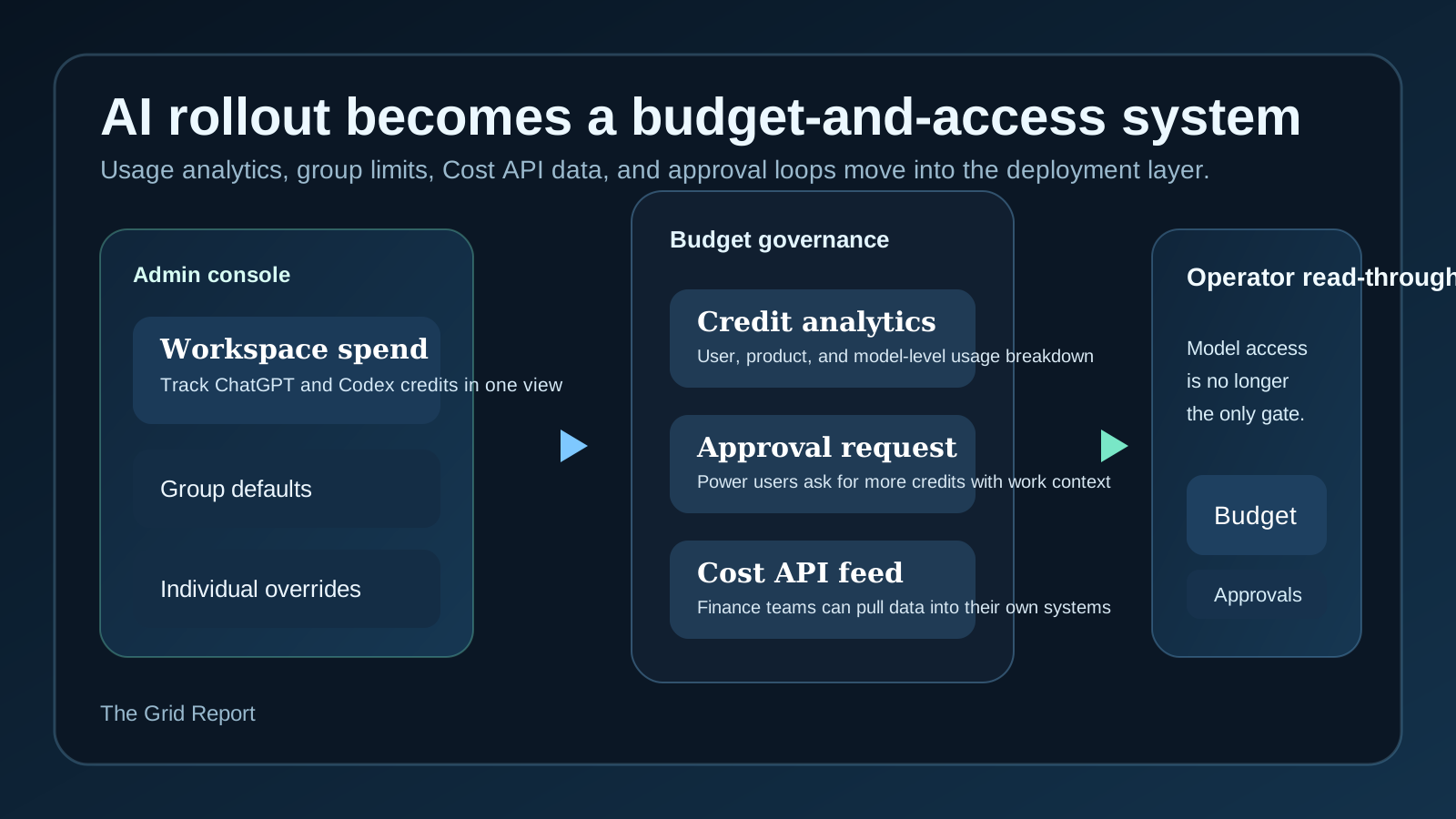
OpenAI’s June 18 admin update clears the publish bar because it captures where enterprise AI adoption is actually heading. The company introduced new credit-usage analytics in the Global Admin Console and updated spend controls for ChatGPT Enterprise, including workspace defaults, group limits, individual overrides, and user requests for more credits. That matters because once those controls show up, the deployment problem changes. AI stops being only an access question and becomes a budget-allocation system.
The stronger angle is that enterprise AI is maturing into FinOps. OpenAI said admins can now view ChatGPT and Codex credit consumption in one place, break usage down by user, product, and model, and access the same data through the Cost API. That is a practical shift in control. Leaders can start separating valuable usage from noisy usage instead of treating all model demand as equally strategic.
Once AI credits get budgets, group rules, and approval loops, enterprise adoption stops being a novelty story and starts becoming a real operating system.
This matters because most enterprise AI deployments eventually run into the same friction: a small number of high-output users need more advanced-model capacity, finance teams want visibility, and managers do not want to either block power users or let spend drift. OpenAI’s updated controls are effectively a response to that operational reality. The new structure lets admins set default budgets, define group-level rules, and approve exceptions only where the work justifies it.
The more original read-through is that AI leverage inside a company is becoming a routing problem. The question is no longer only which model is best. It is which teams get premium capacity, which workflows deserve higher spend, and what approval loop decides when usage should expand. That sounds mundane until you realize it is how real software categories become institutionalized. First comes access, then permissions, then reporting, then budget ownership.
Operators should care because this is the layer that determines whether AI usage scales intelligently or turns into a messy internal subsidy. Once employees can see their credit usage against a limit and request more with context, the system starts encouraging resource discipline without forcing the whole company into one flat policy. That is more useful than crude lockouts because it preserves upside for teams doing work that actually compounds.
It also says something about where enterprise AI product competition is moving. The deployment surface is no longer just model quality or chat UX. It is controls, observability, budgeting, and how easily a company can connect AI usage to internal governance systems. OpenAI is explicitly bringing ChatGPT and Codex into that frame, which suggests the next enterprise buying conversation will focus at least as much on control layers as on raw capability.
There are limits. This is OpenAI describing its own product evolution, and the update does not answer harder questions about total ROI, internal chargeback practices, or how companies should compare model spend across vendors. But those caveats do not change the signal. They explain why the story matters now: enterprise AI is becoming a managed operating expense, not just a promising tool.
The better conclusion is that enterprise AI adoption is entering its budget-governance phase. Once that happens, the winners are the teams that can connect model access to actual work quality, not just the teams that consume the most credits.
Sources
OpenAI, “New usage analytics and updated spend controls for enterprises,” published June 18, 2026: https://openai.com/index/chatgpt-enterprise-spend-controls/
OpenAI Help Center, “Setting usage limits in ChatGPT Enterprise and Edu,” updated June 18, 2026: https://help.openai.com/en/articles/20001001-setting-usage-limits-for-custom-roles-in-chatgpt-enterprise
By Nawaz Lalani
The Grid Report is written by Nawaz Lalani and focuses on source-backed coverage of AI infrastructure, grid power demand, automation systems, and market signals.
Follow the signal, not just the headline.
Get the daily Grid brief for source-backed coverage on AI power demand, infrastructure timing, automation, and market signals.